Hermann Hesse - The Glass Bead Game
Здесь есть возможность читать онлайн «Hermann Hesse - The Glass Bead Game» весь текст электронной книги совершенно бесплатно (целиком полную версию без сокращений). В некоторых случаях можно слушать аудио, скачать через торрент в формате fb2 и присутствует краткое содержание. Год выпуска: 1969, Жанр: Современная проза, Социально-психологическая фантастика, на английском языке. Описание произведения, (предисловие) а так же отзывы посетителей доступны на портале библиотеки ЛибКат.
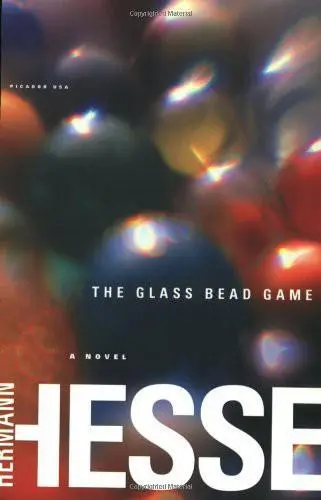
- Название:The Glass Bead Game
- Автор:
- Жанр:
- Год:1969
- ISBN:нет данных
- Рейтинг книги:4 / 5. Голосов: 2
-
Избранное:Добавить в избранное
- Отзывы:
-
Ваша оценка:
The Glass Bead Game: краткое содержание, описание и аннотация
Предлагаем к чтению аннотацию, описание, краткое содержание или предисловие (зависит от того, что написал сам автор книги «The Glass Bead Game»). Если вы не нашли необходимую информацию о книге — напишите в комментариях, мы постараемся отыскать её.
Something like chess but far more intricate, the game of Magister Ludi known as the Glass Bead Game is thought in its purest form, a synthesis through which philosophy, art, music and scientific law are appreciated simultaneously. The scholar-players are isolated within Castalia, an autonomous elite institution devoted wholly to the mind and the imagination…
The Glass Bead Game — читать онлайн бесплатно полную книгу (весь текст) целиком
Ниже представлен текст книги, разбитый по страницам. Система сохранения места последней прочитанной страницы, позволяет с удобством читать онлайн бесплатно книгу «The Glass Bead Game», без необходимости каждый раз заново искать на чём Вы остановились. Поставьте закладку, и сможете в любой момент перейти на страницу, на которой закончили чтение.
Интервал:
Закладка:
It is to this old and much-mocked custom that we owe the three “Lives” by Knecht written during his years of free study. These were, then, not a purely voluntary and unofficial, not to say secret and more or less illicit kind of literary activity, such as his poems written at Waldzell had been, but a normal and official assignment. Far back in the earliest days of the Pedagogic Province the custom had arisen of requiring the younger students, those who had not yet been admitted to the Order, to compose from time to time a special kind of essay or stylistic exercise which was called a “Life.” It was to be a fictitious autobiography set in any period of the past the writer chose. The student’s assignment was to transpose himself back to the surroundings, culture, and intellectual climate of any earlier era and to imagine himself living a suitable life in that period. Depending on the times and the fashion, imperial Rome, seventeenth-century France, or fifteenth-century Italy might be the period most favored, or Periclean Athens or Austria in the time of Mozart. Among language specialists it had become the custom to compose their imaginary biographies in the language of the country and the style of the period in which they were versed. Thus there had been highly ingenious Lives written in the style of the Papal Curia at Rome around the year 1200, in monastic Latin, in the Italian of the “Cento Novelle Antiche,” in the French of Montaigne, and the baroque German of Martin Opitz.
A remnant of the ancient Asian doctrine of reincarnation and the transmigration of souls survived in this playful, highly flexible form. All teachers and students were familiar with the concept that their present existence might have been preceded by others, in other bodies, at other times, under other conditions. To be sure they did not believe this in any strict sense; there was no element of dogma in the idea. Rather, it was an exercise, a game for the imaginative faculties, to conceive of oneself in different conditions and surroundings. In writing such Lives students made a stab at a cautious penetration of past cultures, times, and countries, just as they did in many seminars on stylistics, and in the Glass Bead Game as well. They learned to regard their own persons as masks, as the transitory garb of an entelechy. The custom of writing such Lives had its charm, and a good many solid benefits as well, or it probably would not have endured for so long.
Incidentally, there was a rather considerable number of students who not only more or less believed in the idea of reincarnation, but also in the truth of their own fictional Lives. Thus the majority of these imaginary pre-existences were not merely stylistic exercises and historical studies, but also creations of wishful thinking and exalted self-portraits. The authors cast themselves as the characters they longed to become. They portrayed their dream and their ideal. Furthermore, from the pedagogic point of view the Lives were not a bad idea at all. They provided a legitimate channel for the creative urge of youth. Although serious, creative literary work had been frowned on for generations, and replaced partly by scholarship, partly by the Glass Bead Game, youth’s artistic impulse had not been crushed. In these Lives, which were often elaborated into small novels, it found a permissible means of expression. What is more, while writing these Lives some of the authors took their first steps into the land of self-knowledge.
Incidentally, the students frequently used their Lives for critical and revolutionary outbursts on the contemporary world and on Castalia. The teachers usually regarded such sallies with understanding benevolence. In addition, these Lives were extremely revealing to the teachers during those periods in which the students enjoyed maximum freedom and were subject to no close supervision. The compositions often provided astonishingly clear insight into the intellectual and moral state of the authors.
Three such Lives written by Joseph Knecht have been preserved. We intend to reproduce their full text, and regard them as possibly the most valuable part of our book. There is much room for conjecture as to whether he wrote only these three Lives, or whether there might have been others which have been lost. All we know definitely is that after Knecht handed in his third, “Indian” Life, the Secretariat of the Board of Educators suggested that if he wrote any additional Lives he ought to set them in an era historically closer to the present and more richly documented, and that he should pay more attention to historical detail. We know from anecdotes and letters that he thereupon actually engaged in preliminary research for a Life set in the eighteenth century. He cast himself as a Swabian pastor who subsequently turned from the service of the Church to music, who had been a disciple of Johann Albrecht Bengel, a friend of Oetinger, and for a while a guest of Zinzendorf’s congregation of Moravian Brethren. We know that he was reading and taking notes on a quantity of old and often out-of-the-way books on church organization, Pietism, and Zinzendorf, as well as on the liturgy and church music of the period. We know also that he was fascinated with Oetinger, the charismatic prelate, and that he felt genuine love and veneration for Magister Bengel; he went to some pains to have a photograph made of Bengel’s portrait and for a while had the picture standing on his desk. He also honestly tried to write an account of Zinzendorf, who both intrigued and repelled him. But in the end he dropped this project, content with what he had learned from it. He declared that he had lost the capacity for making a Life out of these materials through having studied the subject from too many angles and accumulated too many details. In view of this statement, we may justifiably regard the three Lives he did complete rather as the creations of a poetic spirit than the works of a scholar. In saying this we do not think we are doing them any injustice.
In addition to the freedom of the student at last permitted to range at will in self-chosen studies, Knecht now enjoyed a different kind of freedom and relaxation. He had not, after all, been merely a student like all the others; he had not only submitted to the strict training, the exacting schedules, the careful supervision and scrutiny of the teachers, in a word to all the rigor of elite schooling. For along with all that, because of his relationship to Plinio he had borne the far greater strain of a responsibility which had in part spurred him to the utmost of his potentialities, in part drawn heavily on his energies. In assuming the role of public advocate of Castalia he had taken on a responsibility that was really too much for his years and his strength. He had run grave risks, and succeeded only by applying excessive will power and talent. In fact, without the Music Master’s powerful assistance from afar, he would not have been able to carry his assignment to its conclusion.
At the end of those unusual years at Waldzell we find him, a young man of twenty-four, mature beyond his age and somewhat overstrained, but amazingly bearing no visible traces of damage. But the degree to which his whole nature had been taxed and brought to the verge of exhaustion is apparent, although there is no direct documentation for it, from the way he employed the first few years of that freedom he had at last attained, and for which he had no doubt deeply yearned. Having stood in so conspicuous a position during his last years at school, he immediately and completely withdrew from the public eye. Indeed, when we seek the traces of his life at that time, we have the impression that if he could he would have made himself invisible. No surroundings and no society seemed undemanding enough for him, no mode of living private enough. For example, he replied curtly and reluctantly to several long and tempestuous letters from Designori, then ceased to answer altogether. The famous student Knecht vanished and could no longer be located; but in Waldzell his fame continued to flower, and in time became almost a legend.
Читать дальшеИнтервал:
Закладка:
Похожие книги на «The Glass Bead Game»
Представляем Вашему вниманию похожие книги на «The Glass Bead Game» списком для выбора. Мы отобрали схожую по названию и смыслу литературу в надежде предоставить читателям больше вариантов отыскать новые, интересные, ещё непрочитанные произведения.




Обсуждение, отзывы о книге «The Glass Bead Game» и просто собственные мнения читателей. Оставьте ваши комментарии, напишите, что Вы думаете о произведении, его смысле или главных героях. Укажите что конкретно понравилось, а что нет, и почему Вы так считаете.