Hermann Hesse - The Glass Bead Game
Здесь есть возможность читать онлайн «Hermann Hesse - The Glass Bead Game» весь текст электронной книги совершенно бесплатно (целиком полную версию без сокращений). В некоторых случаях можно слушать аудио, скачать через торрент в формате fb2 и присутствует краткое содержание. Год выпуска: 1969, Жанр: Современная проза, Социально-психологическая фантастика, на английском языке. Описание произведения, (предисловие) а так же отзывы посетителей доступны на портале библиотеки ЛибКат.
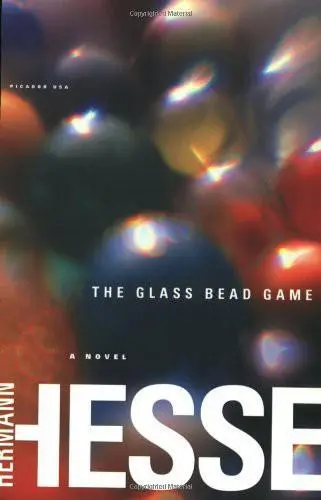
- Название:The Glass Bead Game
- Автор:
- Жанр:
- Год:1969
- ISBN:нет данных
- Рейтинг книги:4 / 5. Голосов: 2
-
Избранное:Добавить в избранное
- Отзывы:
-
Ваша оценка:
The Glass Bead Game: краткое содержание, описание и аннотация
Предлагаем к чтению аннотацию, описание, краткое содержание или предисловие (зависит от того, что написал сам автор книги «The Glass Bead Game»). Если вы не нашли необходимую информацию о книге — напишите в комментариях, мы постараемся отыскать её.
Something like chess but far more intricate, the game of Magister Ludi known as the Glass Bead Game is thought in its purest form, a synthesis through which philosophy, art, music and scientific law are appreciated simultaneously. The scholar-players are isolated within Castalia, an autonomous elite institution devoted wholly to the mind and the imagination…
The Glass Bead Game — читать онлайн бесплатно полную книгу (весь текст) целиком
Ниже представлен текст книги, разбитый по страницам. Система сохранения места последней прочитанной страницы, позволяет с удобством читать онлайн бесплатно книгу «The Glass Bead Game», без необходимости каждый раз заново искать на чём Вы остановились. Поставьте закладку, и сможете в любой момент перейти на страницу, на которой закончили чтение.
Интервал:
Закладка:
At the beginning of his years of free study he avoided Waldzell for the reasons given. This meant that for the time being he eschewed the graduate and postgraduate courses in the Glass Bead Game. But although to the superficial observer Knecht was ostentatiously neglecting the Game, we know that on the contrary the entire seemingly wayward and disconnected, and certainly altogether unusual course of his studies had been influenced by the Glass Bead Game and led back to it and to the service of the Game. We mean to discuss this somewhat at length, for this trait was characteristic. Joseph Knecht employed his freedom for study in the strangest and most idiosyncratic fashion, one that revealed an astonishing youthful genius. During his years at Waldzell he had, as was usual, taken the official introduction to the Glass Bead Game and the review course as well. During his last school year and among his friends he already had the reputation of being an excellent player. But then he was gripped with such a passion for this Game of games that after completing another course and while still in school he had been admitted to a course for players of the second stage, which was a very rare distinction indeed.
Some years later he told his friend and later assistant, Fritz Tegularius (who had at school taken the review course along with him) of an experience which not only decided his destiny as a Glass Bead Game player, but also greatly influenced the course of his studies. The letter is extant; the passage runs: “Let me remind you of the time the two of us, assigned to the same group, were so eagerly working on our first sketches for Glass Bead Games. Do you recall a certain day and a certain game? Our group leader had given us various suggestions and proposed all sorts of themes for us to choose from. We had just arrived at the delicate transition from astronomy, mathematics, and physics to the sciences of language and history, and the leader was a virtuoso in the art of setting traps for eager beginners like us and luring us on to the thin ice of impermissible abstractions and analogies. He would slip into our hands tempting baubles taken from etymology and comparative linguistics, and enjoyed seeing us grab them and come to grief. We counted Greek quantities until we were worn out, only to feel the rug pulled out from under us when he suddenly confronted us with the possibility, in fact the necessity, of accentual instead of a quantitative scansion, and so on. In formal terms he did his job brilliantly, and quite properly, although I did not like the spirit of it. He showed us false trails and lured us into faulty conjectures, partly with the good intention of familiarizing us with the perils, but also a little in order to laugh at us for being such stupid boys and to instil a heavy dose of skepticism into those of us who were most enthusiastic about the Game. And yet as things turned out it happened under his instruction and in the course of one of his complicated trick experiments — we were timidly and awkwardly trying to sketch a halfway decent Game problem — that I was all at once seized by the meaning and the greatness of our Game, and was shaken by it to the core of my being. We were picking apart a problem in linguistic history and, as it were, examining close up the peak period of glory in the history of a language; in minutes we had traced the path which had taken it several centuries. And I was powerfully gripped by the vision of transitoriness: the way before our eyes such a complex, ancient, venerable organism, slowly built up over many generations, reaches its highest point, which already contains the germ of decay, and the whole intelligently articulated structure begins to droop, to degenerate, to totter toward its doom. And at the same time the thought abruptly shot through me, with a joyful, startled amazement, that despite the decay and death of that language it had not been lost, that its youth, maturity, and downfall were preserved in our memory, in our knowledge of it and its history, and would survive and could at any time be reconstructed in the symbols and formulas of scholarship as well as in the recondite formulations of the Glass Bead Game. I suddenly realized that in the language, or at any rate in the spirit of the Glass Bead Game, everything actually was all-meaningful, that every symbol and combination of symbols led not hither and yon, not to single examples, experiments, and proofs, but into the center, the mystery and innermost heart of the world, into primal knowledge. Every transition from major to minor in a sonata, every transformation of a myth or a religious cult, every classical or artistic formulation was, I realized in that flashing moment, if seen with a truly meditative mind, nothing but a direct route into the interior of the cosmic mystery, where in the alternation between inhaling and exhaling, between heaven and earth, between Yin and Yang, holiness is forever being created.
“Of course by that time I had attended many a well-constructed and well-executed Game. Listening, I had often been exalted and overjoyed by the insights such Games afforded; but up to that time I had repeatedly been inclined to doubt the real value and importance of the Game. After all, every neatly solved problem in mathematics could provide intellectual pleasure; every good piece of music could exalt and expand the soul toward universality when heard, and even more when played; and every reverent meditation could soothe the heart and tune it to harmony with the universe. But perhaps for that very reason, my doubts whispered, the Glass Bead Game was merely a formal art, a clever skill, a witty combination, so that it would be better not to play this Game, but to occupy oneself with uncontaminated mathematics and good music.
“But now for the first time I had heard the inner voice of the Game itself, its meaning. It had reached me and penetrated me, and since that moment I have believed that our royal game is truly a lingua sacra, a sacred and divine language. You will remember, for you remarked on it yourself at the time, that a change had taken place within me, a summons had come to me. I can compare it only to that unforgettable call which once lifted my heart and transformed my life when as a boy I was tested by the Magister Musicae and summoned to Castalia. You noticed it; I felt that at the time, although you said not a word about it. Let us say no more about it today. But now I have something to ask you, and in order to explain my request I must tell you something that no one else knows or is to know: that my seemingly disorganized studies at the present time are not the result of whim, but of a definite underlying plan. You will recall, at least in general outline, the Glass Bead Game exercise we constructed at that time, as pupils in the Third Course, and with the leader’s assistance — in the course of which I heard that voice and experienced my vocation as a lusor . That game began with a rhythmic analysis of a fugal theme and in the center of it was a sentence attributed to Confucius. Now I am studying that entire game from beginning to end. That is, I am working through each of its phrases, translating it from the language of the Game back into its original language, into mathematics, ornament, Chinese, Greek, and so on. At least this once in my life I intend to restudy and reconstruct systematically the entire content of a Glass Bead Game. I have already finished the first part, and it has taken me two years. Of course it is going to cost me quite a few years more. But since we are granted our famous freedom of study in Castalia, this is how I mean to use it. I am familiar with the objections to such a procedure. Most of our teachers would say: We have devoted several centuries to inventing and elaborating the Glass Bead Game as a universal language and method for expressing all intellectual concepts and all artistic values and reducing them to a common denominator. Now you come along and want to check over everything to see if it is correct. That will take you a lifetime, and you will regret it.
Читать дальшеИнтервал:
Закладка:
Похожие книги на «The Glass Bead Game»
Представляем Вашему вниманию похожие книги на «The Glass Bead Game» списком для выбора. Мы отобрали схожую по названию и смыслу литературу в надежде предоставить читателям больше вариантов отыскать новые, интересные, ещё непрочитанные произведения.







Обсуждение, отзывы о книге «The Glass Bead Game» и просто собственные мнения читателей. Оставьте ваши комментарии, напишите, что Вы думаете о произведении, его смысле или главных героях. Укажите что конкретно понравилось, а что нет, и почему Вы так считаете.