Hermann Hesse - The Glass Bead Game
Здесь есть возможность читать онлайн «Hermann Hesse - The Glass Bead Game» весь текст электронной книги совершенно бесплатно (целиком полную версию без сокращений). В некоторых случаях можно слушать аудио, скачать через торрент в формате fb2 и присутствует краткое содержание. Год выпуска: 1969, Жанр: Современная проза, Социально-психологическая фантастика, на английском языке. Описание произведения, (предисловие) а так же отзывы посетителей доступны на портале библиотеки ЛибКат.
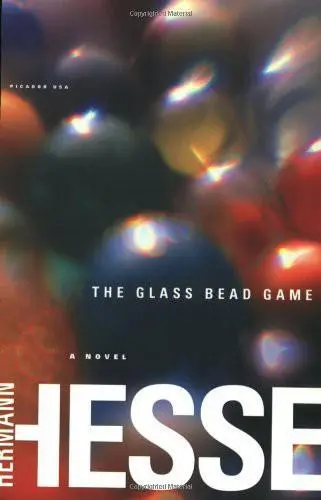
- Название:The Glass Bead Game
- Автор:
- Жанр:
- Год:1969
- ISBN:нет данных
- Рейтинг книги:4 / 5. Голосов: 2
-
Избранное:Добавить в избранное
- Отзывы:
-
Ваша оценка:
The Glass Bead Game: краткое содержание, описание и аннотация
Предлагаем к чтению аннотацию, описание, краткое содержание или предисловие (зависит от того, что написал сам автор книги «The Glass Bead Game»). Если вы не нашли необходимую информацию о книге — напишите в комментариях, мы постараемся отыскать её.
Something like chess but far more intricate, the game of Magister Ludi known as the Glass Bead Game is thought in its purest form, a synthesis through which philosophy, art, music and scientific law are appreciated simultaneously. The scholar-players are isolated within Castalia, an autonomous elite institution devoted wholly to the mind and the imagination…
The Glass Bead Game — читать онлайн бесплатно полную книгу (весь текст) целиком
Ниже представлен текст книги, разбитый по страницам. Система сохранения места последней прочитанной страницы, позволяет с удобством читать онлайн бесплатно книгу «The Glass Bead Game», без необходимости каждый раз заново искать на чём Вы остановились. Поставьте закладку, и сможете в любой момент перейти на страницу, на которой закончили чтение.
Интервал:
Закладка:
There was a period when this whole complex of problems troubled him so deeply that he was always dreaming of debates with Designori. And one day, as he was strolling across one of the spacious courtyards of the Waldzell Players’ Village, he heard someone behind him calling his name. The voice sounded very familiar, although he did not recognize it at once. When he turned around he saw a tall young man with a trim beard rushing tempestuously toward him. It was Plinio, and with a surge of affection and warm memories, Joseph greeted him heartily. They arranged to meet that evening. Plinio, who had long ago finished his studies at the universities in the outside world and was already a government official, had come to Waldzell on holiday for a short guest course in the Glass Bead Game, as he had in fact done once before, several years earlier.
The evening they spent together, however, proved an embarrassment to both friends. Plinio was here as a guest student, a tolerated dilettante from outside; although he was pursuing his course with great eagerness, it was nevertheless a course for outsiders and amateurs. The distance between them was too great; he was facing a professional, an initiate whose very delicacy and polite interest in his friend’s enthusiasm for the Glass Bead Game inevitably made him feel that he was not a colleague but a child playfully dabbling on the outer edges of a science which the other understood to its very core. Knecht tried to turn the conversation away from the Game by asking Plinio about his official functions and his life on the outside. And now Joseph was the laggard and the child who asked innocent questions and was tactfully tutored. Plinio had gone into law, was seeking political influence, and was about to become engaged to the daughter of a party leader. He spoke a language that Joseph only half understood; many recurrent expressions sounded empty to him, or seemed to have no content. At any rate he realized that Plinio counted for something in his world, knew his way about in it, and had ambitious aims. But the two worlds, which ten years ago both youths had each touched with tentative curiosity and a measure of sympathy, had by now grown irreconcilably apart.
Joseph could appreciate the fact that this man of the world and politician had retained a certain attachment to Castalia. This was, after all, the second time he was sacrificing a holiday to the Glass Bead Game. But in the end, Joseph thought, it was pretty much the same as if he were one day to pay a visit to Plinio’s district and attend a few sessions of the court as a curious guest, and have Plinio show him through a few factories or welfare institutions. Both were disappointed. Knecht found his former friend coarse and superficial. Designori, for his part, found his former schoolmate distinctly haughty in his exclusive esotericism and intellectuality; he seemed to Plinio to have become a “pure intellect” altogether absorbed by himself and his sport.
Both made an effort, however, and Designori had all sorts of tales to tell, about his studies and examinations, about journeys to England and to the south, political meetings, parliament. At one point, moreover, he said something that sounded like a threat or a warning. “You will see,” he said. “Soon there will be times of unrest, perhaps wars, in which case your whole existence in Castalia might well come under attack.”
Joseph did not take this too seriously. He merely asked: “And what about you, Plinio? In that case would you be for or against Castalia?”
“Oh that,” Plinio said with a forced smile. “It’s not likely that I’d be asked my opinion. But of course I favor the undisturbed continuance of Castalia; otherwise I wouldn’t be here, you know. Still and all, although your material requirements are so modest, Castalia costs the country quite a little sum every year.”
“Yes,” Joseph said, laughing, “it amounts, I am told, to about a tenth of what our country used to spend annually for armaments during the Century of Wars.”
They met several more times, and the closer the end of Plinio’s course approached, the more assiduous they became in courtesies toward each other. But it was a relief to both when the two or three weeks were over and Plinio departed.
The Magister Ludi at that time was Thomas von der Trave, a famous, widely traveled, and cosmopolitan man, gracious and obliging toward everyone who approached him, but severe to the point of fanaticism in guarding the Game against contamination. He was a great worker, something unsuspected by those who knew him only in his public role, dressed in his festive robes to conduct the great Games, or receiving delegations from abroad. He was said to be a cool, even icy rationalist, whose relationship to the arts was one of mere distant civility. Among the young and ardent amateurs of the Glass Bead Game, rather deprecatory opinions of him could be heard at times — misjudgments, for if he was not an enthusiast and in the great public games tended to avoid touching on grand and exciting themes, the brilliant construction and unequalled form of his games proved to the cognoscenti his total grasp of the subtlest problems of the Game’s world.
One day the Magister Ludi sent for Joseph Knecht. He received him in his home, in everyday clothes, and asked whether he would care to come for half an hour every day at this same time for the next few days. Knecht, who had never before had any private dealings with the Master, was somewhat astonished.
For the present, the Master showed him a bulky memorandum, a proposal he had received from an organist — one of the innumerable proposals which the directorate of the Game regularly had to examine. Usually these were suggestions for the admission of new material to the Archives. One man, for example, had made a meticulous study of the history of the madrigal and discovered in the development of the style a curve that he had expressed both musically and mathematically, so that it could be included in the vocabulary of the Game. Another had examined the rhythmic structure of Julius Caesar’s Latin and discovered the most striking congruences with the results of well-known studies of the intervals in Byzantine hymns. Or again some fanatic had once more unearthed some new cabala hidden in the musical notation of the fifteenth century. Then there were the tempestuous letters from abstruse experimenters who could arrive at the most astounding conclusions from, say, a comparison of the horoscopes of Goethe and Spinoza; such letters often included pretty and seemingly enlightening geometric drawings in several colors.
Knecht attacked the manuscript with eagerness. He himself, after all, had often pondered such proposals, although he had never submitted any. Every active Glass Bead Game player naturally dreams of a constant expansion of the fields of the Game until they include the entire universe. Or rather, he constantly performs such expansions in his imagination and his private Games, and cherishes the secret desire for the ones which seem to prove their viability to be crowned by official acceptance. The true and ultimate finesse in the private Games of advanced players consists, of course, in their developing such mastery over the expressive, nomenclatural, and formative factors of the Game that they can inject individual and original ideas into any given Game played with objective historical materials. A distinguished botanist once whimsically expressed the idea in an aphorism: “The Glass Bead Game should admit of everything, even that a single plant should chat in Latin with Linnaeus.”
Knecht, then, helped the Magister analyze the suggestion. The half-hour passed swiftly. He came punctually the next day, and so for two weeks came daily for a half-hour session with the Magister Ludi. During the first few days it struck him that the Master was asking him to work carefully and critically through altogether inferior memoranda, whose uselessness was evident at first glance. He wondered that the Master had time for this sort of thing, and gradually became aware that the purpose was not just to lighten the Master’s work load. Rather, this assignment, although necessary in itself, was giving the Master a chance to subject him, the young adept, to an extremely courteous but stringent examination. What was taking place was rather similar to the appearance of the Music Master in his boyhood; he suddenly became aware of it now by the behavior of his associates, who treated him more shyly, reservedly, and sometimes with ironic respect. Something was in the wind; he sensed it; but now it was far less a source of joy than it had been then.
Читать дальшеИнтервал:
Закладка:
Похожие книги на «The Glass Bead Game»
Представляем Вашему вниманию похожие книги на «The Glass Bead Game» списком для выбора. Мы отобрали схожую по названию и смыслу литературу в надежде предоставить читателям больше вариантов отыскать новые, интересные, ещё непрочитанные произведения.








Обсуждение, отзывы о книге «The Glass Bead Game» и просто собственные мнения читателей. Оставьте ваши комментарии, напишите, что Вы думаете о произведении, его смысле или главных героях. Укажите что конкретно понравилось, а что нет, и почему Вы так считаете.