Michael Chabon - Telegraph Avenue
Здесь есть возможность читать онлайн «Michael Chabon - Telegraph Avenue» — ознакомительный отрывок электронной книги совершенно бесплатно, а после прочтения отрывка купить полную версию. В некоторых случаях можно слушать аудио, скачать через торрент в формате fb2 и присутствует краткое содержание. Город: New York, Год выпуска: 2012, ISBN: 2012, Издательство: Harper, Жанр: Современная проза, на английском языке. Описание произведения, (предисловие) а так же отзывы посетителей доступны на портале библиотеки ЛибКат.
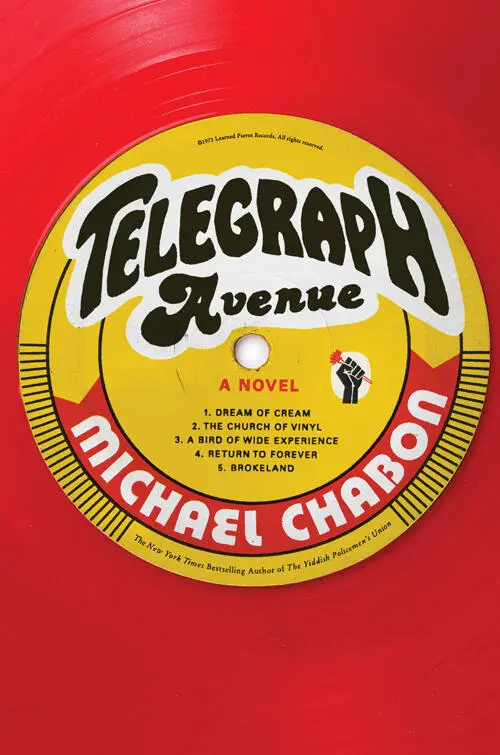
- Название:Telegraph Avenue
- Автор:
- Издательство:Harper
- Жанр:
- Год:2012
- Город:New York
- ISBN:978-0-06-149334-8
- Рейтинг книги:3.5 / 5. Голосов: 2
-
Избранное:Добавить в избранное
- Отзывы:
-
Ваша оценка:
Telegraph Avenue: краткое содержание, описание и аннотация
Предлагаем к чтению аннотацию, описание, краткое содержание или предисловие (зависит от того, что написал сам автор книги «Telegraph Avenue»). Если вы не нашли необходимую информацию о книге — напишите в комментариях, мы постараемся отыскать её.
When ex–NFL quarterback Gibson Goode, the fifth-richest black man in America, announces plans to build his latest Dogpile megastore on a nearby stretch of Telegraph Avenue, Nat and Archy fear it means certain doom for their vulnerable little enterprise. Meanwhile, Aviva and Gwen also find themselves caught up in a battle for their professional existence, one that tests the limits of their friendship. Adding another layer of complication to the couples’ already tangled lives is the surprise appearance of Titus Joyner, the teenage son Archy has never acknowledged and the love of fifteen-year-old Julius Jaffe’s life.
An intimate epic, a NorCal
set to the funky beat of classic vinyl soul-jazz and pulsing with a virtuosic, pyrotechnical style all its own,
is the great American novel we’ve been waiting for. Generous, imaginative, funny, moving, thrilling, humane, triumphant, it is Michael Chabon’s most dazzling book yet.
Telegraph Avenue — читать онлайн ознакомительный отрывок
Ниже представлен текст книги, разбитый по страницам. Система сохранения места последней прочитанной страницы, позволяет с удобством читать онлайн бесплатно книгу «Telegraph Avenue», без необходимости каждый раз заново искать на чём Вы остановились. Поставьте закладку, и сможете в любой момент перейти на страницу, на которой закончили чтение.
Интервал:
Закладка:
Out of the self-assembling nanoparticles of her pessimism, in Aviva’s imagination, a narrative began to take shape. Titus’s nappy head, the unchanged clothes to which there clung an unmistakable if faint smell of Berkeley at night (purple salvia, jasmine, fog, cat spray), the evident depth of his slumber.
Oh, the sneaky little shit!
She backed out of the kitchen so as not to wake him before her theory could be confirmed. Like most people with a suspicious nature, she was gifted at sneakiness herself and inclined to be stealthy in the corroboration of her theories. She crept upstairs to Julie’s room and eased open the door, ignoring three separate tacked-up signs warning off a variety of intruders in Klingon, runic, and (presumably) simulated blood. In the dim light, in his IKEA bed, Julie lay curled into a ball so impossibly tiny that she didn’t dare look at it, lest nostalgia for the vanished little old man he once had been impede her investigation. On the floor of the attic room, the futon bed, unrolled two nights earlier to accommodate Titus, bore a faint oblong indentation, but it was still made, the covers as tucked and taut as the boy’s shirttails and pleats. To Aviva, this suggested or rather confirmed that Titus had lain down on it, fully dressed, until he felt that it was safe to sneak out through the lone attic window, whose lower sash was open as wide as it could go. Under the window, Titus’s megalith sneakers lounged at louche angles, suggesting that he had kicked them off as soon as he came tumbling back in from outside.
Aviva went over to stand beside Julie’s bed, trying to determine from the visible evidence—the arcing bones of his spine, a tangled sketch of knees and elbows in the bedclothes—whether he, too, had sneaked out of the house last night, then sneaked back in. Using perspicacity as a shield against panic. No telltale shoes, no flung socks.
Aviva went back down to the kitchen and began angrily to cook Titus’s stated favorite breakfast, pancakes and bacon. She broke the eggs as if they were the spurious arguments of unworthy adversaries. With the contempt we reserve for those who fail to deliver on arrant boasts, she watched the bacon shrink in its own fat. She peeled the bubbling pancakes from the griddle and flipped them over with a sense of cutting off a pointless discussion. In the batter, buttermilk and baking soda enacted their allegory of her emotional pH. By the time she had, in her view, cashed out the boy’s account in silver-dollar pancakes and a sizzling rasher of the Berkeley Bowl’s best applewood-smoked, she had worked through and expended most of the outrage that her discovery of his nocturnal adventuring had stirred in her. This was in compliance with Aviva Roth-Jaffe’s official policy on outrage, which was that, even when justified, it was an ineffective tool.
“Okay, mister,” she said, setting the plate in front of him. “Wake up.”
He started, opened his eyes wide, unstuck his cheek from his hand. He looked at her, at the plate, back to Aviva. Putting it together, where he was, what she had made for him, those wide brown eyes going all moist and puppy-dog. Just as Aviva felt the last inch of annoyance drain away, she saw Titus remember what a hard-on he was supposed to be. His gaze iced over. His nostrils flared as if they detected in the steam off the pancakes a distinct whiff of something vile.
“Thank you,” he said, neutering his voice of any gratitude, cutting a neat wedge out of the stack of pancakes.
“When did you get in?”
Instead of replying, he hoisted up stratified forkfuls, one after another, as if they were riding a conveyor belt to his mouth.
“You can drop the man-of-few-words routine, dude. I hear you running your mouth to Julie. I know you think you’re making a statement about how pointless it is to talk to adults or white people or whatever, but you’re just being disrespectful. I haven’t done anything to deserve your disrespect. I know your grandmother didn’t raise you to be rude.”
He chewed the last mouthful, weighing her argument, thinking it through. He swallowed. Took a sip of milk. “Could you please repeat the question?” he said.
“What time did you get in? I know you were out, Titus. Your bed hasn’t been slept in. Don’t even try to lie to me.”
“Huh, yeah, well, I don’t wear no watch, so….”
The confirmation of her guess did not amaze her—her guesses, rooted in pessimism, were tantamount to Laws of Physics—but neither did it console her. She felt her initial sense of panic begin to return. “Did Julie go out with you?”
“Yeah.”
“Oh my God.”
Aviva fell into a chair at the table. Sometimes in the event of a shoulder dystocia, after everything else had failed, a doctor would attempt the Zavanelli maneuver, planting his hand on the head of the shoulder-bound baby, pushing it back up into the darkness. Aviva effected a similar maneuver on the sense of panic that was struggling out of her into the light of morning.
“Well,” she said. She sat back, trying to come up with something reasonable and authoritative to say. “Where did you go?”
He seemed genuinely to consider attempting to answer her question. Then he picked up a piece of bacon and shrugged. “Everywhere,” he said. “Just, like, walking around.”
“Walking around?”
“Riding my bike. Him riding his skateboard. Can’t do much beside ride it, but he can hook a ride on my bike, I kind of like give him a tow.”
She could see it: Julie rolling along behind Titus through the summer darkness of Berkeley, holding on to his friend’s shoulder, the way she had seen other pairs of skater boys do.
“I don’t want you doing that anymore,” she said. “Not while you’re a guest in my house. You go to bed, you stay in bed, you wake up in bed in the morning. Do you understand me?”
“Yes, ma’am.”
She had to admit that she loved the “sirs” and “ma’ams” that flowed from his lips so readily, drawled out like pats of butter smeared across a biscuit. She remembered hiking in Yosemite with Nat and Julie a few summers back. Climbing to the top of the Mist Trail up a preposterous stairway of stones proposed, cut, hauled, and fixed immovably into place, proof against time and earthquakes, under the auspices of the WPA. She remembered feeling grateful to those long-dead men, the planners and the workers, for their foresight, their labor, the heroic absurdity of that granite stair. That was how she felt, whenever he would “ma’am” her, toward the dead grandmother of this boy.
“When you do that, Titus,” she said, softening her tone because she was getting in his face, “when you sneak out of my house like that, you are showing disrespect toward me.”
The boy shook his head, face indented with the thumbprint of a smirk, eyes downcast to show his pity for her.
“What?” Aviva said. “You don’t agree?”
“I ain’t— I’m not saying nothing.”
He took up the study of the backsplash behind the sink, tiled in iridescent rust red and cream. Aviva once hated that tile, then for a decade ignored it, and now felt toward those earth tones the same poignant derision she felt toward much of the surviving evidence of the 1970s. The boy might have been staring longingly at some bleak and lonely peak of snow.
“I don’t even want to be here.” His eyes abandoned their scrutiny of the high cold home of his soul long enough to toss a mocking look in her direction. “No disrespect.”
“Really?” Aviva said, knowing that she had him on that one, wondering what she hoped to gain from prolonging this conversation, asking herself why she couldn’t cut the kid a break. “That isn’t what Julie said. He said you begged him to let you stay with us.”
Читать дальшеИнтервал:
Закладка:
Похожие книги на «Telegraph Avenue»
Представляем Вашему вниманию похожие книги на «Telegraph Avenue» списком для выбора. Мы отобрали схожую по названию и смыслу литературу в надежде предоставить читателям больше вариантов отыскать новые, интересные, ещё непрочитанные произведения.









Обсуждение, отзывы о книге «Telegraph Avenue» и просто собственные мнения читателей. Оставьте ваши комментарии, напишите, что Вы думаете о произведении, его смысле или главных героях. Укажите что конкретно понравилось, а что нет, и почему Вы так считаете.