Michael Chabon - Telegraph Avenue
Здесь есть возможность читать онлайн «Michael Chabon - Telegraph Avenue» — ознакомительный отрывок электронной книги совершенно бесплатно, а после прочтения отрывка купить полную версию. В некоторых случаях можно слушать аудио, скачать через торрент в формате fb2 и присутствует краткое содержание. Город: New York, Год выпуска: 2012, ISBN: 2012, Издательство: Harper, Жанр: Современная проза, на английском языке. Описание произведения, (предисловие) а так же отзывы посетителей доступны на портале библиотеки ЛибКат.
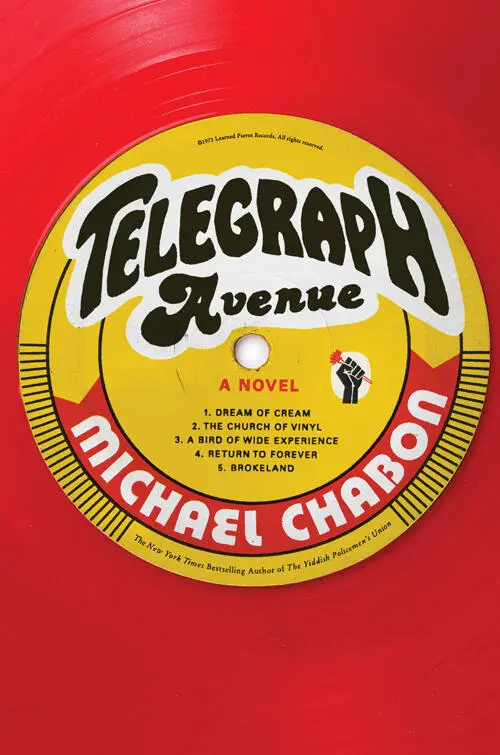
- Название:Telegraph Avenue
- Автор:
- Издательство:Harper
- Жанр:
- Год:2012
- Город:New York
- ISBN:978-0-06-149334-8
- Рейтинг книги:3.5 / 5. Голосов: 2
-
Избранное:Добавить в избранное
- Отзывы:
-
Ваша оценка:
Telegraph Avenue: краткое содержание, описание и аннотация
Предлагаем к чтению аннотацию, описание, краткое содержание или предисловие (зависит от того, что написал сам автор книги «Telegraph Avenue»). Если вы не нашли необходимую информацию о книге — напишите в комментариях, мы постараемся отыскать её.
When ex–NFL quarterback Gibson Goode, the fifth-richest black man in America, announces plans to build his latest Dogpile megastore on a nearby stretch of Telegraph Avenue, Nat and Archy fear it means certain doom for their vulnerable little enterprise. Meanwhile, Aviva and Gwen also find themselves caught up in a battle for their professional existence, one that tests the limits of their friendship. Adding another layer of complication to the couples’ already tangled lives is the surprise appearance of Titus Joyner, the teenage son Archy has never acknowledged and the love of fifteen-year-old Julius Jaffe’s life.
An intimate epic, a NorCal
set to the funky beat of classic vinyl soul-jazz and pulsing with a virtuosic, pyrotechnical style all its own,
is the great American novel we’ve been waiting for. Generous, imaginative, funny, moving, thrilling, humane, triumphant, it is Michael Chabon’s most dazzling book yet.
Telegraph Avenue — читать онлайн ознакомительный отрывок
Ниже представлен текст книги, разбитый по страницам. Система сохранения места последней прочитанной страницы, позволяет с удобством читать онлайн бесплатно книгу «Telegraph Avenue», без необходимости каждый раз заново искать на чём Вы остановились. Поставьте закладку, и сможете в любой момент перейти на страницу, на которой закончили чтение.
Интервал:
Закладка:
She wiped at her own cheek with a forearm. She came over and did her best to get herself around him. He was too high and she too deep. So she pulled him over to a chair, one of those Mexican affairs made out of pigskin and sticks. She fell onto his lap, panicking the chair. In her arms, Archy let go of himself for a minute. The smell of Gwen’s hair, cool against his cheek, clean, flowery.
“It’s okay,” she said. “I know.”
All at once—just like that—he could feel her forgive him. Somewhere in the midst of the continent of shock and grief that was Archy Stallings, a minor principality rejoiced.
“Closest thing I had to a father,” he said.
“That’s what you always said.”
She meant it to sound sweet, he knew, but it came out sounding like reproof as much as eulogy. Gwen got along with Mr. Jones, but to her he was a sweet-natured, emotionally vague, and reticent man whose greatest steadfastness, away from the keys of his organ, was loyalty to his parrot and to leisure wear of the 1970s, nothing at all like a father in any important way. Archy did not disagree with that assessment. He was okay with coming in second to Fifty-Eight, parrot was like some kind of prodigy, a Mozart of the birds.
“He was loading the Hammond,” Nat said, slipping his phone back into his pocket. “I guess he didn’t have the straps right on the dolly. The Hammond fell on top of him.”
Day I need help moving that thing is the day I give it up for good. Archy had let him go, let him walk out of the garage. Angry, stirred up about something that Archy would never understand. Careless, distracted, nobody to help him lift that heavy, heavy thing.
“Oh, uh, hi,” said Leslie the clipboard girl, peering out from behind Gwen, the one they sent in with a stick to poke the wrestling bear. “So, people are starting to show up? Robin and David were thinking you might want to, uh. Start?”
“We’re ready,” Nat said. “Just, uh, I’m going to have to make a little adjustment in the fee for you all, a reduction, I mean, because my bass player has a birthing class, and it turns out, wow, tragic thing, my organ player, he, uh, he just died .”
“Oh, no,” Leslie said, blinking. She glanced down at the clipboard, looking for a little help from the campaign on how to proceed in the event of a dead musician. “I’m so sorry.”
“So I only have a two-piece for you tonight. Guitar and drums. But we can—”
Two of the valet parkers came out onto the patio. One had Archy’s Jazz Bass in its soft gig jacket, the other coming right behind him with Archy’s tubes and wires. The lead parker handed Gwen a claim ticket for the car, and Gwen nodded them toward Archy.
“You got a trio,” she said to Leslie. “Plus one pregnant lady in a bowling shirt.”
Just before his hostess for the evening, who held the patent on a gene that coded for a protein to prevent the rejection of a transplanted kidney, directed everyone to gather under the carved and stenciled fir beams of her living room, and sent the young woman from the campaign out to tell the band to knock it off for ten minutes so that the state senator, Obama of Illinois, could address his fellow guests, each of whom had contributed at least one thousand dollars to attend this event, an address in which he would attempt by measured words and a calm demeanor to reassure them (vainly and mistakenly, as it would turn out) that their candidate for the presidency of the United States would not go down to inglorious defeat in November, Obama stopped in the doorway that opened onto the flagstone patio to listen for a minute to the hired band. They were cooking their way with evident seriousness of intent through an instrumental cover of “Higher Ground.”
The rhythm section consisted of a gray-haired older man in a white turtleneck, who had that deceptive stillness of the rock-solid drummer, whaling away and at the same time immobile as a gecko on a rock. A big dude in a preposterous suit, a younger man, played bass through a huge old wooden organ amplifier that was the size of an oven. Its acoustics lent a fat, muddy, molasses-black grandeur to the bass line. Off to one side, a grim-countenanced stick figure of a white guy coiled up the notes in high jazzy meringues on top of the heavy, heavy bottom of the tune, a personal favorite of the state senator. He lingered there in the doorway, his hostess getting a tiny bit antsy. Obama tapping his foot, bobbing his close-cropped head.
“Those guys are pretty funky,” he observed, directing his remark to a short, extraordinarily pregnant woman in a man’s bowling shirt who stood beyond the open patio doors, dark, pretty, her hair worn in a fetching artful anemone of baby dreadlocks. The fingers of her right hand flicked shadow bass notes on her belly. At his remark, the pregnant woman nodded without turning to look at him—there was an elaborate candelabra of a potted cactus behind whose tapered thorns she appeared to be attempting, somewhat punitively, to conceal herself. Obama was running for the United States Senate that summer and had given a wonderful speech last month at the Democratic Convention in Boston. When she did turn to him, her eyes got very wide.
“Friends of yours?” he said.
It was a reasonable inference, given the fact that, in her bowling shirt, she stood out from the other women in attendance, most of them done up in cocktail attire. She was also one of a strikingly few women of color in the room. She nodded again, more stiffly, no longer playing along with the bass, stare going glassy. Feeling big, he supposed, underdressed, and trapped behind a cactus by a celebrated black man in a fancy house full of white folks. He went further out a limb.
“My man on bass?”
The pregnant woman looked sidelong at him, a droll look, and seemed to recover from her initial bout of self-consciousness. “Well, that’s the question, now,” she said with an asperity that took him aback. “Isn’t it?”
“Senator?” said the hostess, looking very handsome in an elaborate thing, all crinkled and structural. “If you’re ready? I can ask the band to—”
“Let’s let them finish this number,” Obama said.
His memory filled in the missing vocal line, the lyrics that somehow managed to be at once hopeful and apocalyptic, perfectly in keeping with the mood of the hour politically, if there were anyone in the crowd to attend, which, frankly, the state senator from the 13th district of Illinois, judging from the bright unrelenting roil of chatter and gloomy expatiation going on, inside the house and out, kind of doubted. He listened awhile longer.
“Shame nobody’s dancing,” he said.
“I guess it’s not that kind of party,” said the pregnant woman.
“They seldom are,” Obama allowed. “All too seldom. Now, I would ask you to dance, but I don’t think my wife would be happy if it got back to her that I was observed dancing with a gorgeous sister in your condition.”
“I like the underlying philosophy of that,” the pregnant woman said, staring fixedly at the bass player in a way that confirmed, to the senator’s satisfaction, his earlier inference. “That’s a philosophy I can get behind. Shame it isn’t more widespread.”
The senator felt compelled to smile. “Brother puts his heart into it, though,” he observed. “You can see that. A lot of heart.”
The bass man felt his way up and down the fretboard like a blind man reading something passionate in Braille. The senator recalled having caught a few words over the PA earlier tonight, to the effect that the band wanted to dedicate tonight’s performance to someone who had died, name of Jones. He watched the man in the purple suit play his kaddish.
“That is quite a suit,” Obama said. “Takes a special kind of man to go around wearing a suit like that.”
Читать дальшеИнтервал:
Закладка:
Похожие книги на «Telegraph Avenue»
Представляем Вашему вниманию похожие книги на «Telegraph Avenue» списком для выбора. Мы отобрали схожую по названию и смыслу литературу в надежде предоставить читателям больше вариантов отыскать новые, интересные, ещё непрочитанные произведения.









Обсуждение, отзывы о книге «Telegraph Avenue» и просто собственные мнения читателей. Оставьте ваши комментарии, напишите, что Вы думаете о произведении, его смысле или главных героях. Укажите что конкретно понравилось, а что нет, и почему Вы так считаете.