Michael Chabon - Telegraph Avenue
Здесь есть возможность читать онлайн «Michael Chabon - Telegraph Avenue» — ознакомительный отрывок электронной книги совершенно бесплатно, а после прочтения отрывка купить полную версию. В некоторых случаях можно слушать аудио, скачать через торрент в формате fb2 и присутствует краткое содержание. Город: New York, Год выпуска: 2012, ISBN: 2012, Издательство: Harper, Жанр: Современная проза, на английском языке. Описание произведения, (предисловие) а так же отзывы посетителей доступны на портале библиотеки ЛибКат.
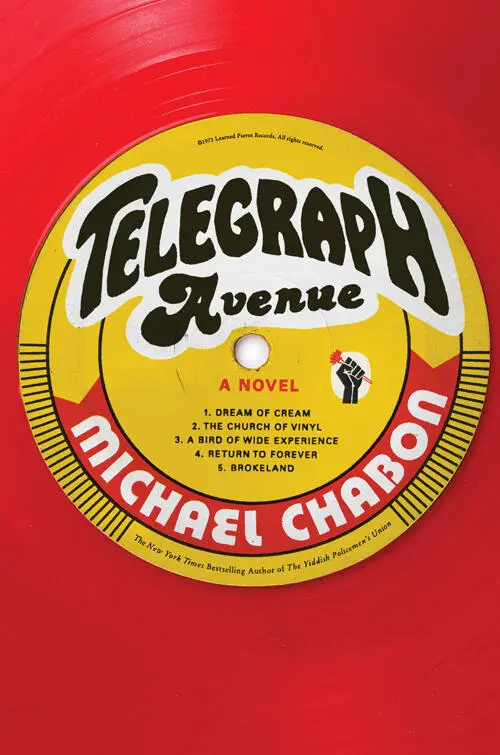
- Название:Telegraph Avenue
- Автор:
- Издательство:Harper
- Жанр:
- Год:2012
- Город:New York
- ISBN:978-0-06-149334-8
- Рейтинг книги:3.5 / 5. Голосов: 2
-
Избранное:Добавить в избранное
- Отзывы:
-
Ваша оценка:
Telegraph Avenue: краткое содержание, описание и аннотация
Предлагаем к чтению аннотацию, описание, краткое содержание или предисловие (зависит от того, что написал сам автор книги «Telegraph Avenue»). Если вы не нашли необходимую информацию о книге — напишите в комментариях, мы постараемся отыскать её.
When ex–NFL quarterback Gibson Goode, the fifth-richest black man in America, announces plans to build his latest Dogpile megastore on a nearby stretch of Telegraph Avenue, Nat and Archy fear it means certain doom for their vulnerable little enterprise. Meanwhile, Aviva and Gwen also find themselves caught up in a battle for their professional existence, one that tests the limits of their friendship. Adding another layer of complication to the couples’ already tangled lives is the surprise appearance of Titus Joyner, the teenage son Archy has never acknowledged and the love of fifteen-year-old Julius Jaffe’s life.
An intimate epic, a NorCal
set to the funky beat of classic vinyl soul-jazz and pulsing with a virtuosic, pyrotechnical style all its own,
is the great American novel we’ve been waiting for. Generous, imaginative, funny, moving, thrilling, humane, triumphant, it is Michael Chabon’s most dazzling book yet.
Telegraph Avenue — читать онлайн ознакомительный отрывок
Ниже представлен текст книги, разбитый по страницам. Система сохранения места последней прочитанной страницы, позволяет с удобством читать онлайн бесплатно книгу «Telegraph Avenue», без необходимости каждый раз заново искать на чём Вы остановились. Поставьте закладку, и сможете в любой момент перейти на страницу, на которой закончили чтение.
Интервал:
Закладка:
“You know, he isn’t even aware of that?” the pregnant woman said. “Man doesn’t feel self-conscious, not one little bit embarrassed, walking around in that thing.” Scorn and admiration in her tone in about equal measure. “The outside of him matches perfectly with the inside. It’s like, I can’t even tell you. Not stubborn, I mean, yes, he can be stubborn as hell, stubborn and full of pride, but to walk around looking like that, I mean, a purple suit even a pimp might have doubts about it, and saddle shoes … you have to have—”
“Dignity.”
At the sound of the word, the pregnant woman looked at him. A strange expression passed over her face, as if, he thought, she might be experiencing a contraction.
“He just had a loss,” she said.
“I gathered that, something about a man named Jones.”
“Yeah, yes, he was supposed to be here, he played the organ. It’s Cochise Jones.”
“Cochise Jones, okay.”
Perhaps the name registered, a shallow footprint tracked in the sand of the senator’s memory. But the print might as easily have been left by Elvin or Philly Joe.
“He was supposed to be here, to play. It just happened, he passed this afternoon.”
“I am so sorry to hear that.”
“He was like a father to my husband.”
Somehow, seamlessly, the band morphed into a cover of Bad Medicine’s “Trespasser.”
“Thank you for telling me that,” Obama said. “You know, I could hear it in his playing. Something grieving. But I didn’t know what it was.”
“Mr. Jones was his own kind of shiftless fool,” she said gently. “A musician. He made, I guess he made, all these elaborate plans for his funeral, a marching band, a Cadillac hearse.” She shook her head. “The past two weeks, when we could have been getting ready for the baby, enjoying our last time alone together? My husband chose to spend them in the garage, repairing that dusty old dinosaur of an amplifier over there. Now, with a month to go? He’s going to get caught up in all this funeral foolishness. Instead of what he should be focusing on.”
“But you know,” the senator said, “I, I understand your frustration. We’ve all heard, we all know how musicians can be. But traveling around, campaigning, at home, around the country, I have seen a lot of people, met a lot of people. The lucky ones are the people like your husband there. The ones who find work that means something to them. That they can really put their heart into, however foolish it might look to other people.”
At these words, perhaps, the state senator felt a slight misgiving, a mild Braxton-Hicks spasm of dread, recalling the purpose for which he had been flown up here yesterday, aboard Gibson Goode’s private airship, the Minnie Riperton , Goode on his way to some kind of memorabilia show, the senator catching a ride.
“And that reminds me.”
He turned back to the hostess, her evident impatience with his delay motivated less by some schedule she was sticking to than by her possible desire for reassurance about the upcoming election, which he hoped he would be able to provide.
“All right, Robin,” he told her. “Let’s do this.”
He shook hands with the pregnant woman, who appeared distracted, lost in thought, even surprisingly, given her original discomfiture, uninterested in the rising star from Illinois.
“You’re right,” she said, and for a second he could not retrieve the thread of conversation that she was following. “I have been wasting my life.”
“Oh, don’t be too hard on the brother, now,” he said, trying, with departure imminent, to keep his tone light.
“I don’t mean him,” she said. “I mean, I do, but I don’t. I mean what you said about work. About putting your heart and soul into something meaningful. Thank you for that.”
She shook his hand with a puzzling solemnity.
The band was silenced, the guests assembled, and Barack Obama loped into the living room, at ease and smiling. He stood against a high wall painted cinnamon brown, under a display of retablos , battered squares of scrap tin and steel on which credulous souls of Mexico had painted, with painful and touching simplicity of technique, scenes that depicted their woes and expressed in stark terms their gratitude to the Holy Mother of God or various santos and santas for the granting of relief. The state senator seemed to at least one observer to feel the weight of such wishes upon him. He paused for a couple of seconds before opening his remarks.
“He was the closest thing you had to a father,” said the pregnant woman to the man in the big purple suit, filling, at least for those standing nearby, that prolonged silence with her grave whisper, “of course you’ve got to bury him properly .”
The kid sat at Aviva’s kitchen table, wearing the cast-iron dungarees, sweater vest, and short-sleeved plaid shirt in which he had bade her good night the previous evening. If Julie was always a premature zayde , born nostalgic, born cranky, born 103 years old, then maybe that was the connection he felt to old man Titus, what to make of him, hunched over a magazine beside a box of Nat’s All-Bran in an acrylic sweater vest, sinking his palm into the cheek of his inclined head, so lost in whatever he was reading that he did not look up when Aviva stopped in the doorway, belting her robe more tightly around her waist, and said, “Morning, you.”
Titus sat there, perfecting his stillness. She had yet to make up her mind about the kid—she was still collecting evidence—but Aviva liked him for his immobility, his effortless parsimony of movement. He was not a Drummer on All Resonant Surfaces, like Julie, or a Perpetual Hummer of Infinite Tunes, like Nat. She was willing to give Titus credit for that much, at least.
Over the course of the day and two nights of his exile among the Jaffes, Aviva had gotten into the habit of doling out to Titus these modest quanta of credit, none larger or more valuable than, say, a nickel, or a pinto bean. For his neatness, his familiarity with soap and water, his polite manners, his readiness to clear his place after dinner without being told. Behind each of these qualities, she felt the ghostly hard hand of the late Texan grandmother, and it must have been in honor of that lost woman of iron that Aviva was keeping Titus’s file open, because from the instant he came limping into the house with that constipated granddaddy walk of his, humping a stained sailor’s duffel, bearing, safety-pinned to his soul like a note scrawled in his putative father’s hasty hand, an indefinite embargo on sharing the news of his existence with her partner and best friend, Aviva’s snap judgment on the kid was: Trouble. Trouble for everyone but trouble especially, she guessed, for Julie, who had clearly fallen into some kind of inchoate and disorderly love with Titus Joyner.
Nat agreed (a rare pairing of those words) that on the advent of Titus, all the recent incidents of inexplicable behavior on the part of their son appeared to snap into alignment. Only Aviva’s long habit of taking the temperature of her own racism, of her biases and stereotypes about young black males (or about the iron-hard perdurance of their grandmothers) enabled Aviva to set aside, for the time being, her gut reaction—the boy was trouble—and admire Titus’s stillness. Here was yet another quality that he did not share with her own ill-washed, ill-mannered, sloppy, and hyperactive offspring.
Then she heard the moist, slow rasp of Titus’s breathing: The kid was sleeping. His hair, hitherto maintained with curatorial punctilio in an archival 1973 Afro, was lumps and nap, a topographical globe. He sat propped up and snoozing in the mild gray sunshine that irradiated the morning fog outside the kitchen window, over a copy of—she went over, reached in, and peeled back the front cover of the magazine— American Cinematographer .
Читать дальшеИнтервал:
Закладка:
Похожие книги на «Telegraph Avenue»
Представляем Вашему вниманию похожие книги на «Telegraph Avenue» списком для выбора. Мы отобрали схожую по названию и смыслу литературу в надежде предоставить читателям больше вариантов отыскать новые, интересные, ещё непрочитанные произведения.








Обсуждение, отзывы о книге «Telegraph Avenue» и просто собственные мнения читателей. Оставьте ваши комментарии, напишите, что Вы думаете о произведении, его смысле или главных героях. Укажите что конкретно понравилось, а что нет, и почему Вы так считаете.