Arthur Hailey - Evening News
Здесь есть возможность читать онлайн «Arthur Hailey - Evening News» весь текст электронной книги совершенно бесплатно (целиком полную версию без сокращений). В некоторых случаях можно слушать аудио, скачать через торрент в формате fb2 и присутствует краткое содержание. Жанр: Современная проза, на английском языке. Описание произведения, (предисловие) а так же отзывы посетителей доступны на портале библиотеки ЛибКат.
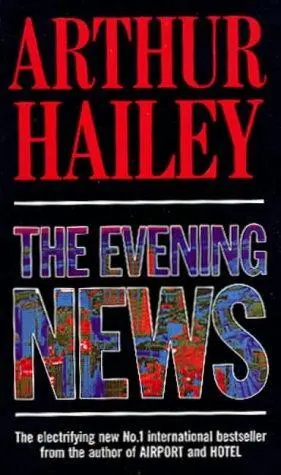
- Название:Evening News
- Автор:
- Жанр:
- Год:неизвестен
- ISBN:нет данных
- Рейтинг книги:3.5 / 5. Голосов: 2
-
Избранное:Добавить в избранное
- Отзывы:
-
Ваша оценка:
Evening News: краткое содержание, описание и аннотация
Предлагаем к чтению аннотацию, описание, краткое содержание или предисловие (зависит от того, что написал сам автор книги «Evening News»). Если вы не нашли необходимую информацию о книге — напишите в комментариях, мы постараемся отыскать её.
Evening News — читать онлайн бесплатно полную книгу (весь текст) целиком
Ниже представлен текст книги, разбитый по страницам. Система сохранения места последней прочитанной страницы, позволяет с удобством читать онлайн бесплатно книгу «Evening News», без необходимости каждый раз заново искать на чём Вы остановились. Поставьте закладку, и сможете в любой момент перейти на страницу, на которой закончили чтение.
Интервал:
Закладка:
Fortunately, when she let it be known at Alitalia that she was prepared to quit, the airline assigned her to ground duties that kept her permanently in Rome. Both Gemma and Partridge were delighted because now they had much more time together.
They used their spare hours to explore and enjoy Rome, dipping into its millennium of history about which, Partridge discovered, Gemma's mind held a treasure trove of bric-a-brac.
”The Emperor Augustus, Harry.—he was Julius Caesar's stepson—started a fire brigade of slaves. But there was a big fire they didn't put out, so he got rid of the slaves and had freemen as firemen, vigiles, who were better. That's because people who are free want to put out fires.”
Partridge said doubtfully, "Is all that true?” Gemma only smiled, though later research showed him she was right and that the switch to freemen happened in A.D. 6. Subsequently, when the United Nations held a Freedom Symposium in Rome, which Partridge covered, he adroitly slipped the ancient fire brigade story into his CBA News script.
On another occasion: "The Sistine Chapel, Harry, where new popes are chosen, was named after Pope Sixtus IV He licensed brothels in Rome and had sons, one by his own sister. He made three of his sons cardinals.”
And "Our famous Spanish Steps, Scala di Spagna, have a wrongful name. They ought to be Scala di Francia. The French suggested the steps, a Frenchman left the money for them in his will. The Spanish Embassy—just happened to be there. Spain had nothing, nothing, Harry, to do with those steps at all.”
When work and time permitted, Partridge and Gemma journeyed farther afield to Florence, Venice and Pisa. It was while returning from Florence by train that Gemma appeared pale and excused herself several times to enter the toilet. When Partridge expressed concern, she dismissed it as unimportant.”I probably ate something I should not. Do not worry.”
In Rome, away from the train, Gemma seemed her normal self and next day Partridge went as usual to the CBA bureau. In the evening, however, when he returned home he was surprised to find an extra small plate at his dinner place and, on it, the keys of Gemma's Alfa Romeo.When he asked about them, Gemma, a small smile on her face, answered, "A promise isfor keeping.”
For a moment he was puzzled, then with a surge of love and a shout of joy, he remembered her statement, "As soon as I am pregnant I will not drive a car.”
Gemma had tears of happiness in her eyes as they kissed and held each other tightly.
* * *
One week later Partridge received word from CBA News that he would no longer be Rome correspondent and was being given a more important assignment—as senior correspondent in London.
His immediate reaction was to wonder how Gemma would feel about the change. He need not have been concerned.
”It is wondrous news, Harry caro,” she told him.”I adore London. I flew there with Alitalia. We will make a good life there together.”
* * *
"We're here, Mr. Partridge.”
Partridge, who had closed his eyes in the CBA car—momentarily, as he thought—opened them to discover they had reached Manhattan and were on Forty-eighth Street outside the Inter-Continental Hotel. He thanked the driver, said good night, then went inside.
In the elevator on the way to his room he realized it was now Monday—the beginning of what was likely to be a crucial week.
4
Jessica was trying desperately to hold on to awareness, to keep her mind functioning and to understand what was going on around her, but mostly she was not succeeding. She would have moments of clarity in which she could see other people and feel her own body—its pain and discomfort, nausea, an acute thirst. Yet even while this was happening, panic possessed her with one dominating thought: Nicky! "Where was he? "What had happened? Then abruptly everything would ebb away, becoming a swirling, misty montage in which she could grasp nothing mentally, not even who she was. During such lapses she seemed engulfed by some sluggish, opaque liquid.
Somehow, even while teetering in and out of consciousness, she managed to hold on to memories of what she had briefly perceived. She knew that something which had been connected to her arm was now removed and in its place was a throbbing ache. She was aware of being helped from some resting place, then partly walked and partly carried to wherever she was now seated, which seemed—again in moments of awareness—to be a flat surface. There was something solid—she wasn't sure what —behind her back.
In between such thoughts, as fright and panic returned, she tried to tell herself what she knew to be important: Keep control!
One thing she was clear about was the sudden sight, and now the memory, of a man. The image of him was sharp and strong. He was tall and partly bald, held himself straight, and looked as if he had authority. It was that impression of authority which made her attempt to speak to him, to plead for help. She knew he had been startled by her voice; that response was also precisely etched, though the reality of the man had disappeared. But did her plea get through? Would he return to help? . . . Oh god! Who knew?
Now . . . once more awareness had swirled in. There was another man, this time leaning over her . . . Wait. She had seen this one before, recognized his cadaverous face . . . Yes! Just minutes ago, while she was desperately fighting with some kind of knife, she had slashed his face, seen blood spurt out . . . But why wasn't he bleeding now? How was it that his face was bandaged?
In Jessica's mind her long interval of unconsciousness did not exist . . .
She reasoned: This man was an enemy. Now she remembered: He had done something to Nicky. Oh, how she hated him/ . . . Wild anger sent adrenaline pumping, brought back movement to her limbs. She reached up, seized the adhesive bandage and pulled it off. Then, following through, her nails raked flesh and scab.
With a startled cry, Baudelio leaped back. Putting a hand to his cheek, it came away red with blood . . . That goddamn woman! She had messed up his face again. Instinctively he had been thinking like a doctor, and of her as a patient, but not now! Enraged, he clenched a fist, leaned forward and hit her hard.
An instant later, for clinical reasons, he regretted having done it. He had wanted to see how far all three captives were advanced in consciousness—up to this point they had come out of sedation satisfactorily and their pulses and breathing were okay. The woman had seemed a little ahead of the others. He thought ruefully: She had just proved it.
They would all suffer after effects, of course—from his anesthesiology experience he knew them well. There would be a sense of confusion probably followed by depression, some numbness, a severe headache, almost certainly nausea. The general effect would be much like a drunkard's hangover. They should all be given water soon; he would attend to that. No food, though—at least not until they had reached their next destination. Hell camp, Baudelio thought.
Socorro appeared beside him and he told her about the need for water. She nodded and went out to see what she could find. Paradoxically, as Baudelio knew, in this sparsely inhabited, damp jungle, drinking water was a problem. Rivers and streams, though plentiful, were fouled by chemicals—sulfuric acid, kerosene and other by—products used by drug dealers in transforming coca leaves into coca paste, the substance of cocaine. As well, there were dangers of malaria and typhoid, so that even impoverished peasants drank soft drinks, beer and, when possible, boiled water.
Miguel had entered the hut in time to see the incident involving Jessica and Baudelio and hear the latter's instruction to Socorro. He called after her, "And get something to tic these scumbags' hands, then do it—behind their backs.”
Читать дальшеИнтервал:
Закладка:
Похожие книги на «Evening News»
Представляем Вашему вниманию похожие книги на «Evening News» списком для выбора. Мы отобрали схожую по названию и смыслу литературу в надежде предоставить читателям больше вариантов отыскать новые, интересные, ещё непрочитанные произведения.





Обсуждение, отзывы о книге «Evening News» и просто собственные мнения читателей. Оставьте ваши комментарии, напишите, что Вы думаете о произведении, его смысле или главных героях. Укажите что конкретно понравилось, а что нет, и почему Вы так считаете.