Arthur Hailey - Evening News
Здесь есть возможность читать онлайн «Arthur Hailey - Evening News» весь текст электронной книги совершенно бесплатно (целиком полную версию без сокращений). В некоторых случаях можно слушать аудио, скачать через торрент в формате fb2 и присутствует краткое содержание. Жанр: Современная проза, на английском языке. Описание произведения, (предисловие) а так же отзывы посетителей доступны на портале библиотеки ЛибКат.
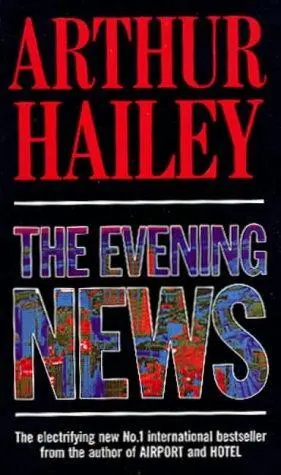
- Название:Evening News
- Автор:
- Жанр:
- Год:неизвестен
- ISBN:нет данных
- Рейтинг книги:3.5 / 5. Голосов: 2
-
Избранное:Добавить в избранное
- Отзывы:
-
Ваша оценка:
Evening News: краткое содержание, описание и аннотация
Предлагаем к чтению аннотацию, описание, краткое содержание или предисловие (зависит от того, что написал сам автор книги «Evening News»). Если вы не нашли необходимую информацию о книге — напишите в комментариях, мы постараемся отыскать её.
Evening News — читать онлайн бесплатно полную книгу (весь текст) целиком
Ниже представлен текст книги, разбитый по страницам. Система сохранения места последней прочитанной страницы, позволяет с удобством читать онлайн бесплатно книгу «Evening News», без необходимости каждый раз заново искать на чём Вы остановились. Поставьте закладку, и сможете в любой момент перейти на страницу, на которой закончили чтение.
Интервал:
Закладка:
Using a phone in his temporary private office, he ordered a CBA car and driver to meet him at the news building's main entrance.
* * *
"I'm grateful you came out, Harry,” Crawford Sloane said after Partridge made his report.”Will you go on air with this tomorrow?”
"I'm not sure.” Partridge described his reasoning both ways, adding, "I want to sleep on it.”
They were having drinks in the living room where, only four evenings earlier, Sloane thought sadly, he had sat talking with Jessica and Nicholas after his own return from work.
On Partridge's way in, an FBI agent had regarded him inquiringly. The agent was substituting that night for Otis Havelock who was at home with his family. But Sloane had firmly closed the door connecting with the outside hallway and the two newsmen talked in low voices.
”Whatever you decide,” Sloane said, "I'll back your judgment. Either way, do you have enough reason to take off for Colombia?”
Partridge shook his head.”Not yet, because Rodriguez is a gun-for-hire. He's operated all over Latin America, Europe too. So I need to know more—specifically, where this operation is based. Tomorrow I'll work the phones again. The others will do the same.”
One call in particular Partridge intended to make was to the lawyer for organized crime figures he had spoken to on Friday, but who hadn't yet called back. Instinct told him that anyone operating in the U.S. as Rodriguez appeared to have done would need an organized crime connection.
As Partridge was leaving, Sloane put his hand on the other's shoulder.”Harry, my friend,” he said, his voice emotional, "I've come to believe that the only —chance I have of getting Jessica, Nicky and my Dad back is through you.” He hesitated, then went on.”I guess there have been times when you and I weren't the closest companions, or even allies, and whatever's been my fault in that, I'm sorry. But apart from that, I just want you to know that most of what I have and care about in this world is riding on you.”
Partridge tried to find words to reply, but couldn't. Instead he nodded several times, touched Sloane on the shoulder too, and said, "Good night.”
* * *
"Where to, Mr. Partridge?” the CBA driver inquired.
It was close to midnight and Partridge answered tiredly, "The Inter-Continental Hotel, please.”
Leaning back in the car and remembering Sloane's parting words, Partridge thought that, yes, he did know what it meant to have lost, or face the chance of losing, someone you loved. In his own case, long ago, there had first been Jessica, though the circumstances then were in no way comparable to Crawf's desperate situation now. Then later there was Gemma . . .
He stopped. Not He would not let himself think of Gemma tonight. The remembrance of her had come back to him so much lately . . . it seemed to happen with tiredness . . . and always, along with memory, there was pain.
Instead, he forced his mind back to Crawf who, in circumstances equally dire as those affecting Jessica, was also suffering the loss of a child, his son. Partridge himself had never known what it was to have a child. Still, he knew that the loss of one must be unbearable, perhaps the most unbearable burden of all. He and Gemma had wanted children . . .
He sighed . . . Oh, dearest Gemma . . .
He gave in . . . relaxed as the smoothly moving car closed the distance to Manhattan . . . allowed his mind to drift.
* * *
For always, after that simple marriage ceremony in Panama City when he and Gemma stood before the municipal juez in his cotton guayabera and took their unpretentious vows, Partridge nursed a conviction that simple ceremonies produced the better marriages and flamboyant, ritzier circuses were more likely to be followed by divorce.
He admitted it was a prejudice, based heavily on his own experience. His first marriage, in Canada, had begun with a "white wedding” complete with bridesmaids, several hundred guests and incantations in a church—the bride's mother insisting on it all—and preceded by theatrical rehearsals which seemed to rob the ceremony itself of meaning. Afterward the marriage simply didn't work, something Partridge conceded to be at least fifty percent his fault, and the rhetorical pledge of "until death us do part” was—by mutual agreement, this time in court before a judge—shortened to a year.
The marriage to Gemma, however, from its unlikely beginning aboard the Pope's airplane, had strengthened as their love had grown. At no point in his life had Partridge ever been happier.
He continued to be the network's correspondent in Rome where foreign journalists were able, as a colleague working for CBS expressed it, "to live like kings.”Almost at once after returning from the papal flight Partridge and Gemma found an apartment in a sixteenth-century palazzo. Located midway between the Spanish Steps and the Trevi Fountain, it had eight rooms and three balconies. In those days, when networks consumed money as if there were no tomorrow, correspondents found their own accommodation and were reimbursed More recently, with leaner budgets and accountants in catbird seats, the network supplied living quarters—of lesser quality and cheaper.
As it was, on looking over what would be their first home, Gemma declared, "Harry, mio amore, it is heaven now. I will make it seven heavens for you.”And she did.
Gemma had a gift for imparting laughter and joy and love of living. As well, she ran the home proficiently and was a superb cook What she could not do, as Partridge quickly learned, was manage money or balance a checkbook. When Gemma wrote a check she often forgot to fill in a counterfoil, so the balance in their account was invariably less than she believed Coupled with that, even when she remembered the counterfoil her arithmetic was unreliable—she would sometimes add instead of subtract so that Gemma and the bank were constantly at odds.”Harry, tesoro,” she complained after one stern lecture from the manager, "bankers have no tenderness. They are . . . what is that English word?”
He said, amused, "How about pragmatic?”
"Oh, Harry, you have such a clever mind! Yes, “Gemma said decisively, "bankers are too pragmatic.”
Partridge found the solution easy. He simply took over their household finances, which seemed a small contribution in return for the many agreeable condiments now added to his life.
Another problem with Gemma required more delicate handling. She adored cars, owned a dilapidated Alfa Romeo and, like many other Italians, drove like a crazed fiend There were times when Partridge, seated beside her either in the Alfa or his own BMW, which she enjoyed driving too, closed his eyes, convinced that disaster was about to happen. Each time it didn't, he equated himself with a cat having lost one more of its nine lives.
He was down to four when he summoned the courage to ask Gemma if she would consider not driving anymore.”It's because I love you so much, “he assured her.”When I'm away I have nightmares, dreading something may happen with the car and you may be hurt when I get back.”
“But Harry, “Gemma protested, not understanding at all, "I am a safe, prudent driver.”
For the moment Partridge left it there, though managing to bring the subject up again from time to time, his revised strategy being that Gemma was indeed a safe driver but he himself was neurotically nervous. The best he could get, though, was a conditional promise.
”Mio amore, as soon as I am pregnant I will not drive a car. That I swear to you.”
It was a reminder of how much they both wanted children.”At least three, “Gemma announced soon after their marriage and Partridge saw no reason to disagree.
Meanwhile he traveled away from Rome periodically on CBA News assignments and, at the beginning, Gemma continued with her stewardess job. Very quickly, though, it became evident they would see little of each other that way because sometimes when Partridge returned from a trip Gemma would be flying; at others the reverse was true. It was Gemma who decided she would make the adjustment for them both by ceasing to fly.
Читать дальшеИнтервал:
Закладка:
Похожие книги на «Evening News»
Представляем Вашему вниманию похожие книги на «Evening News» списком для выбора. Мы отобрали схожую по названию и смыслу литературу в надежде предоставить читателям больше вариантов отыскать новые, интересные, ещё непрочитанные произведения.
Обсуждение, отзывы о книге «Evening News» и просто собственные мнения читателей. Оставьте ваши комментарии, напишите, что Вы думаете о произведении, его смысле или главных героях. Укажите что конкретно понравилось, а что нет, и почему Вы так считаете.