Arthur Hailey - Evening News
Здесь есть возможность читать онлайн «Arthur Hailey - Evening News» весь текст электронной книги совершенно бесплатно (целиком полную версию без сокращений). В некоторых случаях можно слушать аудио, скачать через торрент в формате fb2 и присутствует краткое содержание. Жанр: Современная проза, на английском языке. Описание произведения, (предисловие) а так же отзывы посетителей доступны на портале библиотеки ЛибКат.
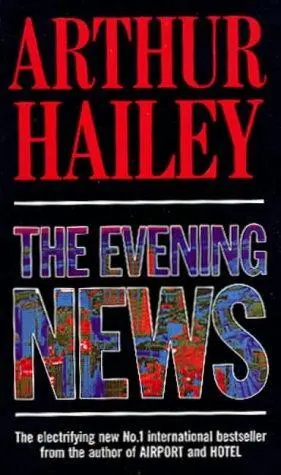
- Название:Evening News
- Автор:
- Жанр:
- Год:неизвестен
- ISBN:нет данных
- Рейтинг книги:3.5 / 5. Голосов: 2
-
Избранное:Добавить в избранное
- Отзывы:
-
Ваша оценка:
Evening News: краткое содержание, описание и аннотация
Предлагаем к чтению аннотацию, описание, краткое содержание или предисловие (зависит от того, что написал сам автор книги «Evening News»). Если вы не нашли необходимую информацию о книге — напишите в комментариях, мы постараемся отыскать её.
Evening News — читать онлайн бесплатно полную книгу (весь текст) целиком
Ниже представлен текст книги, разбитый по страницам. Система сохранения места последней прочитанной страницы, позволяет с удобством читать онлайн бесплатно книгу «Evening News», без необходимости каждый раз заново искать на чём Вы остановились. Поставьте закладку, и сможете в любой момент перейти на страницу, на которой закончили чтение.
Интервал:
Закладка:
He knew others in the hut were watching him—the three men and the woman who had been his passengers from Teterboro through Opa Locka to Sion. They too appeared to have been startled by his entry.
It was at that moment that the semiconscious woman on the ground stirred. She raised her head weakly. Looking directly at Underhill, her eyes came into focus and she moved her lips though no sound emerged. Then she managed to gasp, "Help . . . please help . . . tell someone . . .”Abruptly her eyes lost their focus, her head slumped forward.
From the far side of the hut a figure moved quickly toward Underhill. It was Miguel. With a Makarov nine-millimeter pistol in his hand, he motioned.”Out!”
Underhill moved ahead of Miguel and his gun to the jungle outside. There, Miguel said matter-of-factly, "I can kill you now. No one will care.”
A sense of numbness overwhelmed Underhill. He shrugged.”You've done me in anyway, you bastard. You've made me part of kidnapping those people, so whatever comes next won't make a helluva lot of difference.” His eyes dropped to the Makarov; the safety catch was off. Well, it figured, he thought. He had been in tight situations before and this looked like one he wouldn't get out of. He had known others like this thug Palacios—or whatever his real name was. A human life meant nothing to them, snuffing one out no more than spitting in the dust. He just hoped the guy would shoot straight. That way it should be quick and painless . . . Why hadn't he done it yet? . . . Suddenly, despite his reasoning, desperate fear seized Underhill. Though sweat still poured from him, he was shivering. He opened his mouth to plead, but saliva filled it and words failed him.
For some reason, he perceived, the man facing him with the gun was hesitating.
In fact, Miguel was calculating. If he killed one pilot, he would have to kill both, which meant the Learjet could not be flown out for the time being—a complication he could do without. He knew also that the airplane's Colombian owner had friends in the Medellin cartel. The owner could make trouble . . .
Miguel thumbed the safety on. He said menacingly, "Maybe you just thought you saw something. Maybe you didn't after all. Maybe, this whole journey, you saw nothing.”
Underhill's mind flashed a message: For a reason he didn't understand, he was being given a chance. He responded hastily, breathlessly, "That's right. Didn't see a goddamn thing.”
"Get the fucking airplane out of here,” Miguel snarled, "and afterward keep your mouth shut. If you don't, I promise wherever you are you'll be found and killed. Is that clear?”
Trembling with relief, knowing he had been closer to death than ever before in his life, and also that the closing threat was real, Underhill nodded.”It's clear.” Then he turned and walked back to the airstrip.
* * *
Morning mist and broken cloud hung over the jungle. The Learjet passed through it as they climbed. The ascending sun was blurry amid haze, the sign of a scorching, steamy day ahead for those left on the ground.
But Underhill, going through piloting motions automatically, was thinking only of what lay ahead.
He reasoned that Faulkner, seated beside him, hadn't seen the Sloane family captives and knew nothing of Underhill's involvement or what had happened just a few minutes ago. And they would keep it that way. Not only was there no need for Faulkner to be told now that there had been live, kidnapped people in those caskets they had carried, but if he weren't told, the copilot could swear later on that Underhill didn't know either.
That was the essential thing for Underhill to insist on whenever inquiry was made, as he was certain it would be: He didn't know. From beginning to end, he didn't know about the Sloanes.
Would he be believed? Perhaps not, but it didn't matter, he thought with growing confidence. It made no difference as long as there was no one who could prove the contrary.
He was reminded of the woman who had spoken to him. Her name was Jessica, he recalled from the reports. Would she remember seeing him? Could she identify him later? Considering her state, it was highly unlikely. It was also unlikely, the more he thought about it, that she would ever leave Peru alive.
He signaled for Faulkner to take over the flying. Leaning back in his seat, the hint of a smile crossed the senior pilot's face.
At no point did Underhill give any thought to a possible rescue of the Sloane family captives. Nor did he consider reporting to authorities who was holding them and where.
3
After less than three full days of investigation an important success had been achieved by the CBA News special task force.
In Larchmont, New York, an infamous Colombian terrorist, Ulises Rodriguez, had been positively identified as one of the kidnappers of the Sloane family trio and, perhaps, the leader of the kidnap gang.
On Sunday morning—as had been promised the preceding day—a copy of a charcoal sketch of Rodriguez, drawn twenty years earlier by a fellow student at the University of California at Berkeley, arrived at CBA News headquarters. Producer Karl Owens, who had uncovered Rodriguez's name through contacts in Bogota and U.S. Immigration, personally received the sketch and later took it to Larchmont. A camera crew and a hastily summoned New York correspondent accompanied him.
As the camera rolled, Owens had the correspondent show six photos to Priscilla Rhea, the retired schoolteacher who had witnessed the kidnap on the Grand Union parking lot. One photo was of the Rodriguez sketch, the other five had been taken from files and were of men of similar appearance. Miss Rhea pointed instantly to the Rodriguez picture.
”That's him. That's the one who shouted that they were making a movie. He's younger in the picture, but it's the same man. I'd know him anywhere.” She added, "When I saw him, it seemed he was in charge.”
At this point CBA News had the information exclusively.
(It was not, of course, known that Ulises Rodriguez was using the code name Miguel or that during the Learjet flight to Peru he employed the alias Pedro Palacios. But since a terrorist habitually used many names, this was not important.)
The discovery was discussed late Sunday at an informal session by four task force members—Harry Partridge, Rita Abrams, Karl Owens and Iris Everly, Owens, justly pleased by his breakthrough, urged that the new development be included in Monday's edition of the National Evening News.
When Partridge hesitated, Owens argued forcefully.
”Look, Harry, no one else has this yet. We're ahead of the whole pack. If we go on air tomorrow, everyone else will pick it up and have to give us credit which includes—even though we know they hate doing it—the New York Times and Washington Post. But if we hold off and wait too long, word about Rodriguez may get out and we'll lose our exclusive. You know as well as I do, people talk. There's the Rhea woman in Larchmont; she may tell someone and they'll pass it on. Even our own people blab, and there's a chance of someone at another network hearing.”
"I second all that,” Iris Everly said.”You're expecting me to do a follow-up tomorrow, Harry. Without Rodriguez, I have nothing new.”
"I know,” Partridge said.”I'm thinking about going with it, but there are also some reasons to wait. I won't make a decision until tomorrow.”
With that, the others had to be content.
One decision Partridge made privately was that Crawford Sloane must be informed of the fresh discovery. Crawf, he reasoned, was suffering such mental agony that any forward step, even though an inconclusive one, would come as a relief. Late as it was—nearing 10 P.m.—Partridge decided to visit Sloane himself. Obviously he could not telephone. All phone calls to Sloane's Larchmont house were being monitored by the FBI and Partridge was not ready yet to give the FBI the new information.
Читать дальшеИнтервал:
Закладка:
Похожие книги на «Evening News»
Представляем Вашему вниманию похожие книги на «Evening News» списком для выбора. Мы отобрали схожую по названию и смыслу литературу в надежде предоставить читателям больше вариантов отыскать новые, интересные, ещё непрочитанные произведения.


Обсуждение, отзывы о книге «Evening News» и просто собственные мнения читателей. Оставьте ваши комментарии, напишите, что Вы думаете о произведении, его смысле или главных героях. Укажите что конкретно понравилось, а что нет, и почему Вы так считаете.