Arthur Hailey - Evening News
Здесь есть возможность читать онлайн «Arthur Hailey - Evening News» весь текст электронной книги совершенно бесплатно (целиком полную версию без сокращений). В некоторых случаях можно слушать аудио, скачать через торрент в формате fb2 и присутствует краткое содержание. Жанр: Современная проза, на английском языке. Описание произведения, (предисловие) а так же отзывы посетителей доступны на портале библиотеки ЛибКат.
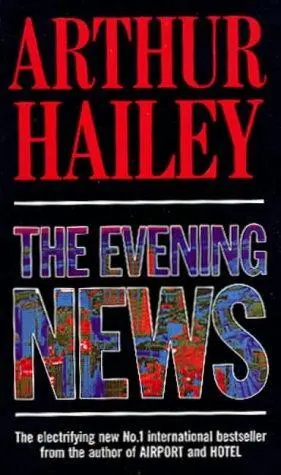
- Название:Evening News
- Автор:
- Жанр:
- Год:неизвестен
- ISBN:нет данных
- Рейтинг книги:3.5 / 5. Голосов: 2
-
Избранное:Добавить в избранное
- Отзывы:
-
Ваша оценка:
Evening News: краткое содержание, описание и аннотация
Предлагаем к чтению аннотацию, описание, краткое содержание или предисловие (зависит от того, что написал сам автор книги «Evening News»). Если вы не нашли необходимую информацию о книге — напишите в комментариях, мы постараемся отыскать её.
Evening News — читать онлайн бесплатно полную книгу (весь текст) целиком
Ниже представлен текст книги, разбитый по страницам. Система сохранения места последней прочитанной страницы, позволяет с удобством читать онлайн бесплатно книгу «Evening News», без необходимости каждый раз заново искать на чём Вы остановились. Поставьте закладку, и сможете в любой момент перейти на страницу, на которой закончили чтение.
Интервал:
Закладка:
As to their would—be sponsors, some could be brushed off easily by the TV executives so approached, but by no means all. Among the non-brushables were important advertisers or their agencies, members of CBA's board of directors, Washingtonians having clout at the White House or on Capitol Hill, other politicians whom it would be foolish to offend, important news sources, and many more.
In BUA days—the initials signifying "Before Uncle Arthur"—CBA executives would spend more time than they should making phone calls to one another about vacancies, then attempting to placate those whose sons/daughters, et al, simply could not be accommodated.
But not anymore. Arthur Nalesworth's assignment, created partly out of desperation by CBA News management, saved his colleagues all of that trouble.
Now, when confronted by a job applicant's sponsor, a CBA big shot could say, "Certainly I'll help. We have a special vice president to deal with bright young people. Tell your candidate to call this number, mention my name, and he (or she) will be given an appointment for an interview.”
The interview was always given, because Arthur Nalesworth, in the tiny, windowless office he had been assigned, interviewed everybody. There had never been so many job applicant interviews before and all were lengthy, lasting an hour, sometimes more. During the interview wide-ranging questions were asked and answered, confidences exchanged. At the end, the interviewee left feeling good about CBA even if no job resulted—as was mostly the case—and Nalesworth was left with a perceptive insight into the personality and potential of the young person he had faced across his desk.
At first the number of interviews and the time they took became a news department joke, with sardonic references to "time filling” and "empire building.” Also, because of Nalesworth's sympathetic encouragement of every applicant, promising or not, the description "Uncle Arthur”was coined and stuck. But gradually a grudging respect replaced the skepticism. It evolved still further when Uncle Arthur strongly urged employing certain young people who, when hired, moved quickly and successfully into the news department's mainstream. In time it became a source of pride, like possessing a diploma, to have been an Uncle Arthur choice.
Now, with Uncle Arthur in his sixty-fifth year and normal retirement only five months away, there was talk among the News Division brass of pleading with him not to go. Suddenly, to everyone's surprise, Arthur Nalesworth was important once again.
Thus, on a Sunday morning in the third week of September, Uncle Arthur arrived at CBA News headquarters to play his part in the search for Jessica, Nicholas and Angus Sloane. As instructed by Les Chippingham. on the telephone the night before, he came to the special task force conference room where Partridge, Rita and Teddy Cooper were on hand to greet him.
The man they met was broad-shouldered and stocky, of medium height, with a cherubic face and a full head of carefully brushed and parted silver hair. He had an assured, easy manner. Acknowledging that it was not a regular working day, instead of his usual dark suit Uncle Arthur wore a brown Harris tweed jacket, light gray slacks with a knife-edge crease, a bolo tie and highly polished brogues.
When Uncle Arthur spoke it was with a sonorous, almostChurchillian delivery. A former colleague once remarked that any opinion Arthur Nalesworth expressed was as if engraved on tablets of stone.
After shaking hands with Partridge and Rita and being introduced to Cooper, Uncle Arthur said, "I understand you need sixty of my brightest and best—if I can assemble that many at short notice. First, though, I suggest you tell me what's in the wind.”
"Teddy will do that,” Partridge said. He motioned to Cooper to begin.
Uncle Arthur listened while the British researcher described the attempts to identify the kidnappers and the apparent dead end now reached. Cooper then outlined his idea of searching through newspaper real estate advertising in an attempt to locate the headquarters the kidnappers might have used, based on his theory of their renting space within a twenty-five-mile radius of the crime scene.
Partridge added, "We know it's a long shot, Arthur, but at the moment it's the best we have.”
"My own experience,” Uncle Arthur replied, "is that when you have nothing whatever to proceed on, long shots are the way to go.”
"I'm glad you think so, sir,” Cooper said.
Uncle Arthur nodded.”A thing about long shots is that while you seldom find exactly what you're looking for, you're likely to stumble over something else that will help you in a different way.” He added, speaking to Cooper directly, "You'll also find, young man, that among the young people I'm about to call, some are dynamos, very much like yourself.”
Cooper accompanied Uncle Arthur to his small office where the older man spread files and index cards around until they covered the surface of his desk. He then began telephoning—a steady procession of calls having a common pattern, though each sounding personal and as if a familiar friend were on the line.
”. . . Well, Ian, you said you wanted an opportunity to get into this business, no matter how modest, and one has just come up.” . . .”No, Bernard, I cannot guarantee that two weeks' work will lead to something permanent, but why not take a chance? .. . . . .. Quite so, Pamela, I agree this temporary job isn't much for a journalism major. Remember, though, that some of broadcasting's biggest names began as gofers.” . . .”Yes, Howard, you're right in saying five dollars fifty cents an hour is not a bountiful wage. But if money's your main concern, forget a news career and head for Wall Street.” . . .”Felix, I do understand the timing may not be convenient; it seldom is. If you wish to be a TV news person you'll have to walk out, if necessary, on your wife's birthday party ... . . .”Don't lose sight of the fact, Erskine, that you'll be able to put on your r6sum6 you did a special job for CBA.”
At the end of an hour Uncle Arthur had made twelve calls resulting in seven "sures” who would report for work the following day, plus one probable. He continued to work patiently through his lists.
One call made outside his lists by Uncle Arthur was to his long-time friend Professor Kenneth K. Goldstein, associate dean of the Columbia School of Journalism. When the CBA network problem was explained, the educator was instantly sympathetic and helpful.
While both men knew that heavy scholastic pressures made the involvement of undergraduate students impossible, some graduate students working on master's degrees in journalism would likely be interested and available. So might other recent graduates who had not yet found employment.
”What we'll do here,” the associate dean said, "is rate this an emergency. I'll do my best to come up with a dozen or so names and will be back to you later.”
"Columbia forever!” Uncle Arthur affirmed, then continued with other phoning.
Teddy Cooper, meanwhile, returned to the conference room to prepare a task plan for the temporary workers who would arrive the next day. His two assistant researchers had come in to help and together they pored over Editor and Publisher International Year Book, local maps and phone directories, selecting libraries and newspaper offices to be visited and routes and schedules to be followed.
At the same time Cooper drew up specifications to guide the young recruits who would sift through three months of classified advertising in some one hundred and sixty newspapers. What would they look for?
As well as the proviso of being within twenty-five miles of Larchmont, Cooper envisaged:
A relatively lonely location with little other activity around. The people being sought would want privacy, also the ability to come and go without arousing curiosity. Any house or premises in a busy or densely populated location should be discounted.
Читать дальшеИнтервал:
Закладка:
Похожие книги на «Evening News»
Представляем Вашему вниманию похожие книги на «Evening News» списком для выбора. Мы отобрали схожую по названию и смыслу литературу в надежде предоставить читателям больше вариантов отыскать новые, интересные, ещё непрочитанные произведения.







Обсуждение, отзывы о книге «Evening News» и просто собственные мнения читателей. Оставьте ваши комментарии, напишите, что Вы думаете о произведении, его смысле или главных героях. Укажите что конкретно понравилось, а что нет, и почему Вы так считаете.