Arthur Hailey - Evening News
Здесь есть возможность читать онлайн «Arthur Hailey - Evening News» весь текст электронной книги совершенно бесплатно (целиком полную версию без сокращений). В некоторых случаях можно слушать аудио, скачать через торрент в формате fb2 и присутствует краткое содержание. Жанр: Современная проза, на английском языке. Описание произведения, (предисловие) а так же отзывы посетителей доступны на портале библиотеки ЛибКат.
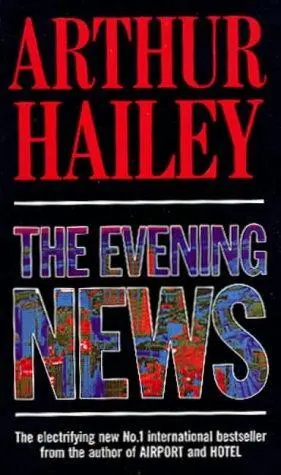
- Название:Evening News
- Автор:
- Жанр:
- Год:неизвестен
- ISBN:нет данных
- Рейтинг книги:3.5 / 5. Голосов: 2
-
Избранное:Добавить в избранное
- Отзывы:
-
Ваша оценка:
Evening News: краткое содержание, описание и аннотация
Предлагаем к чтению аннотацию, описание, краткое содержание или предисловие (зависит от того, что написал сам автор книги «Evening News»). Если вы не нашли необходимую информацию о книге — напишите в комментариях, мы постараемся отыскать её.
Evening News — читать онлайн бесплатно полную книгу (весь текст) целиком
Ниже представлен текст книги, разбитый по страницам. Система сохранения места последней прочитанной страницы, позволяет с удобством читать онлайн бесплатно книгу «Evening News», без необходимости каждый раз заново искать на чём Вы остановились. Поставьте закладку, и сможете в любой момент перейти на страницу, на которой закончили чтение.
Интервал:
Закладка:
With careful foresight Miguel had obtained all the needed documents; they were forgeries, but good ones. Supplementary were the gory traffic accident photographs, unidentified but fitting the general story, also the bogus press clippings, the latter stating that the bodies were so badly burned and mangled as to be unrecognizable.
So if a Customs man was on duty at Opa Locka and came their way, all papers were in order, but would he insist on looking into the caskets? Equally to the point, having read the descriptions, would he want to?
Once more Miguel felt himself tense as the Learjet landed smoothly and taxied in to Hangar One.
* * *
Customs Inspector Wally Amsler figured that some game plan—happy bureaucrat in Washington must have dreamed up Operation Egress. Whoever it was, he (or maybe she) was probably in bed and asleep by now, which was where Wally would prefer to be instead of wandering around this godforsaken Opa Locka Airport, which was off the beaten track in daytime and lonely as hell at night. It was half an hour before midnight and there were two more hours after that before he and the other two Customs guys on special duty here could put Egress behind them and go home.
The grouchiness was unusual for Amsler who was basically cheerful and friendly, except to those who broke the laws he upheld. Then he could be cool and tough, his sense of duty inflexible. Mostly he liked his work, though he had never cared for night duty and avoided it whenever possible. But a week ago he had had a bout with flu and still didn't feel good; earlier tonight he had considered calling in sick, though he decided not to. And something else had been distressing him lately—his status in the Customs Service.
Despite doing his job conscientiously for more than twenty years, he hadn't advanced to where he believed he should have been by his present age, a few months short of fifty. His status was Inspector, GS-9, which was really a journeyman grade, no more. There were plenty of others younger than himself and with far less experience who were already Senior Inspectors, GS- 11. Amsler took orders from them.
He had always assumed that someday he would move up to Senior Inspector but now, being realistic, he knew his chances were remote. Was that fair? He wasn't sure. His record was good and he had always put duty to the Service above other considerations, including some personal ones. At the same time, he had never pushed hard to become a leader and nothing he had done in line of duty was spectacular; perhaps that had been the problem. Of course, even as a GS-9, the pay wasn't bad. With overtime, working a six-day week, he earned about $50,000 a year and there would be a good pension in another fifteen years.
But pay and pension weren't, by themselves, enough. He needed to activate his life, to do something by which, even in a modest way, he would be remembered. He wished it would happen and he felt he deserved it. But at Opa Locka, late at night and working Operation Egress, it wasn't likely to.
Egress was a program involving the random inspection of aircraft about to depart the United States for other countries.
There was no way all of them could be checked; Customs didn't have the staff. So a blitz-type operation was used in which a team of inspectors descended on an airport unannounced and for the next several hours boarded foreign—destined flights—mostly private planes. The program was often in effect at night.
Officially the objective was to search for high-tech equipment being exported illegally. Unofficially, Customs was also looking for currency in excess of authorized amounts, particularly large sums of drug money. The latter motive had to be unofficial because legally, under the Fourth Amendment, there could be no search for money without "probable cause.” However, if a lot of money was discovered during another type of search, Customs had the right to deal with it.
Sometimes Egress produced results—occasionally sensational. But nothing of that kind had happened when Amsler was around, a reason he wasn't enthusiastic about the program. Just the same, Egress was why he and two other inspectors were at Opa Locka tonight, though outbound foreign flights had been fewer than usual and it seemed unlikely there would be many more.
One of the few was preparing to leave shortly—a Learjet that had arrived from Teterboro and, a few minutes ago, filed a flight plan for Bogota, Colombia. Amsler was now on his way to Hangar One to take a look at it.
* * *
In contrast to most of southern Florida, the small town of Opa Locka was an unattractive place. Its name derived from a Seminole Indian word, opatishawockalocka , meaning "high, dry hummock.” The description fitted, as did a more recent one by author T. D. Allman who described Opa Locka as an impoverished "ghetto” appearing like "a long-abandoned and vandalized amusement park.” The adjoining airport, though busy, had few buildings, and the area's overall dry flatness—on top of that natural hummock—conveyed the impression of a desert.
Amid that desert, Hangar One was an oasis.
It was a modem, attractive white building, only part of which was a hangar, the whole comprising a luxury terminal catering to private aircraft, their passengers and pilots.
Seventy people worked at Hangar One, their duties ranging from vacuuming incoming planes' interiors and disposing of their trash, through restocking galleys with meals and beverages, to mechanical maintenance—minor repairs or a major overhaul. Other staffers tended to VIP lounges, showers, and a conference room equipped with audiovisual, fax, telex and copying aids.
Across an almost but not quite invisible dividing line, similar facilities existed for pilots, plus a comprehensive flight planning area. It was in that area that Customs Inspector Wally Amsler approached the Learjet pilot, Underhill, who was studying a printout of weather data.
”Good evening, Captain. I believe you're scheduled out for Bogota.”
Underhill looked up, not entirely surprised at the sight of the uniform.”That's right.”
In fact, both his answer and the flight plan were lies. The Learjet's destination was a dirt landing strip in the Andes near Sion in Peru and the flight there would be nonstop. But the exacting instructions Underhill had been given, and for which the pay would be munificent, specified that his departure data should show Bogota. In any case, it didn't matter. As soon as he had shed U.S. Air Traffic Control, shortly after takeoff, he could fly anywhere he chose and no one would check or care.
”If you don't mind,” Amsler said politely, "I'd like to inspect your ship and your people aboard.”
Underhill did mind, but knew it would do no good to say so. He only hoped that his oddball quartet of passengers could satisfy this Customs guy sufficiently to have him clear the airplane and let the flight get on its way. He was uneasy, all the same, not for the passengers but about his own potential involvement with whatever was going on.
There was something unusual, possibly illegal, about those caskets, Denis Underhill suspected. His best guess was that either they contained items other than bodies, being smuggled out of the country, or, if bodies, they were victims of some kind of Colombian-Peruvian gang war and were being removed before U.S. authorities realized it. Not for a moment did he believe the story told to him at the time the charter was arranged in Bogota, about accident victims and a grieving family. If that was true, why all the cloak-and-dagger secrecy? Added to that, Underhill was sure at least two of those people aboard the Lear were armed. Why, also, the obvious attempt to avoid what had now happened—an encounter with U.S. Customs?
Though Underhill didn't own the Learjet—it belonged to a wealthy Colombian investor and was registered in that country —he managed it, and along with salary and expenses received a generous share of profits. He was certain his employer knew that comers were sometimes cut with charters that were either downright illegal or on the borderline, but the man trusted Underhill to handle such situations and keep his investment and his airplane out of jeopardy.
Читать дальшеИнтервал:
Закладка:
Похожие книги на «Evening News»
Представляем Вашему вниманию похожие книги на «Evening News» списком для выбора. Мы отобрали схожую по названию и смыслу литературу в надежде предоставить читателям больше вариантов отыскать новые, интересные, ещё непрочитанные произведения.







Обсуждение, отзывы о книге «Evening News» и просто собственные мнения читателей. Оставьте ваши комментарии, напишите, что Вы думаете о произведении, его смысле или главных героях. Укажите что конкретно понравилось, а что нет, и почему Вы так считаете.