Arthur Hailey - Evening News
Здесь есть возможность читать онлайн «Arthur Hailey - Evening News» весь текст электронной книги совершенно бесплатно (целиком полную версию без сокращений). В некоторых случаях можно слушать аудио, скачать через торрент в формате fb2 и присутствует краткое содержание. Жанр: Современная проза, на английском языке. Описание произведения, (предисловие) а так же отзывы посетителей доступны на портале библиотеки ЛибКат.
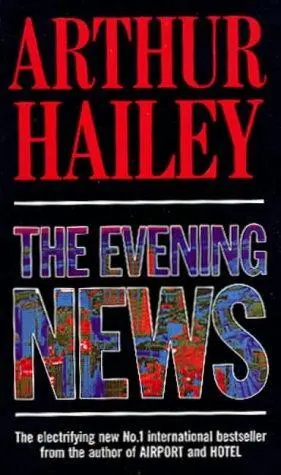
- Название:Evening News
- Автор:
- Жанр:
- Год:неизвестен
- ISBN:нет данных
- Рейтинг книги:3.5 / 5. Голосов: 2
-
Избранное:Добавить в избранное
- Отзывы:
-
Ваша оценка:
Evening News: краткое содержание, описание и аннотация
Предлагаем к чтению аннотацию, описание, краткое содержание или предисловие (зависит от того, что написал сам автор книги «Evening News»). Если вы не нашли необходимую информацию о книге — напишите в комментариях, мы постараемся отыскать её.
Evening News — читать онлайн бесплатно полную книгу (весь текст) целиком
Ниже представлен текст книги, разбитый по страницам. Система сохранения места последней прочитанной страницы, позволяет с удобством читать онлайн бесплатно книгу «Evening News», без необходимости каждый раз заново искать на чём Вы остановились. Поставьте закладку, и сможете в любой момент перейти на страницу, на которой закончили чтение.
Интервал:
Закладка:
As he had before, he liked what he saw.
Rita, a natural brunette, began dying her hair in her early thirties when a few gray strands appeared. But after changing her job and image from correspondent to producer, she let nature have its way and now her hair was an attractive mixture of dark brown and silver. Her figure, too, had matured and she carried an extra ten pounds over an earlier sleek hundred and twenty.”You could say,” she told Les on the first occasion he had viewed her nude, "that I went from Aphrodite to a comfortable Venus.”
"I'll take your Venus,” he had said.
Either way, Rita's five-foot-six body was in excellent shape, the hips well rounded, breasts high and firm.
As her eyes dropped, she knew Les needed no further arousal. Yet he came to her slowly, bending down to kiss her forehead, her eyelids and her mouth. Then, gently cupping his hands around her breasts, he drew the nipples, each in turn, into his mouth. A quiver of bliss ran through her as she felt them harden.
Breathing deeply, each movement of her body a growing delight, Rita's hands reached down to Les's groin, moving her fingers gently, slowly, her touch feather—light, experienced. She felt his whole body stiffen, heard the sharp intake of his breath and a soft low sigh of pleasure.
Gently, Chippingham. pushed her down on the bed, his hands and tongue continuing to explore the sweet, warm wetness of her body. When neither could wait any longer, he slid inside her. Rita cried out, then moments later soared to a final, glorious peak.
Rita floated for a while, savoring the lazy moments until her ever-active mind posed questions. Each time, their lovemaking was so smooth, so perfect, so experienced, that she wondered: Was it always like this for the women who had sex with Les? She supposed it must be. He had a way of handling a woman's body that had given Rita—and probably all the others —an undiluted ecstasy. And Rita's own excitement undoubtedly enhanced his own. Only after her exquisite climax—and how wonderful not to have to fake or strain toward it!—did he, too, explode within her.
Later, bodies damp, sweat mingling in its own sweet union, they lay side by side breathing deeply, evenly.
”Leslie Chippingham,” Rita said, "has anyone told you you're the world's most perfect lover?”
He laughed, then kissed her.”Loving is poetry. Poetry feeds on inspiration. At this moment, you are mine.”
"You're good with words, too,” she told him.”Maybe you should be in the news business.”
After a while they slept, then, awakening, made love again.
* * *
Eventually, inevitably, Chippingham and Rita turned from sex to the pile of Sunday papers which Les had stopped to buy. They spread them on the bed and he started with the Times, Rita the Post.
Both devoured the latest developments from the Sloane family kidnap, emphasis being on Saturday morning's explosion at White Plains in the vehicle the kidnappers had used, and the resulting devastation. From a professional viewpoint, Rita was pleased to see that CBA News had missed nothing major in its Saturday evening coverage. While the print press had longer stories with more reactions, the essentials were the same.
From the kidnap, Rita and Les moved on to major national and international stories to which they had paid less than usual attention in the past few days. Neither spent any time reading, and scarcely noticed, a single-column report appearing only in the Post and buried on an inside page.
UN DIPLOMAT
SLAYS LOVER, AND SELF
IN JEALOUS RAGE
A United Nations diplomat, Jose Antonio Salaverry, and his woman friend, Helga Efferen, were found shot dead Saturday in Salaverry's 48th St. apartment. Police describe the shootings as "a jealous lover's murder-suicide.”
Salaverry was a member of the Peruvian delegation to the UN. Efferen, an American citizen, formerly a Lebanese immigrant, was employed by the American-Amazonas Bank at its Dag Hammarskjold Plaza branch.
The bodies of the dead couple were discovered early Saturday by a janitor. A medical examiner fixed the time of death between 8 and 11 p.m. the previous day. Substantial evidence, police say, points to the discovery by Salaverry that Efferen was using his apartment as a base for her sexual affairs with other men. Enraged, he shot her, then himself.
16
With the grace of a gull the Learjet 55LR descended through the night, its powerful engines momentarily curbed. It settled toward two parallel strands of lights ahead, marking runway one-eight of Opa Locka Airport. Beyond the airport were the myriad lights of Greater Miami, their reflection a vast halo in the sky.
From his seat in the passenger cabin Miguel peered through a window, hoping that America's lights and all they represented would be behind him soon.
He checked his watch. 11: 18 P.m. The flight from Teterboro had taken slightly more than two and a quarter hours.
Rafael, in the seat ahead, was watching the approaching lights. Socorro, beside him, appeared to be dozing.
Miguel turned his head toward Baudelio who, a few feet away, was continuing to monitor the three caskets, using the external equipment he had fastened to them. Baudelio nodded, indicating all was well, and Miguel turned his mind to another potential problem which had just arisen.
A few minutes earlier he had gone forward to the flight deck and asked, "At Opa Locka, how quickly can you do what's needed and get us on our way?”
"Shouldn't take more than half an hour,” the pilot, Underhill, had said.”All we have to do is refuel and file a flight plan.”He hesitated, then added, "Though if Customs decide to take a look at us, it could be longer.”
Miguel said sharply, "We don't have to clear Customs here.”
The pilot nodded.”Normally true; they don't bother with outgoing flights. Lately, though, I've heard they've been making occasional checks, sometimes at night.” Though attempting to sound casual, his voice betrayed concern.
Miguel was jolted by the information. His own and the Medellin cartel's intelligence about the rules and habits of U.S. Customs was the reason Opa Locka had been chosen as the airport of departure.
Like Teterboro, Florida's Opa Locka was used by private aircraft only. Because of incoming flights from overseas, it had a U.S. Customs office—a small, makeshift affair housed in a trailer, with a correspondingly small staff. Compared with Customs departments at important international airports like Miami, New York, Los Angeles or San Francisco, Opa Locka was a poor relation, obliged to use less exacting procedures than elsewhere. Usually no more than two Customs officers were on duty, and even then only from 11 A.M. to 7 P.m. on weekdays and 10 A.M. to 6 P.m. Sundays. The present Learjet journey had been scheduled on the assumption that by this late hour Customs would be closed, the staff long gone.
Underhill added, "If anyone's in Customs and their airport radio is on, they'll hear us talking with the tower. After that, they may be interested in us, maybe not.”
Miguel realized there was nothing he could do except go back to his seat and wait. When he was there he mentally ran over possibilities.
If they did encounter U.S. Customs tonight, unlikely as it seemed, the cover story was in place and they could use it. Socorro, Rafael and Baudelio would play their parts, Miguel his. Baudelio could quickly disconnect his controls connected to the caskets. No, the problem was not with the cover story and all that supported it, but with the rules a Customs inspector was supposed to follow when a dead body left the country.
Miguel had studied the official regulations and knew them by heart. Specific papers were required for each body—a death certificate, a permit of disposition from a county health department, an entry permit from the country of destination. The dead person's passport was not needed, but—most critically—a casket must be opened, its contents inspected by a Customs officer, then the casket sealed.
Читать дальшеИнтервал:
Закладка:
Похожие книги на «Evening News»
Представляем Вашему вниманию похожие книги на «Evening News» списком для выбора. Мы отобрали схожую по названию и смыслу литературу в надежде предоставить читателям больше вариантов отыскать новые, интересные, ещё непрочитанные произведения.








Обсуждение, отзывы о книге «Evening News» и просто собственные мнения читателей. Оставьте ваши комментарии, напишите, что Вы думаете о произведении, его смысле или главных героях. Укажите что конкретно понравилось, а что нет, и почему Вы так считаете.