Ben Marcus - Leaving the Sea - Stories
Здесь есть возможность читать онлайн «Ben Marcus - Leaving the Sea - Stories» весь текст электронной книги совершенно бесплатно (целиком полную версию без сокращений). В некоторых случаях можно слушать аудио, скачать через торрент в формате fb2 и присутствует краткое содержание. Город: New York, Год выпуска: 2014, ISBN: 2014, Издательство: Borzoi Books, Жанр: Современная проза, на английском языке. Описание произведения, (предисловие) а так же отзывы посетителей доступны на портале библиотеки ЛибКат.
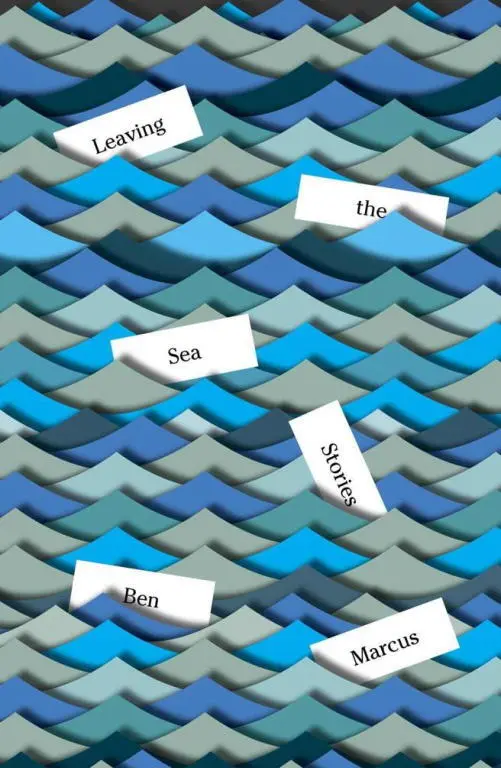
- Название:Leaving the Sea: Stories
- Автор:
- Издательство:Borzoi Books
- Жанр:
- Год:2014
- Город:New York
- ISBN:9780307379382
- Рейтинг книги:4 / 5. Голосов: 1
-
Избранное:Добавить в избранное
- Отзывы:
-
Ваша оценка:
Leaving the Sea: Stories: краткое содержание, описание и аннотация
Предлагаем к чтению аннотацию, описание, краткое содержание или предисловие (зависит от того, что написал сам автор книги «Leaving the Sea: Stories»). Если вы не нашли необходимую информацию о книге — напишите в комментариях, мы постараемся отыскать её.
In the hilarious, lacerating “I Can Say Many Nice Things,” a washed-up writer toying with infidelity leads a creative writing workshop on board a cruise ship. In the dystopian “Rollingwood,” a divorced father struggles to take care of his ill infant, as his ex-wife and colleagues try to render him irrelevant. In “Watching Mysteries with My Mother,” a son meditates on his mother’s mortality, hoping to stave off her death for as long as he sits by her side. And in the title story, told in a single breathtaking sentence, we watch as the narrator’s marriage and his sanity unravel, drawing him to the brink of suicide.
As the collection progresses, we move from more traditional narratives into the experimental work that has made Ben Marcus a groundbreaking master of the short form. In these otherworldly landscapes, characters resort to extreme survival strategies to navigate the terrors of adulthood, one opting to live in a lightless cave and another methodically setting out to recover total childhood innocence; an automaton discovers love and has to reinvent language to accommodate it; filial loyalty is seen as a dangerous weakness that must be drilled away; and the distance from a cubicle to the office coffee cart is refigured as an existential wasteland, requiring heroic effort.
In these piercing, brilliantly observed investigations into human vulnerability and failure, it is often the most absurd and alien predicaments that capture the deepest truths. Surreal and tender, terrifying and life-affirming,
is the work of an utterly unique writer at the height of his powers.
Leaving the Sea: Stories — читать онлайн бесплатно полную книгу (весь текст) целиком
Ниже представлен текст книги, разбитый по страницам. Система сохранения места последней прочитанной страницы, позволяет с удобством читать онлайн бесплатно книгу «Leaving the Sea: Stories», без необходимости каждый раз заново искать на чём Вы остановились. Поставьте закладку, и сможете в любой момент перейти на страницу, на которой закончили чтение.
Интервал:
Закладка:
My mother, if she were able, would attend my bed, and possibly even urge me to fight for my life, although I cannot picture her issuing such a command without laughing. It is her stated idea that many things we know and say and feel are ridiculous. I would think that by the time I am in my hospital bed being urged to fight for my life, my mother will be dead. She will have already fought for her life and lost. But now, on the brink of death herself, though not today, I don’t think, I fear my mother is similarly in the dark. If I asked her to fight for her life, assuming a calamity brought her to the hospital, she might politely agree, if she could even speak, but to herself she would be forced to admit that she could not carry out such an action. The technique is beyond her. It has been beyond everyone in our family. None of us possess the skill to fight for our lives. One by one we pass away. If the known people of the world were ranked according to their ability to fight for their lives, my family would not score well.
I will hold my mother’s hand and ask her to please hang on. She will want to please me because she has always wanted to please me, and so she will agree to fight for her life, to please me, but when it comes to actually fighting for her life she will be baffled. She will have spent her entire life having no control whatsoever of what happens inside her body, with her blood and cells and bones, not to mention the organs and nerves, and now, eighty-six years into this seasoned indifference, allowing the insides of her body to conduct their own affairs, she will be urged to suddenly pay attention and control her body to such a degree that it does not die. How could anyone ask this of a frail old woman?
In the nature films the behavior is clear. When their lives are threatened, animals shoot through the grass, faster than they’ve ever run before, sometimes shitting out of fright, or they turn and crouch, meet the attack. When they fight for their lives there is compelling evidence, whereas people are meant to fight for their lives without moving, without showing the slightest effort. A strictly internal struggle, not even detectable by medical machinery.
The scullery maid often has a confidant. The confidant might be a beautiful homosexual man, who has his own tricks to play. Someone on the staff has access to the secrets of the wealthy family they work for but at the same time feels too much allegiance to betray them.
I must wonder if I am terribly wrong to think my mother will not die today.
Someone who could easily address the question of odds is my father. He was a statistician by profession. A probablist is the official term. The question regarding the odds of my mother dying today would be an elementary one for my father and his colleagues, most of whom came from India. A fertile country for mathematicians, my father reportedly said. Or, perhaps, only for probablists. My father passed away, so he cannot address the question, and I cannot refer to my father’s publications, some of which I have here with me, because they do not treat matters as elementary as these.
My mother’s odds of dying increase every moment of her life. Right now, sleeping in her bed, she has never in her entire life been in greater danger of dying. So it would seem to me that I shouldn’t be so secure in thinking she will not die today, not that I am particularly secure anymore, if only because it is more likely than ever that she will die right now. This statement, whenever I make it, will be true for the rest of her life. It will be true even if I do not make it. Even if I do not think this thought—that the danger my mother faces has never been greater—it will be true, which suggests to me that there are then likely many more thoughts I have not had, some of which are true. Many more. A tally of the thoughts I have not had would be impossible. Surely some of these thoughts I have failed to think bear down directly on the matter of my mother’s life and death. Of the many things I have failed to think, and within that category those thoughts that are also true, which of them, if only I could think them now, would reveal to me more about my mother and her prospects for survival today?
And, if I should not be secure in thinking that my mother won’t die today, it occurs to me that I would do well to return to her now, so that I might enjoy her company for her last moments alive.
You see, I aim to do what is right with regards to my mother and her last living days.
I need to consider this more carefully, though. By this reasoning, I would never be able to part from my mother again, since whenever I left her I would be doing so at the direst moment in her life when she was more likely than ever to pass away. This will be true, assuming my mother lives through the night, whenever I see her again. I would say good night, wish her well, and depart knowing that her risk of death was increasing while I walked away, while I left her apartment building, nodding to the doorman, and then walked the quiet side street to the busier avenue where the taxis gather. It would be difficult not to wonder at such times what kind of son walks away when his mother is in ever-greater danger of dying. Who does that? Kisses an old woman at her door, his own mother, knowing the whole time that she has never been in more danger?
It would appear that I do that. Every time I have left her, I have done that. If she lives through the night, I will do it again, take my leave knowing that even though yesterday her risk of dying was terribly high, today it has grown worse. It worsens as we speak, and still I must say good-bye to her as if I don’t care that she is in increasing danger of dying.
I did it to her as a child, too. I said good-bye and went to school. I said good-bye and went to camp. I said good-bye on a Saturday morning and who knows when I came home. When I did this, I left my mother dying. In doorways, in kitchens, in living rooms, on lawns. Sometimes even when she was sick with a cold in bed, I said good-bye from the bottom of the stairs, just as her chances of dying had peaked. I said good-bye and went to college, when she was even more likely to die. And when I came home to visit, it wasn’t long before I departed again, leaving her to die. Just as tonight, after watching a mystery on PBS, I said good night to my mother and left her at home to die.
We speak of having one foot in the grave, but we do not speak of having both feet and both legs and then one’s entire torso, arms, and head in the grave, inside a coffin, which is covered in dirt, upon which is planted a pretty little stone.
The castle is always the same castle. Despite the mystery, despite the show, despite the cast, despite hundreds of years spanning different periods of time, it is always the same castle. A castle acquired for this purpose, perhaps, rented out to anyone needing to make a British mystery. Once there were real people living real lives in this castle, just as we, living in our own homes, consider ourselves real, with real lives. And if we consider that one day our own homes, as with the castle, will be used exclusively for the filming of television shows about people much like ourselves, it gives us a certain feeling about the destiny of our homes, where people hired to portray us will scamper about reciting sentences to each other, while off-camera the contemporary men and women, with up-to-date perspectives on life, devour unimaginable snacks and laugh at what simple, blind fools we must have been.
It is not untoward to believe that at some other location, so many years from now, an old woman and her only son will sit and watch this television show, or whatever it is called then, enjoying their dinner, not saying much, one of them sleeping, the other one looking on, waiting for her to wake up and declare something wonderful.
Читать дальшеИнтервал:
Закладка:
Похожие книги на «Leaving the Sea: Stories»
Представляем Вашему вниманию похожие книги на «Leaving the Sea: Stories» списком для выбора. Мы отобрали схожую по названию и смыслу литературу в надежде предоставить читателям больше вариантов отыскать новые, интересные, ещё непрочитанные произведения.


Обсуждение, отзывы о книге «Leaving the Sea: Stories» и просто собственные мнения читателей. Оставьте ваши комментарии, напишите, что Вы думаете о произведении, его смысле или главных героях. Укажите что конкретно понравилось, а что нет, и почему Вы так считаете.