Ben Marcus - Leaving the Sea - Stories
Здесь есть возможность читать онлайн «Ben Marcus - Leaving the Sea - Stories» весь текст электронной книги совершенно бесплатно (целиком полную версию без сокращений). В некоторых случаях можно слушать аудио, скачать через торрент в формате fb2 и присутствует краткое содержание. Город: New York, Год выпуска: 2014, ISBN: 2014, Издательство: Borzoi Books, Жанр: Современная проза, на английском языке. Описание произведения, (предисловие) а так же отзывы посетителей доступны на портале библиотеки ЛибКат.
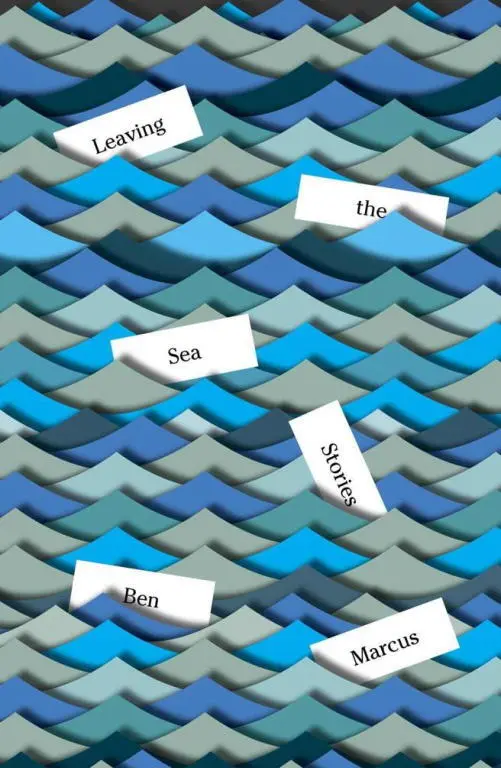
- Название:Leaving the Sea: Stories
- Автор:
- Издательство:Borzoi Books
- Жанр:
- Год:2014
- Город:New York
- ISBN:9780307379382
- Рейтинг книги:4 / 5. Голосов: 1
-
Избранное:Добавить в избранное
- Отзывы:
-
Ваша оценка:
Leaving the Sea: Stories: краткое содержание, описание и аннотация
Предлагаем к чтению аннотацию, описание, краткое содержание или предисловие (зависит от того, что написал сам автор книги «Leaving the Sea: Stories»). Если вы не нашли необходимую информацию о книге — напишите в комментариях, мы постараемся отыскать её.
In the hilarious, lacerating “I Can Say Many Nice Things,” a washed-up writer toying with infidelity leads a creative writing workshop on board a cruise ship. In the dystopian “Rollingwood,” a divorced father struggles to take care of his ill infant, as his ex-wife and colleagues try to render him irrelevant. In “Watching Mysteries with My Mother,” a son meditates on his mother’s mortality, hoping to stave off her death for as long as he sits by her side. And in the title story, told in a single breathtaking sentence, we watch as the narrator’s marriage and his sanity unravel, drawing him to the brink of suicide.
As the collection progresses, we move from more traditional narratives into the experimental work that has made Ben Marcus a groundbreaking master of the short form. In these otherworldly landscapes, characters resort to extreme survival strategies to navigate the terrors of adulthood, one opting to live in a lightless cave and another methodically setting out to recover total childhood innocence; an automaton discovers love and has to reinvent language to accommodate it; filial loyalty is seen as a dangerous weakness that must be drilled away; and the distance from a cubicle to the office coffee cart is refigured as an existential wasteland, requiring heroic effort.
In these piercing, brilliantly observed investigations into human vulnerability and failure, it is often the most absurd and alien predicaments that capture the deepest truths. Surreal and tender, terrifying and life-affirming,
is the work of an utterly unique writer at the height of his powers.
Leaving the Sea: Stories — читать онлайн бесплатно полную книгу (весь текст) целиком
Ниже представлен текст книги, разбитый по страницам. Система сохранения места последней прочитанной страницы, позволяет с удобством читать онлайн бесплатно книгу «Leaving the Sea: Stories», без необходимости каждый раз заново искать на чём Вы остановились. Поставьте закладку, и сможете в любой момент перейти на страницу, на которой закончили чтение.
Интервал:
Закладка:
—But you have destroyed an unprecedented number of families.
—I don’t destroy anything. I do question the term limits of parents, and I’m not the first to promote child-driven power reversals. We have to remember how much thought Benner-Louis put into this subject, and how resonant her geological metaphors were. If prodding an object for flaws causes a momentarily resolved family to unravel, then what you’re saying is that we should stay silent and paralyzed, the classic demand placed upon children. It is not my problem that families are hurt when we notice how they have hardened into stone, how they stoke each other’s failure instinct, and if Matures are not powerful enough to admit a stagnation, they are welcome to blame me, but that’s merely evasive. I give choices to children, and I supply functional tunnels to those who have yet to become children. This is mapping as Parsons envisioned it: you don’t map a route that has been spoiled by the progress of others. Adulthood looks like an exhaustion farm. Who would knowingly purchase a ticket to that? In my work, I re-child certain people who have presumed a premature adulthood, and, most importantly, I question adulthood as a retreat from the power of infancy. I’m a supplier.
—Which brings us to Maryland.
—My tantrum work is still being fine-tuned, but you could reference an entire series of Chesapeake catastrophes that might seem now like open wounds, even as our daily perspective, as time passes and fewer of us can recall the perished, will refresh itself to show how essential, for instance, something like the Lake Maneuver was. Assertive Submersion may not be pleasant, in the lived sense, but if the values of a social group are being collectively ignored, forcing Matures, through panic, to relocate their child-state, it is an adequate way to broadcast a set of perspectives and beliefs that have been conveniently forgotten. Behaviors are advertised and promoted all the time. Why should we be penalized for making our case so powerfully that people nearly die from the overwhelming logic of it?
—But can you sketch for me a picture of your ethics?
—I think that fixed moral boundaries are harmful, even if they provide momentary comfort and save lives. I think our ethical duty is to eliminate the behavioral corsets that are cinched over children just as their explosive energy is at its most threatening. Is a tantrum disruptive, or does it point to an emotional tunnel we’re afraid of entering? The doctrines of the tantras involve meditation, mantras, ritual, and explosive behavior. We’re talking about ancient ideas that are elementary and obvious to high schoolers. My ethics? I’d like to shed the strictures of adulthood and make maturity an optional result of a freely lived human life, not the necessary path to power and success, lorded over by depressed, overweight, unimaginative corpses. The twenty most central mantras have their roots in baby talk. No one disputes this anymore. A syntax comprised of these mantras, which should not be confused with NASA’s failed language, can marshal the force of an entire infant society, but—and this is key—this syntax is not capable of instructional phrasings, so nothing can be taught, which keeps maturity and its death mask perfectly at bay.
—Has it been necessary to denounce such important figures in child development as Dr. Spock? Where has that adversarial approach benefited your child program?
—Dr. Spock reviewed existing children, but he didn’t promote new ones. His art was to survey the past and ensure a predictable persona outcome. He devised solutions for the escape of childhood, very good ones, I might add. I think that some of his approaches are worth modifying, if only in service of a kind of dark science. We can bottle that kind of curatorial approach to behavior, but it won’t save anyone. These were tonics for escape, and they should have been marketed that way from the start. I’ve simply asked for honesty. Spock’s entire approach presents infancy as a problem to be managed, to be grown out of, and I’m not alone in finding this condescending. Physical growth is (mostly) a necessity (although we’ll soon see about that), but emotional growth is something Matures crave strictly for others. Rarely is it satisfying to the person who accomplishes it. There’s a missionary zeal around this dirty word, development, and it’s exerted on otherwise defenseless people. A spell has been cast on us, and it leads to a spectacularly depressing failure we have come to call “adulthood.” The artwork of children is so often discarded because Matures cannot accept, let alone decipher, the chaos and disorder children depict after only briefly gazing at the crushed and gargantuan figures that supposedly parent them. Children’s art perfectly captures the sloppy, disordered, ugly world that awaits them if they choose the path of maturity.
—Many people would disagree with that.
—And I bet they’re old and “adult” and reasonable, accumulating comprehension as if it were food. It’s a laughable mistake, this certainty compulsion. Your entire line of questioning revolves around the notion that if not everyone agrees with me, there must be something wrong with my ideas. This is a classic rhetorical tactic—I think it’s called the Consensus Chalice—for a Mature. The Fear of the Infant wasn’t merely a successful film; it depicted a real aversion to the kinds of discoveries that might be possible if Matures didn’t operate with such staggering fear. Baby talk has tremendous potential, despite its obvious dangers and its near-total incomprehensibility. The only reason you don’t embrace it is your abject terror.
—What’s next for you?
—Meyerowits, for all of his accomplishments, died as an adult, and it has shamed his entire family. His legacy, in the end, means nothing, because he left this world knowing and thinking too much, headed down the wrong road, with a body that weighed as much as six children. He attacked his own theories, in fear of the complexities and richness of innocence, and now he’s dead. I want to die as I am, looking out at a world that I can admit is too complex to know and far too terrible to join. I want to die as a child: barely able to walk, careening through the fog of objects and people I can never know, wearing nothing but the tattered onesie my first mother bought me. This is my goal.
My Views on the Darkness
—People are pursuing different strategies during the hardship, and yours would seem among the most severe. How long have you advocated the cave?
— Advocate is the wrong word. If I occupy a life raft out on the ocean, and people are drowning, I don’t “advocate” the raft to them. I enjoy the raft and my relative security. If the people in the water choose to survive, they will swim to me and petition the raft, and of course I’ll give fair consideration to their request, weighing the relevant factors. In such a case, advocacy of the raft is hardly necessary, and the same is true for what you call the cave.
—So you don’t need to promote what people cannot live without?
—Right. But even if I hold a deep conviction about survival, particularly during the hardship, our species is too complex for me to assume that everyone wants or needs to survive. There will be people, to follow this life raft example, who must stay in the water and perish, for reasons peculiar to them, and it’s not my business to probe their motives. Oceans require people to drown in them. That’s not only a line from a popular song. To me it’s beautiful that our survival strategies are wonderfully diverse and not all of us can succeed.
—In other words, you feel that people who do not agree with you about the cave have a death wish?
Читать дальшеИнтервал:
Закладка:
Похожие книги на «Leaving the Sea: Stories»
Представляем Вашему вниманию похожие книги на «Leaving the Sea: Stories» списком для выбора. Мы отобрали схожую по названию и смыслу литературу в надежде предоставить читателям больше вариантов отыскать новые, интересные, ещё непрочитанные произведения.








Обсуждение, отзывы о книге «Leaving the Sea: Stories» и просто собственные мнения читателей. Оставьте ваши комментарии, напишите, что Вы думаете о произведении, его смысле или главных героях. Укажите что конкретно понравилось, а что нет, и почему Вы так считаете.