Ben Marcus - Leaving the Sea - Stories
Здесь есть возможность читать онлайн «Ben Marcus - Leaving the Sea - Stories» весь текст электронной книги совершенно бесплатно (целиком полную версию без сокращений). В некоторых случаях можно слушать аудио, скачать через торрент в формате fb2 и присутствует краткое содержание. Город: New York, Год выпуска: 2014, ISBN: 2014, Издательство: Borzoi Books, Жанр: Современная проза, на английском языке. Описание произведения, (предисловие) а так же отзывы посетителей доступны на портале библиотеки ЛибКат.
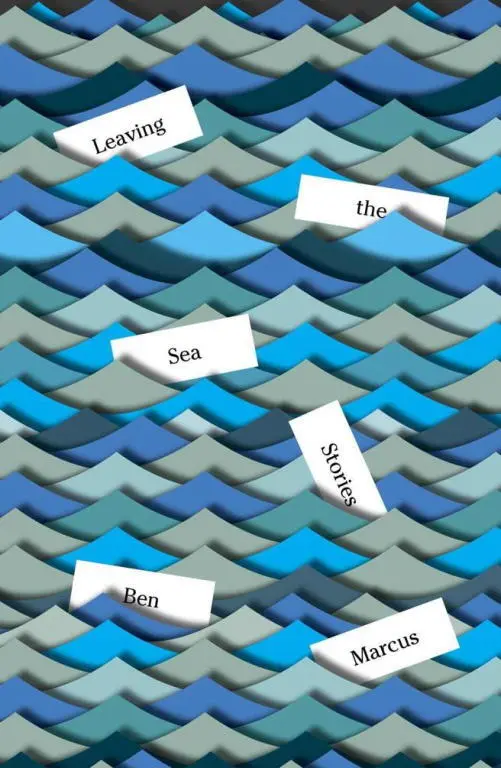
- Название:Leaving the Sea: Stories
- Автор:
- Издательство:Borzoi Books
- Жанр:
- Год:2014
- Город:New York
- ISBN:9780307379382
- Рейтинг книги:4 / 5. Голосов: 1
-
Избранное:Добавить в избранное
- Отзывы:
-
Ваша оценка:
Leaving the Sea: Stories: краткое содержание, описание и аннотация
Предлагаем к чтению аннотацию, описание, краткое содержание или предисловие (зависит от того, что написал сам автор книги «Leaving the Sea: Stories»). Если вы не нашли необходимую информацию о книге — напишите в комментариях, мы постараемся отыскать её.
In the hilarious, lacerating “I Can Say Many Nice Things,” a washed-up writer toying with infidelity leads a creative writing workshop on board a cruise ship. In the dystopian “Rollingwood,” a divorced father struggles to take care of his ill infant, as his ex-wife and colleagues try to render him irrelevant. In “Watching Mysteries with My Mother,” a son meditates on his mother’s mortality, hoping to stave off her death for as long as he sits by her side. And in the title story, told in a single breathtaking sentence, we watch as the narrator’s marriage and his sanity unravel, drawing him to the brink of suicide.
As the collection progresses, we move from more traditional narratives into the experimental work that has made Ben Marcus a groundbreaking master of the short form. In these otherworldly landscapes, characters resort to extreme survival strategies to navigate the terrors of adulthood, one opting to live in a lightless cave and another methodically setting out to recover total childhood innocence; an automaton discovers love and has to reinvent language to accommodate it; filial loyalty is seen as a dangerous weakness that must be drilled away; and the distance from a cubicle to the office coffee cart is refigured as an existential wasteland, requiring heroic effort.
In these piercing, brilliantly observed investigations into human vulnerability and failure, it is often the most absurd and alien predicaments that capture the deepest truths. Surreal and tender, terrifying and life-affirming,
is the work of an utterly unique writer at the height of his powers.
Leaving the Sea: Stories — читать онлайн бесплатно полную книгу (весь текст) целиком
Ниже представлен текст книги, разбитый по страницам. Система сохранения места последней прочитанной страницы, позволяет с удобством читать онлайн бесплатно книгу «Leaving the Sea: Stories», без необходимости каждый раз заново искать на чём Вы остановились. Поставьте закладку, и сможете в любой момент перейти на страницу, на которой закончили чтение.
Интервал:
Закладка:
Except it’s not Maureen, it’s someone with poor English, on a poor connection, who asks several times for Mr. Mather.
“This is he,” Mather says, as Ferguson and the new employees look at him with polite curiosity.
The caller asks again for Mather, and again he says, “This is he,” until it occurs to him that she doesn’t understand the expression.
“This is Mr. Mather. Who’s calling, please?” Without people watching him, he might have hung up already.
Mather figures out that it’s the sitter, and what she’s saying to him, over and over, is the name of his boy. She’s saying “Alan,” except with her accent it sounds like “Allah.” She has little ability to elaborate. Something is wrong with the boy. She needs him to come home right away.
Mather stays calm.
“I have to go. It’s my son.”
“I guess you can’t get rid of him that easy!” Ferguson laughs.
Mather rushes to the elevator, and behind him Ferguson calls out that business about H.R. again and scheduling an appointment.
“Strategy!” Ferguson shouts, as the elevator doors close.
It’s not until Mather gets on the bus that he realizes precisely what has happened. This is how it’s done. No doubt Ferguson took a workshop to learn the exact language. Perhaps he was excited to practice it on Mather. Firing is an opportunity, the start of something wonderful and new.
While Mather is on the bus, the sitter calls again, but there’s nothing he can do. He’s on his way, she has to hold tight, and he will be there as soon as he can.
His phone rings once more as he approaches the back of his building. This time it’s Maureen.
“Finally,” he says. It’s as if the whole crisis were over, simply because she has called. He’s not even mad, just relieved.
“Where are you?” Maureen demands.
“Where am I? Where am I?” Mather can’t believe it. “Are you kidding me? Where the fuck are you?”
Then he sees, across the parking lot, at the entrance to his building, Maureen talking on her phone. Robert is with her, and he’s got the boy. Next to them is the sitter, and even from here Mather can see that she’s crying hysterically.
“You left him with a stranger,” Maureen hisses into the phone. “I can’t go away for one minute. I can’t leave him with you for a single second. A stranger who knows nothing about children.”
Mather sees the full hatred in her body, how she’d like to crawl into her phone and kill him as she stalks around the parking lot.
“I’m right here,” Mather says. “Look up,” and he watches her uncoil.
Maureen sees Mather and takes the boy from Robert. They’ve got him wrapped up in his snowsuit, and he’s wearing one of those white stocking caps they give to babies at the hospital. Somehow it still fits him.
“We’re leaving,” she announces, and Robert falls into step behind her.
Mather approaches and the sitter rushes at him, frantic.
“I don’t give them Allah. They take Allah. It’s okay they take Allah?”
Mather tells Maureen to wait, to hold on, there’s a lot to talk about. She can’t just barge over and take Alan like that. She has a lot to account for.
“Really?” Maureen says, and she looks almost excited, as if she can’t wait to tear into Mather over this.
Mather wants to see the boy, and, when he approaches, Alan looks at him with his pink-rimmed eyes, crusty and dry in the corners, and his skin not so much pale as yellow. Mather goes to touch the boy gently—this is his little son, he would like to give him a kiss—and the boy cringes, nestling further into his mother.
Mather backs away.
“It’s okay, Mr. Mather?” the sitter says. “It’s okay they take him?” She’s acting like Mather’s only friend.
“You’re asking the wrong person, you bitch,” Maureen says. But Mather calms the sitter down and says, “Yes, it’s okay, don’t worry.”
“Leave my friends alone,” Maureen spits. “Don’t call my work. Don’t call us.”
Robert looks at Mather, and there’s not even malice in his eyes. Just boredom.
Mather watches them drive away and he goes upstairs, alone, to his apartment. It’s not even noon. He’ll start by doing laundry, all the boy’s clothes. He takes everything down to the machines in the basement, then upstairs he vacuums, opens the windows for air.
From the boy’s crib he removes the humidifier. What Mather will do is take off the tubes and soak them in a good, hot solution. The plastic water tank has to be soaked, too. The mask pulls easily from the hose and it still smells a little bit of the boy, his sleeping breath. When Mather puts it back together it will be as clean as new.
Later, Mather will go shopping and he’ll buy the boy’s favorite foods. He’ll stock up on distilled water for the tank. He’ll even lay in some candy, for those times when nothing else works. If it’s not too late after that and he has the energy, Mather will take the bus down to Rollingwood to the toy store he loved when he was young, if it’s even still there, and he will pick up something fun for the boy. There has to be something that Alan will love to play with, maybe a train table, which he’s too young for at the moment, though not really for long. He’s growing up. It’s not a bad idea to start thinking about getting the right train table built up in the living room.
At home tonight, Mather will lay the pieces out on the floor, and he’ll start building, because it could take a few days to get it done, and this way he’ll have a head start. He wants to be ready for next time. He wants to bring the boy in and present it to him and see the look in the boy’s eyes when he lowers him into place and pushes that very first train into view.
PART 2
On Not Growing Up
—How long have you been a child?
—Seventy-one years.
—Who did you work with?
—Meyerowits for the first phase: colic, teething, walking, talking. He taught me how to produce false prodigy markers and developmental reversals, to test the power in the room without speaking. I was encouraged to look beyond the tantrum and drastic mood migrations that depended on the environment, and if you know my work you have an idea what resulted. The rest is a hodgepodge, but I don’t advocate linear apprenticeships. A stint in the Bonn Residency. Fellowships at the Cleveland Place, then later a stage at Quebec Center. I entered that Appalachian Trail retreat in 1974, before Krenov revised it, but had to get helicoptered out. Probably my first infant crisis, before I knew to deliberately court interference. The debt to Meyerowits is huge, obviously, if just for the innocence training. Probably I should have laid off after that, because now it’s all about unlearning.
—Unlearning as Kugler practices it? That radical?
—I skip the hostility to animals. I skip the forced submersion and the chelation flush. That’s proven to be a dead end. But Kugler is a walking contradiction in that respect, isn’t he? He keeps a horse barn. He does twilight childishness, and now he’s suddenly opposing the Phoenix baby-talk crowd, who I think are not as threatening as he makes out.
—They’re not registered.
—True, but they’re pro-family, and I still believe, when I’m out in the field, in a pro-parent regimen, in supporting those with maturity fixations.
—Which is contradictory, isn’t it, given how many adult families you’ve worked with, and how many of them have ultimately disbanded?
—The term adult is problematic, I think, and it’s too easy to say that my childwork is directly divisive to Matures, particularly Rigid or Bolted Matures. I may help accelerate a latent behavior, I may enable conflict vectors along the lines of the Michiganders, who fasted as a form of warfare, and I feign indifference to familial tension, but I think that success itself has been fetishized, and a certain nostalgia for growth has spoiled our thinking. I can be pro-family without coddling actual families. I can support familial fear-based clustering even if it involves admitting that we are most likely members of the wrong family. There is that famous German phrase, which I can’t remember exactly, that describes a certain way to hold a gun to someone’s head. The literal meaning of the phrase is that you love that person deeply, just not at the moment. I argue for a love that functions perfectly in theory.
Читать дальшеИнтервал:
Закладка:
Похожие книги на «Leaving the Sea: Stories»
Представляем Вашему вниманию похожие книги на «Leaving the Sea: Stories» списком для выбора. Мы отобрали схожую по названию и смыслу литературу в надежде предоставить читателям больше вариантов отыскать новые, интересные, ещё непрочитанные произведения.












Обсуждение, отзывы о книге «Leaving the Sea: Stories» и просто собственные мнения читателей. Оставьте ваши комментарии, напишите, что Вы думаете о произведении, его смысле или главных героях. Укажите что конкретно понравилось, а что нет, и почему Вы так считаете.