Ben Marcus - Leaving the Sea - Stories
Здесь есть возможность читать онлайн «Ben Marcus - Leaving the Sea - Stories» весь текст электронной книги совершенно бесплатно (целиком полную версию без сокращений). В некоторых случаях можно слушать аудио, скачать через торрент в формате fb2 и присутствует краткое содержание. Город: New York, Год выпуска: 2014, ISBN: 2014, Издательство: Borzoi Books, Жанр: Современная проза, на английском языке. Описание произведения, (предисловие) а так же отзывы посетителей доступны на портале библиотеки ЛибКат.
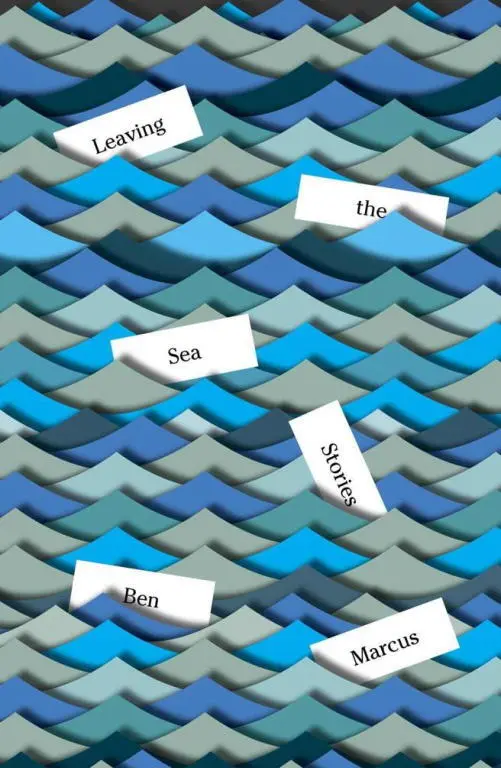
- Название:Leaving the Sea: Stories
- Автор:
- Издательство:Borzoi Books
- Жанр:
- Год:2014
- Город:New York
- ISBN:9780307379382
- Рейтинг книги:4 / 5. Голосов: 1
-
Избранное:Добавить в избранное
- Отзывы:
-
Ваша оценка:
Leaving the Sea: Stories: краткое содержание, описание и аннотация
Предлагаем к чтению аннотацию, описание, краткое содержание или предисловие (зависит от того, что написал сам автор книги «Leaving the Sea: Stories»). Если вы не нашли необходимую информацию о книге — напишите в комментариях, мы постараемся отыскать её.
In the hilarious, lacerating “I Can Say Many Nice Things,” a washed-up writer toying with infidelity leads a creative writing workshop on board a cruise ship. In the dystopian “Rollingwood,” a divorced father struggles to take care of his ill infant, as his ex-wife and colleagues try to render him irrelevant. In “Watching Mysteries with My Mother,” a son meditates on his mother’s mortality, hoping to stave off her death for as long as he sits by her side. And in the title story, told in a single breathtaking sentence, we watch as the narrator’s marriage and his sanity unravel, drawing him to the brink of suicide.
As the collection progresses, we move from more traditional narratives into the experimental work that has made Ben Marcus a groundbreaking master of the short form. In these otherworldly landscapes, characters resort to extreme survival strategies to navigate the terrors of adulthood, one opting to live in a lightless cave and another methodically setting out to recover total childhood innocence; an automaton discovers love and has to reinvent language to accommodate it; filial loyalty is seen as a dangerous weakness that must be drilled away; and the distance from a cubicle to the office coffee cart is refigured as an existential wasteland, requiring heroic effort.
In these piercing, brilliantly observed investigations into human vulnerability and failure, it is often the most absurd and alien predicaments that capture the deepest truths. Surreal and tender, terrifying and life-affirming,
is the work of an utterly unique writer at the height of his powers.
Leaving the Sea: Stories — читать онлайн бесплатно полную книгу (весь текст) целиком
Ниже представлен текст книги, разбитый по страницам. Система сохранения места последней прочитанной страницы, позволяет с удобством читать онлайн бесплатно книгу «Leaving the Sea: Stories», без необходимости каждый раз заново искать на чём Вы остановились. Поставьте закладку, и сможете в любой момент перейти на страницу, на которой закончили чтение.
Интервал:
Закладка:
—My feeling about other people and their wishes is not important. What I think doesn’t interest me, just as survival is not a theoretical project, at least as I practice it. When you outlast everyone addicted to unprotected space—Americans, as we call them—you don’t much care to hear the ravings of the newly dead. Every species is defined by death and every creature has a role to play, even if some of those roles appear negating or doomed, or beguilingly marginal. If I was assigned a death role, if I was meant to die tonight, for example, which I’d be prepared to do if such an event could lift the shadow, you might still hear me disputing the reigning survival narratives, perhaps even arguing that death is the most radical form of survival. It is a necessary imperfection of the species that we each believe we are in the right.
—So the cave is a survival narrative?
—It’s not a cave any more than a house is a cave.
—It’s underground.
—A relative distinction, and a sloppy one. Caves have entrances, in any case, so your terminology is moot. Let’s try to think outside of our disease. It’s enormously difficult to penetrate a true underground space, and I’m hardly an absolutist when it comes to subterranean levels.
—Explain.
—Most of what you call the underground was once cold, blue space that is now simply clotted with matter. It’s the old adage we learned in grade school: solids attract, space is a punishment. Are there ideal clottages of matter that feature high survival ratios? Perhaps, but it’s not so simple. I look for below-grade cavities that are aperture free, but I’m not interested in fixating on pure coordinates because I don’t believe in compassing. These foolish tools are just treasure maps to one hell or another. Areas of high solidity, which often occur at extremely low altitudes, are simply safer. The sea-levelers have lost access to light and power and laid themselves bare to every sort of attack, yet still we have to listen to their sentimental justifications and old-fashioned cries for the good pastures and prairies which are graveyards now. I don’t believe in some absolute mineral intelligence, but you’d have to be a moron not to notice what is surviving and to wonder very seriously how to model it.
—To the outsider, this looks like you’re burying yourself alive.
—I would agree with the word alive here. I put a premium on life, even while others wring their hands and object to the “idea” of the low home, or other safe zones, all the while groping in cold darkness with no food, at an altitude—where our buildings used to be—with a remarkably grim survival rate. Drs. Moskin and Ruefle have repeatedly refuted the idea of an absolute sea level. Why are we even having this conversation? We key your dangerous coordinates into a GPS and find ourselves headlong over a cliff. What good will it do me to grab on to you if we’re both falling to our deaths?
—But we’re not falling.
—Said the remarkably uninformed man. The whole idea of a boundary between the earth and the air is problematic. It is one of those intellectual wrong turns that has marked us with a terrible shadow. The scar around our necks is where sea level used to be.
—What scar?
—It’s an expression. Altitude itself has been fanatically idealized since early mythology. We’ve been banning the wrong books. The beauty of flight, the freedom of space, the supposed poetry of birds: glories or cautions? To me it’s strikingly obvious that we should seek to be supported by matter on all sides, a suit of earth, as Frehlan put it, whether in person-sized cavities or elsewhere. Altitude, even as a concept, has failed. Evolution teaches in the negative, but we are terrible students of the future.
—Is it the Anchorites you side with?
—Who said that if you want to watch someone die, befriend an Anchorite? There’s a narcissism to people who flee to the mountains, and I’m not just singling out my father. The flight of the Anchorites is self-centered and historically minded—in the worst way—and to me they are like characters auditioning for a novel. Pick me, pick me! They are begging to be noticed and they cry when wounded. The preening quality of their isolation has no appeal to me. They have a fondness for exposure, and we might as well watch them decay before our eyes. But my opinion on this is merely personal. I care about results. In terms of efficacy, which is what matters, Anchorites die. Six of them will die during this conversation.
—Is that your final measurement for people, whether or not they die?
—That measurement predates me, and it will outlast me, too. I’d be curious to learn of a more revealing criterion.
—You’ve given up many things in pursuit of the cave: your family, your home, your job.
—I’ll have those things again. They might not take the same shape or form, it might not be the same family, home, or job, but those things will return to me even stronger because of my survival work.
—But do you miss your actual family?
—I feel relief. Relief and gratitude. Gratitude because I can experience strong feelings for those people. How many of us really have that intense flood of emotion, like being drugged? Feelings are a gift, and I am lucky. In some sense, my feelings toward my wife and children are more intense when the moment is not complicated by their presence, and there is no accounting for the magnification that happens when we are swaddled by earth, fully enclosed, necessarily free of people.
—As a father and husband, are you responsible for the survival strategies, flawed as they may be in your view, of your wife and children? Is there an obligation here?
—I am not here to talk about particular people I may have known. There’s no need to cripple our thinking with specificity. But I presented an airtight survival case to those individuals, and my views on this are well documented. Families necessitate energetic concealments of the obvious, to be plain about it. To be in a family is to work strenuously to suppress the truth, for reasons I cannot determine, and the shadow, when it came, caused competing strategies in the family I occupied. My wife tuned her intelligence to a dilemma altogether different from the dilemma at hand, and I was confirmed in my belief that survival cannot be outwardly imposed, even within a niche group like a family. Responsibility, during a hardship, is a luxury, and it is a luxury I strove to enjoy, even as it compromised the project. It was decadent of me to show so much responsibility for my family, as it was then defined. I admit to this indulgence of youth. We have our weaknesses. One of mine was loyalty. But hardships necessitate that we forgo luxury, and in this case I needed to move from my own comforts toward the necessarily desolate work I’m doing now.
—Survival, then, but at what cost?
—That question doesn’t become you. I choose to be alive in order to measure the depth of my sacrifice, if any. Are we supposed to gloat from the afterlife that we avoided difficult choices and took the easy way out? If other people, including my affiliates, do not choose to navigate hardship by seeking out full earth swaddling, then I cannot help them.
—In a time of intermittent sun and fee-rationed power, I am curious if you are worried about the people above, as you have called them.
—My views on the darkness are well known. I have found that after the first bracing moments, stepping into an ossified berm of shale, or what have you, when your hand appears ink-soaked and then invisible, and when sounds are suddenly so heightened that you can hear your blood rushing through your body, a release occurs, a lightness, and it is in this space that a great feeling arises. I can only wish that such a feeling has become available not just to those people you name, but to everyone. The shadow has made new experiences possible. In the end, it should not matter how deserving we are, and the people above should not be punished for their mistake. I would hate to think that only a lucky few of us could feel the safety of stone, protecting us from all sides, where we can let ourselves believe that beyond our private walls, another good person might be resting and waiting. If our sight was such that we saw only bodies, and not the stone and earth that encloses so many of our survivors, a floating web of people would appear before us, and such a diagram of the species, hovering there and breathing just fine, would be beautiful.
Читать дальшеИнтервал:
Закладка:
Похожие книги на «Leaving the Sea: Stories»
Представляем Вашему вниманию похожие книги на «Leaving the Sea: Stories» списком для выбора. Мы отобрали схожую по названию и смыслу литературу в надежде предоставить читателям больше вариантов отыскать новые, интересные, ещё непрочитанные произведения.





Обсуждение, отзывы о книге «Leaving the Sea: Stories» и просто собственные мнения читателей. Оставьте ваши комментарии, напишите, что Вы думаете о произведении, его смысле или главных героях. Укажите что конкретно понравилось, а что нет, и почему Вы так считаете.