Ben Marcus - Leaving the Sea - Stories
Здесь есть возможность читать онлайн «Ben Marcus - Leaving the Sea - Stories» весь текст электронной книги совершенно бесплатно (целиком полную версию без сокращений). В некоторых случаях можно слушать аудио, скачать через торрент в формате fb2 и присутствует краткое содержание. Город: New York, Год выпуска: 2014, ISBN: 2014, Издательство: Borzoi Books, Жанр: Современная проза, на английском языке. Описание произведения, (предисловие) а так же отзывы посетителей доступны на портале библиотеки ЛибКат.
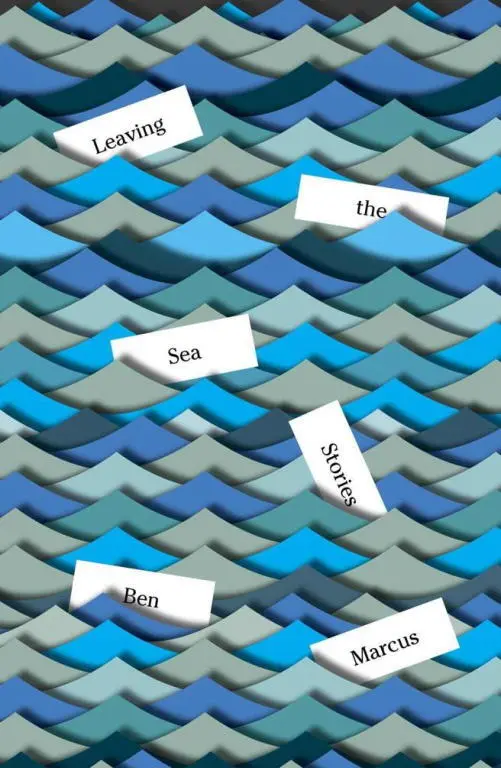
- Название:Leaving the Sea: Stories
- Автор:
- Издательство:Borzoi Books
- Жанр:
- Год:2014
- Город:New York
- ISBN:9780307379382
- Рейтинг книги:4 / 5. Голосов: 1
-
Избранное:Добавить в избранное
- Отзывы:
-
Ваша оценка:
Leaving the Sea: Stories: краткое содержание, описание и аннотация
Предлагаем к чтению аннотацию, описание, краткое содержание или предисловие (зависит от того, что написал сам автор книги «Leaving the Sea: Stories»). Если вы не нашли необходимую информацию о книге — напишите в комментариях, мы постараемся отыскать её.
In the hilarious, lacerating “I Can Say Many Nice Things,” a washed-up writer toying with infidelity leads a creative writing workshop on board a cruise ship. In the dystopian “Rollingwood,” a divorced father struggles to take care of his ill infant, as his ex-wife and colleagues try to render him irrelevant. In “Watching Mysteries with My Mother,” a son meditates on his mother’s mortality, hoping to stave off her death for as long as he sits by her side. And in the title story, told in a single breathtaking sentence, we watch as the narrator’s marriage and his sanity unravel, drawing him to the brink of suicide.
As the collection progresses, we move from more traditional narratives into the experimental work that has made Ben Marcus a groundbreaking master of the short form. In these otherworldly landscapes, characters resort to extreme survival strategies to navigate the terrors of adulthood, one opting to live in a lightless cave and another methodically setting out to recover total childhood innocence; an automaton discovers love and has to reinvent language to accommodate it; filial loyalty is seen as a dangerous weakness that must be drilled away; and the distance from a cubicle to the office coffee cart is refigured as an existential wasteland, requiring heroic effort.
In these piercing, brilliantly observed investigations into human vulnerability and failure, it is often the most absurd and alien predicaments that capture the deepest truths. Surreal and tender, terrifying and life-affirming,
is the work of an utterly unique writer at the height of his powers.
Leaving the Sea: Stories — читать онлайн бесплатно полную книгу (весь текст) целиком
Ниже представлен текст книги, разбитый по страницам. Система сохранения места последней прочитанной страницы, позволяет с удобством читать онлайн бесплатно книгу «Leaving the Sea: Stories», без необходимости каждый раз заново искать на чём Вы остановились. Поставьте закладку, и сможете в любой момент перейти на страницу, на которой закончили чтение.
Интервал:
Закладка:
PART 3
Watching Mysteries with My Mother
Idon’t think my mother will die today. It’s late at night already. She’d have to die in the next forty-five minutes, which doesn’t seem likely. I just saw her for dinner. We ordered in and watched a mystery on PBS. She kissed me good night and I took a taxi home. For my mother to die today, things would need to take a rapid turn.
My mother has her share of health troubles. She lives alone, which increases the likelihood of death. I could wake to a phone call and learn that she died shortly after I left her tonight. I’d like to say that the odds are against my mother dying today, since so much of the day has already passed. She needs only to survive at home, in her bed, for less than an hour, and then she will have lived through the day, proving me correct. But I don’t know enough about odds. It would seem to me that the underlying premise of death—the death of an old woman alone in her apartment—is that it does not participate in man-made conceits like odds. People are often said to beat the odds. But then, perhaps, whoever keeps the odds—if he or she is intelligent—must account in advance for the odds being beaten and adjust the odds accordingly. Odds keepers cannot be ignorant of the claim that the odds are often beaten. This must disturb them. And then would they not adjust the odds, in order to make the odds more accurate? I don’t know. Odds should be odds, and they should never be beaten. If they are, then the odds are incorrect and should be changed.
If my mother knew that she only needed to survive for under an hour—in order not to die today—would her chances of living increase? If I phoned her now and told her to hang on, so that she didn’t die today, would her odds change? In other words, does it increase our chance of survival if we consciously try to live? It wouldn’t seem likely, not that she’d even pick up the phone now. It is late at night. She is tired. She was even tired at dinner. When we watched our mystery, she fell asleep. The phrase for people of a certain age, in certain circumstances, is nodded off . My mother nodded off. I paid her the courtesy of not seeming to notice, even though I watched her sleep under her blanket on the reclining chair she loves. I noticed how her hair no longer moves, not even a strand of it, no matter what position she is in. She woke up throughout the broadcast, and she actually grasped more of the plot than I did. It is possible she’d seen this mystery before.
The people who work in kitchens, in castles in England, at least in the mysteries my mother and I watch, are far more intelligent than their employers. The kitchens are vast stone rooms with gorgeous pots hanging from hooks. Sometimes the difference in intelligence between employer and servant is striking, a fact my mother relies on for her solutions to the mystery.
I understand, of course, that these mystery stories are invented, but I also understand that the people who invent them are hopelessly bound to what they’ve seen and heard. As much as these people might dream of a kind of pure fabrication, imagining out of whole cloth an utterly new Victorian British society in which petty domestic crimes take place, they cannot do it. They hew, like it or not, to what has already happened, to what people have already done, and what people have already thought. In this case, working-class characters are functional geniuses compared to the slow-thinking, wealthy, overfed people who rule them. The popularity of their shows depends upon it. I depend upon it. My mother depends upon it. Even if, at times, while the shows play in her living room, she sleeps.
People are reluctant to admit that they have slept, particularly, perhaps exclusively, when they’ve done so in front of witnesses. Just when it would seem impossible to deny, people deny that they nodded off. A point of pride is perhaps involved. So I never confronted my mother with the fact that she had slept through the second act, even though I watched her sleeping, arguably more than I watched the mystery. Why would I harass her with the truth? I do my best not to watch my mother when she is sleeping. I think it is impolite. Yet sometimes I fail. When she is awake I do not get to watch my mother so carefully, for such extended periods of time. If it is impolite to stare at someone while they sleep, it is more so when they are awake, aware of your scrutiny. It is not only more impolite, it is essentially impossible to closely look at another person for a long time while they are awake. A code prevents it. I would never think of following her around, staring. I am generally aware of the things I should not do.
And yet the crime is the same: staring at another person. Awake or asleep should not matter, but clearly the fact of being seen while staring at a waking person aggravates the transgression. If a third person could be in the room while my mother nodded off and I stared at her, and this third person—not my father, obviously, oh, God, no—witnessed me staring at my sleeping mother, has my offense thus escalated? I do not know.
When I think of her sometimes forgetting her medicine, forgetting to eat much more than a rice cake, neglecting to drink water, I must wonder if my mother could live longer if only she tried.
Servants in the kitchen, especially the daftest ones who appear idiotic in the first act, end up being the most devious. Look out for the stupid ones, my mother will shout, whenever we watch a mystery. She wags a finger at me and smiles.
I try to get her to drink water and she says the water tastes awful. She feels she’s drinking water that someone soaked his teeth in, even if I have only just drawn the water from the tap. It tastes like a stranger’s mouth, she’ll yell. As if the water would be acceptable if only it tasted like the mouth of someone she knew. A person’s determination cannot—can it?—have too much to do with when they die, unless they are choosing to die, which is another topic. If determination played a role, allowing people to deliberately live longer, death would undergo a fundamental change, and people would exert their will in disruptive ways, living so long it would antagonize their families. I do not like to imagine the kinds of things that would happen in such a world where people could delay their own deaths.
On the other hand, there is a long history of people who, without moving a muscle, have fought for their lives. A person inert in a hospital bed, rigged to bags and lines, is referred to as a fighter. Upon observation, no visible fight can be detected. But a will to live is cited in these situations. The family, gathered at the bed, can detect it. Even when their loved one dies, they say she fought so hard. She was such a fighter. She put up an unbelievable fight.
Such circumstances have always concerned me, and not just tonight, as I wonder about my mother’s resolve to live at least until tomorrow, whether or not her resolve, as discussed, even comes into play.
If I am the patient in the hospital bed, and I am urged, even by a stranger, to fight for my life, will I know how to do it? It simply is not clear, has never been clear, how exactly one fights for one’s life, with no tools, no weapons, no training, no information whatsoever.
Even the doctors, standing there personally watching me die, will not tell me a thing about what I can do on my own, right now, to extend my life and not succumb to what is killing me. Why is this information kept secret? A stranger might cheer me on, exhort me to dig deep and fight—and I say stranger because I did not marry and my brother and sister have passed. A stranger would, by necessity, attend my bed. Or no one. No one is more likely. Why would a stranger stop in my room, stand at my bed, and exhort me to live? What kind of stranger does things like that? And if the answer is a good kind of stranger, I must wonder if it is then my duty, not tonight, because I am busy, but sometime soon, to enter a hospital at night and find a patient alone in his or her room, preferably a patient on the brink of death, and urge them to fight, and fight hard? I should strive to be a good stranger, is that not correct?
Читать дальшеИнтервал:
Закладка:
Похожие книги на «Leaving the Sea: Stories»
Представляем Вашему вниманию похожие книги на «Leaving the Sea: Stories» списком для выбора. Мы отобрали схожую по названию и смыслу литературу в надежде предоставить читателям больше вариантов отыскать новые, интересные, ещё непрочитанные произведения.









Обсуждение, отзывы о книге «Leaving the Sea: Stories» и просто собственные мнения читателей. Оставьте ваши комментарии, напишите, что Вы думаете о произведении, его смысле или главных героях. Укажите что конкретно понравилось, а что нет, и почему Вы так считаете.