Ben Marcus - Leaving the Sea - Stories
Здесь есть возможность читать онлайн «Ben Marcus - Leaving the Sea - Stories» весь текст электронной книги совершенно бесплатно (целиком полную версию без сокращений). В некоторых случаях можно слушать аудио, скачать через торрент в формате fb2 и присутствует краткое содержание. Город: New York, Год выпуска: 2014, ISBN: 2014, Издательство: Borzoi Books, Жанр: Современная проза, на английском языке. Описание произведения, (предисловие) а так же отзывы посетителей доступны на портале библиотеки ЛибКат.
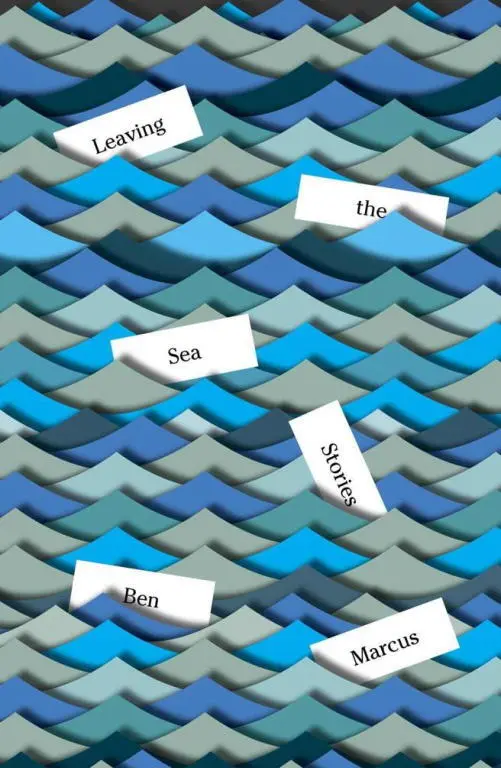
- Название:Leaving the Sea: Stories
- Автор:
- Издательство:Borzoi Books
- Жанр:
- Год:2014
- Город:New York
- ISBN:9780307379382
- Рейтинг книги:4 / 5. Голосов: 1
-
Избранное:Добавить в избранное
- Отзывы:
-
Ваша оценка:
Leaving the Sea: Stories: краткое содержание, описание и аннотация
Предлагаем к чтению аннотацию, описание, краткое содержание или предисловие (зависит от того, что написал сам автор книги «Leaving the Sea: Stories»). Если вы не нашли необходимую информацию о книге — напишите в комментариях, мы постараемся отыскать её.
In the hilarious, lacerating “I Can Say Many Nice Things,” a washed-up writer toying with infidelity leads a creative writing workshop on board a cruise ship. In the dystopian “Rollingwood,” a divorced father struggles to take care of his ill infant, as his ex-wife and colleagues try to render him irrelevant. In “Watching Mysteries with My Mother,” a son meditates on his mother’s mortality, hoping to stave off her death for as long as he sits by her side. And in the title story, told in a single breathtaking sentence, we watch as the narrator’s marriage and his sanity unravel, drawing him to the brink of suicide.
As the collection progresses, we move from more traditional narratives into the experimental work that has made Ben Marcus a groundbreaking master of the short form. In these otherworldly landscapes, characters resort to extreme survival strategies to navigate the terrors of adulthood, one opting to live in a lightless cave and another methodically setting out to recover total childhood innocence; an automaton discovers love and has to reinvent language to accommodate it; filial loyalty is seen as a dangerous weakness that must be drilled away; and the distance from a cubicle to the office coffee cart is refigured as an existential wasteland, requiring heroic effort.
In these piercing, brilliantly observed investigations into human vulnerability and failure, it is often the most absurd and alien predicaments that capture the deepest truths. Surreal and tender, terrifying and life-affirming,
is the work of an utterly unique writer at the height of his powers.
Leaving the Sea: Stories — читать онлайн бесплатно полную книгу (весь текст) целиком
Ниже представлен текст книги, разбитый по страницам. Система сохранения места последней прочитанной страницы, позволяет с удобством читать онлайн бесплатно книгу «Leaving the Sea: Stories», без необходимости каждый раз заново искать на чём Вы остановились. Поставьте закладку, и сможете в любой момент перейти на страницу, на которой закончили чтение.
Интервал:
Закладка:
There is a pecking order regarding who can answer the door, such tasks being left usually to the footman.
The super would make a case for waiting until morning, thereby guaranteeing that even if my mother died today, she would not be discovered until tomorrow.
If, on the other hand, my mother were to die loudly, creating some commotion, and neighbors were to hear, it is possible they would reach her in time, not to save her life, necessarily, but at least to discover that she died today. To find her today, leaving very little surprise for tomorrow. There would be my own surprise upon receiving the terrible phone call alerting me to the unfortunate event inside my mother’s home. Many people would know of my mother’s death before me, a thought that does not please me. I feel that such an event would be mine to know about first, which I realize is the explanation often given by murderers—they wanted to be the first to learn of an important event, and the only way to be in that position was to cause the event itself, so they killed people, thus learning of the event before anyone else. But my motive in this respect is altogether different. To some of these people my mother’s death would be old hat by the time I found out. Other people in the area may have died in the intervening hours, displacing my mother in their thoughts. On the world stage many thousands of people would have died after my mother, yet before I was alerted. If she fell on the stairs and cried out. If she collapsed from some mishap to her circulation. Perhaps instead of crying out, my mother would have the strength to dial her phone. She might lack the energy to cry out loudly enough to be heard. Screaming requires a terrific summoning of muscle. It scares me to think that one day I will be too weak to scream when I most need to scream. I will produce only small sounds, barely audible even to myself. If, crawling on her hands and knees, severely disabled from a circulatory event, my mother reached the phone and dialed it, she could conduct a quiet conversation, alerting the party on the line to the circumstances. Help would be called, and help would come.
The question of discovery becomes complicated here. If, for instance, my mother is able, by telephone, to alert the party on the line to her medical situation, dying shortly thereafter, does this information constitute adequate discovery for the later determination that my mother died today? I think not. I think the remote party on the line can learn that the medical crisis began today, precipitating my mother’s telephone call, but unless she died while talking on the phone, before midnight, it would not, from this evidence, be possible to definitively declare time of death. Even if she, because of death, dropped the phone, the remote party, unable to see her, would lack definitive proof that she suddenly died in the middle of the conversation. The remote party might only conclude that my mother could no longer speak or make sounds, or, also, move, because the remote party would hear nothing if indeed my mother, against the odds, died today. There would be silence. But silence is not enough.
If I want my mother to survive, as I continue to say that I do, so she is not discovered dead in her apartment, should I not hire a companion for her? If people who do not live alone ultimately, per the studies, live longer than people who do, and if I have not rescued my mother from living alone, is it not the case that I am enabling her to die sooner rather than later? This would be a factor I could control. This would be me fighting for her life, since my mother cannot, as established, fight for her own life, just as none of the people in our family, of which we are the two surviving members, can. And if one living partner increases the life of both parties, would not two living partners add that much more time to my mother’s life? Unless there are diminishing returns. But, even so, returns are returns, however diminished, and one must guess that the more people who reside with my mother, the longer she will live. The reasoning hereafter becomes troubling. At what point does it end? Can I continue to acquire companions for my mother, thus sustaining her life perhaps well past her natural point of demise, adding companions to her entourage each day so she never dies? The logistics collapse around such a project.
A crowd employed to accompany my mother would need to be paid and fed, they would need to be lodged, and then, at certain times, such as when I visit for dinner and television, the crowd, at my command, would need to disperse, so I could be alone with my mother and enjoy her company. Together we’d sift through the takeout menus, making a show of choosing, of looking at the entrees for the Afghan place, and the delicious side plates offered from the Turkish place, but settling, as we always do, on Italian, which is what we both love, getting our pastas, requesting extra bread, and sometimes, but not always, sharing a salad. If we are feeling wicked, I will draw up stools by our chairs so we can, as we say, eat and watch, and more and more we are feeling wicked. And yet, when I dispatch the crowd and give my mother only the lone companion, me, am I endangering her, creating a sudden withdrawal from the people who were saving her life? Is this not another way of killing her, making me a murderer? She has thrived with a large population of life-extending companions, and now, her selfish son sends them away so she can die sooner, in exchange for a private moment—even though they hardly speak—of which the selfish son has had far more than his share? He is her son and he has kept his mother to himself his whole life, even when his brother and sister briefly lived, and his father the odds keeper briefly lived, vying for the attention that was always aimed first at him, as if through a bright, golden cone, but all he ever did was say good-bye to her, nearly every day of his life. All of those paid companions, waiting outside—blocking traffic, because there are thousands of them by now, he has spent his last penny on them—the companions crowded together looking in the window at mother and son, eating dinner in front of the television set, wondering how he could do this to her, leave her alone like that. What kind of son is he?
Someone always has a past, and someone’s past is always returning, ruinously. The past, in the mind of the person who had it, is terrible and shameful, but to the television viewer the terrible past this person had is only ever endearing. The illegitimate child is one of the more common shameful pasts dramatized on PBS. This plot troubles my mother. She does not care for it. Once she said that all children are illegitimate, and I laughed, but she shot me a look. Illegitimate children grow up into illegitimate adults, only to die and become illegitimate corpses, buried illegitimately. Soon she fell asleep and I learned that the illegitimate child, who was an heiress, had taken a scullery position in the very mansion where her unwitting family lived. My mother woke and angrily declared, seemingly out of nowhere, that this girl would be the first suspect in the episode, and she would be shamed and abused and shamed again, but in the end they would discover that she did not do it. There is always a first suspect, quickly forgiven. Nowadays there are several suspects who wind up innocent. That’s what you want to be, my mother advised, pointing her finger at me. The first suspect. Be the first suspect. The first suspect never did it.
If my mother did die today, she would die while I was writing. Years from now someone might ask me what I was doing when my mother died and I would have to answer that I was home, writing. This scenario implies that I will one day meet someone who will take the familiar with me, because there is no one presently in my life who would think, I think, to ask me such a question. Does a stranger, even a well-intentioned one, ask such a question? I would have to meet someone who would, quickly or slowly—I’m fine with either—gain enough familiarity with me to pose this personal question. Perhaps this man or woman would be someone with whom I would grow close, even though I would be an older person by then with little to offer in terms of romantic maneuvers. We’d pose each other questions on couches, chairs, park benches, beds, in cars and on buses and sometimes walking through fields, or so I imagine, seeking to overcome each other’s defenses, hoping that personal questions, asked and answered, would come, over time, to pass for intimacy, but wondering, sometimes, if that’s even how it’s done, and if that doesn’t somehow seem too strenuous a method of getting someone finally to love you.
Читать дальшеИнтервал:
Закладка:
Похожие книги на «Leaving the Sea: Stories»
Представляем Вашему вниманию похожие книги на «Leaving the Sea: Stories» списком для выбора. Мы отобрали схожую по названию и смыслу литературу в надежде предоставить читателям больше вариантов отыскать новые, интересные, ещё непрочитанные произведения.





Обсуждение, отзывы о книге «Leaving the Sea: Stories» и просто собственные мнения читателей. Оставьте ваши комментарии, напишите, что Вы думаете о произведении, его смысле или главных героях. Укажите что конкретно понравилось, а что нет, и почему Вы так считаете.