Ben Marcus - Leaving the Sea - Stories
Здесь есть возможность читать онлайн «Ben Marcus - Leaving the Sea - Stories» весь текст электронной книги совершенно бесплатно (целиком полную версию без сокращений). В некоторых случаях можно слушать аудио, скачать через торрент в формате fb2 и присутствует краткое содержание. Город: New York, Год выпуска: 2014, ISBN: 2014, Издательство: Borzoi Books, Жанр: Современная проза, на английском языке. Описание произведения, (предисловие) а так же отзывы посетителей доступны на портале библиотеки ЛибКат.
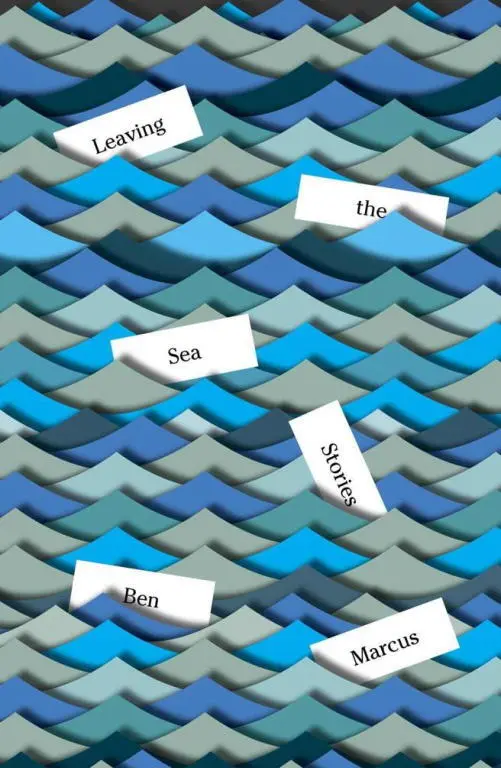
- Название:Leaving the Sea: Stories
- Автор:
- Издательство:Borzoi Books
- Жанр:
- Год:2014
- Город:New York
- ISBN:9780307379382
- Рейтинг книги:4 / 5. Голосов: 1
-
Избранное:Добавить в избранное
- Отзывы:
-
Ваша оценка:
Leaving the Sea: Stories: краткое содержание, описание и аннотация
Предлагаем к чтению аннотацию, описание, краткое содержание или предисловие (зависит от того, что написал сам автор книги «Leaving the Sea: Stories»). Если вы не нашли необходимую информацию о книге — напишите в комментариях, мы постараемся отыскать её.
In the hilarious, lacerating “I Can Say Many Nice Things,” a washed-up writer toying with infidelity leads a creative writing workshop on board a cruise ship. In the dystopian “Rollingwood,” a divorced father struggles to take care of his ill infant, as his ex-wife and colleagues try to render him irrelevant. In “Watching Mysteries with My Mother,” a son meditates on his mother’s mortality, hoping to stave off her death for as long as he sits by her side. And in the title story, told in a single breathtaking sentence, we watch as the narrator’s marriage and his sanity unravel, drawing him to the brink of suicide.
As the collection progresses, we move from more traditional narratives into the experimental work that has made Ben Marcus a groundbreaking master of the short form. In these otherworldly landscapes, characters resort to extreme survival strategies to navigate the terrors of adulthood, one opting to live in a lightless cave and another methodically setting out to recover total childhood innocence; an automaton discovers love and has to reinvent language to accommodate it; filial loyalty is seen as a dangerous weakness that must be drilled away; and the distance from a cubicle to the office coffee cart is refigured as an existential wasteland, requiring heroic effort.
In these piercing, brilliantly observed investigations into human vulnerability and failure, it is often the most absurd and alien predicaments that capture the deepest truths. Surreal and tender, terrifying and life-affirming,
is the work of an utterly unique writer at the height of his powers.
Leaving the Sea: Stories — читать онлайн бесплатно полную книгу (весь текст) целиком
Ниже представлен текст книги, разбитый по страницам. Система сохранения места последней прочитанной страницы, позволяет с удобством читать онлайн бесплатно книгу «Leaving the Sea: Stories», без необходимости каждый раз заново искать на чём Вы остановились. Поставьте закладку, и сможете в любой момент перейти на страницу, на которой закончили чтение.
Интервал:
Закладка:
This question of what I was doing when someone died, however, does not seem to be asked about the death of unremarkable citizens. We only seem to ask after someone’s whereabouts when it comes to the death of celebrities. So I can perhaps count on the odds that—even if I do gain a companion in my life going forward, an event that I would welcome—I won’t be asked what I was doing when my mother died. No one will have to know, unless I volunteer it. Odds are. Unless, in my eulogy, which I would have to write very quickly, I declare my whereabouts when she died.
It’s often the young, wild-haired simpleton, whose accent is more cockney than the others, indicating the deepest possible underdog. She assists the cook and the cook treats her poorly. Everyone treats her poorly. Her very employment is a matter of charity. They underestimate her. Not my mother. Early on, even during the opening credits, my mother wags her finger and says, Look out for that one!
What I will be able to say, without lying, is that when my mother died I was at home thinking about her, since in order to write about my mother I must first think about her, and in that sense she is very much in my thoughts. In order to increase the chances of this being true, it would seem that I should not stop writing, or at the very least thinking, about my mother, at the risk of thinking of something else and then having her suddenly die.
If, for instance, I get up from my chair and become distracted at the refrigerator, deciding that I’d like a taste of cold yogurt, and then for those moments cease thinking about my mother, I run the risk that she will die, alone, in no one’s thoughts, while her only son ate from an open container and stared into nowhere, thinking, for a moment, of nothing.
I cannot let this happen.
Episode after episode, watching mysteries with my mother, I look out for the wild-haired simpleton. I watch the wild-haired simpleton, waiting for her to strike, and yet her endgame is slow, her long play is invisible, so much so that by the time the credits roll the wild-haired simpleton has yet to pounce. She is frequently back where she started, working in a kitchen, having come to nothing. She has nowhere to go, and nobody loves her, and the wild-haired simpleton herself, with her soft, gray teeth, seems incapable of loving anyone else. My mother nods and says, Don’t write that one off.
The credits have rolled, the show is over. The contemporary people standing off camera with their up-to-date views on the world have wandered away to go home. The actress portraying the wild-haired simpleton resumes her normal, highly educated accent, yanks the tangled fright wig from her head, returns to her trailer to shower and put on her smart clothing. My mother, though, watching the credits and smiling, looks at me with sharp eyes.
Next time, she promises. That one isn’t done. She’s got more fight in her. She’s a fighter, that one. She’ll get them next time.
The Loyalty Protocol
The phone call said to come alone, but he couldn’t just leave them. Perhaps they’d been called, too, and didn’t remember the procedure, which would only figure. His father was not good with instructions. Worse, his father was fatally indifferent to what people said. Other people spoke and the man’s face went blank, as if any voice but his own was in a foreign language. Perhaps his father had not heard the phone. Or maybe he mistook the message for a prank and hung up.
Later, his helpless parents in tow, Edward could explain the mistake, if necessary. By then it’d be too conspicuous to leave them stranded in the road while everyone else left town.
Owing to the roadblock that would be set up on Morris Avenue, Edward parked at Grove and Williams and trekked through muddy backyards to the apartment complex. He cursed himself, because he’d have to lead his parents back the same way, down a wet slope where his car would be waiting. In the many configurations they’d rehearsed at the workshop, somehow he had not accounted for this major obstacle: herding his parents in the dark down a steep, wet slope.
His father was awake and packed already, wandering through the apartment. When Edward walked in, his father started to put on his coat.
“Where’s Mom?”
“Not coming, I guess,” his father said.
“Dad.”
“You try. I tried already. You try if you want to. I’m disgusted. I’m ready to go. Do you know how many times I’ve had to do this?”
“Did they call you?” Edward asked.
“Did who call me?” His father was on the defensive. Had he even slept? Had he been up all night, waiting?
“Did your phone ring tonight?” Edward asked, trying not to sound impatient. There were cautions against this very thing, the petty quarrels associated with departure, which only escalate during an emergency.
“I don’t know, Eddie. Our phone doesn’t work. I’m ready to go. I’m always ready. We’re down there almost every night. Why not tonight?”
Edward picked up the phone and heard an odd pitch. More like an emergency signal than a dial tone.
“You don’t believe me?” his father said. “I tell you the phone doesn’t work and you don’t trust me?”
“I trust you. Let’s get Mom and go.”
His mother was in bed, sheets pulled over her face. It felt wrong to sit on his parents’ bed, to touch his mother while she was lying down. Standing up, he could hug and kiss his mother with only the usual awkwardness, but once she was prone it seemed inappropriate, like touching a dead person. He shook her gently.
“C’mon, Mom, let’s go. Get dressed.”
She answered from under the sheets, in a voice that was fully awake. Awake and bothered.
“I’m too tired. I’m not going.”
They’d been told that, at times like this, old people dig in their heels. More than any other population, the elderly refuse to go. They hide in their homes, wait in the dark of their yards while their houses are searched. Often they request to die. Some of them do not request it. They take matters into their own hands.
But there were a few little things you could do to persuade them, and Edward had learned some of them in the workshop.
“Mom, you don’t know what you’re saying. You really don’t want to be here, I promise you.”
“See what I told you?” said his father from the doorway.
“Tell him to shut up,” said his mother.
“You shut up,” his father barked. “Don’t ever tell me to shut up.”
“Shut up,” she whispered.
They waited in his parents’ room, where he’d come and snuggled as a child, a thousand years ago, and he couldn’t help siding with his mother. It would be so wonderful to fall back asleep right now. If only.
“Mom, if you don’t come with us, who knows where you’ll sleep tonight. Or you won’t sleep. I can guarantee that you won’t like what will happen. It will be horrible. Do you want me to tell you what will happen?”
He could hear his mother breathing under the sheets. She seemed to be listening. He paused a bit longer for suspense.
“I could spell it out for you. Would you like me to do that? I have to say I’d rather not.”
Something wordless, passing for surrender, sounded. Edward left the room to give her time and it wasn’t long before she joined them in the front hall, scowling. She’d thrown a coat over her nightgown and carried a small bag.
“Okay?” said Edward.
They didn’t answer, just followed him outside, where the streets were empty.
“Where’s your car?” his mother grumbled.
He explained what they’d have to do and they looked at him as if he were crazy.
“Do you see any other cars here?” he whispered. “Do you know why?”
Читать дальшеИнтервал:
Закладка:
Похожие книги на «Leaving the Sea: Stories»
Представляем Вашему вниманию похожие книги на «Leaving the Sea: Stories» списком для выбора. Мы отобрали схожую по названию и смыслу литературу в надежде предоставить читателям больше вариантов отыскать новые, интересные, ещё непрочитанные произведения.









Обсуждение, отзывы о книге «Leaving the Sea: Stories» и просто собственные мнения читателей. Оставьте ваши комментарии, напишите, что Вы думаете о произведении, его смысле или главных героях. Укажите что конкретно понравилось, а что нет, и почему Вы так считаете.