Ben Marcus - Leaving the Sea - Stories
Здесь есть возможность читать онлайн «Ben Marcus - Leaving the Sea - Stories» весь текст электронной книги совершенно бесплатно (целиком полную версию без сокращений). В некоторых случаях можно слушать аудио, скачать через торрент в формате fb2 и присутствует краткое содержание. Город: New York, Год выпуска: 2014, ISBN: 2014, Издательство: Borzoi Books, Жанр: Современная проза, на английском языке. Описание произведения, (предисловие) а так же отзывы посетителей доступны на портале библиотеки ЛибКат.
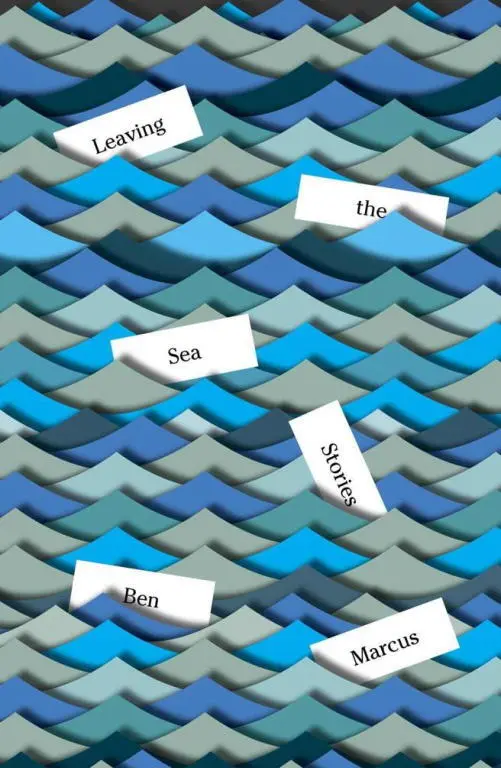
- Название:Leaving the Sea: Stories
- Автор:
- Издательство:Borzoi Books
- Жанр:
- Год:2014
- Город:New York
- ISBN:9780307379382
- Рейтинг книги:4 / 5. Голосов: 1
-
Избранное:Добавить в избранное
- Отзывы:
-
Ваша оценка:
Leaving the Sea: Stories: краткое содержание, описание и аннотация
Предлагаем к чтению аннотацию, описание, краткое содержание или предисловие (зависит от того, что написал сам автор книги «Leaving the Sea: Stories»). Если вы не нашли необходимую информацию о книге — напишите в комментариях, мы постараемся отыскать её.
In the hilarious, lacerating “I Can Say Many Nice Things,” a washed-up writer toying with infidelity leads a creative writing workshop on board a cruise ship. In the dystopian “Rollingwood,” a divorced father struggles to take care of his ill infant, as his ex-wife and colleagues try to render him irrelevant. In “Watching Mysteries with My Mother,” a son meditates on his mother’s mortality, hoping to stave off her death for as long as he sits by her side. And in the title story, told in a single breathtaking sentence, we watch as the narrator’s marriage and his sanity unravel, drawing him to the brink of suicide.
As the collection progresses, we move from more traditional narratives into the experimental work that has made Ben Marcus a groundbreaking master of the short form. In these otherworldly landscapes, characters resort to extreme survival strategies to navigate the terrors of adulthood, one opting to live in a lightless cave and another methodically setting out to recover total childhood innocence; an automaton discovers love and has to reinvent language to accommodate it; filial loyalty is seen as a dangerous weakness that must be drilled away; and the distance from a cubicle to the office coffee cart is refigured as an existential wasteland, requiring heroic effort.
In these piercing, brilliantly observed investigations into human vulnerability and failure, it is often the most absurd and alien predicaments that capture the deepest truths. Surreal and tender, terrifying and life-affirming,
is the work of an utterly unique writer at the height of his powers.
Leaving the Sea: Stories — читать онлайн бесплатно полную книгу (весь текст) целиком
Ниже представлен текст книги, разбитый по страницам. Система сохранения места последней прочитанной страницы, позволяет с удобством читать онлайн бесплатно книгу «Leaving the Sea: Stories», без необходимости каждый раз заново искать на чём Вы остановились. Поставьте закладку, и сможете в любой момент перейти на страницу, на которой закончили чтение.
Интервал:
Закладка:
“You’re not going to walk.”
“Katherine! Katherine!” his father shouted into the car, banging on the window. “Wake up! We have to walk home. Eddie refuses to drive us.”
“Dad, get in. Please. I’m driving you home. Don’t worry.”
“Because we wouldn’t want to put you out.”
They waited in the line of cars revving to leave the high school parking lot. Some people took these evening drills—hellish and deeply pointless as they were—as valuable social encounters. So Edward and his parents sat in traffic—his mother asleep, his father grinding his teeth—while athletically attired settlement leaders strolled up to cars and leaned against drivers’ windows, chatting it out. Running the drill backward, doing the blow by blow, reliving the night because the crisis protocol training was all they damn well had in their lives.
Edward didn’t dare honk. These glad-handing semiprofessional tragedy consumers would turn on him, attack the car, eat his face. Or, worse, they’d stare at him and start to hate him slightly more, if that were possible.
His father, on the other hand, hadn’t noticed that they weren’t moving.
“That Hannah is a Nazi cunt,” his father said.
“Dad, you can’t say things like that about people.”
“She’s a Nazi cunt with a tiny cock.”
“Okay, Dad.”
“What, you don’t agree? You don’t like her, either. Tell me you don’t agree.”
“I don’t agree. She’s in a tough position. She’s just doing her job.”
That set him off.
“Just doing her job! Gandhi was just doing his job.”
“Gandhi?”
“Not Gandhi, that other one. That other one!”
His father was in a rage.
“Which other one? Hitler?”
“The one with the stick. With the blowtorch that reaches across fields down into bunkers. The one who had that huge set of keys! Like a thousand keys on that goddamn monstrous key chain. The one with the small gun they have in the museum in D.C.”
“Mussolini?” he guessed.
“Fuck you!” his father yelled. “Goddamn amateur!”
Edward locked the doors of the car.
“I’m not sure I know who you’re talking about,” Edward responded carefully, “but I know what you mean. You really don’t like Hannah. I get it.”
“Bullshit. You know exactly who I’m talking about. You learned about him in school. I remember you coming home one day saying you wanted to be this motherfucker, this dictator, for Halloween. Imagine how your mother reacted to that.”
His mother. If this had really happened, how would she have reacted? She probably would have cheerfully gone along with it, fitting little Eddie with a large key ring and a blowtorch, sending him off into the neighborhood to gather candy. At the moment, though, his mother had the right idea. She was snoring softly in the backseat.
At Edward’s office the next day, a receptionist fell from her chair and died. The paramedics set up a perimeter around her desk while colleagues from the office looked on, whispering. Edward tried to keep his employees calm. He ran a modest shipping firm where nothing like this ever happened. Why wouldn’t the paramedics touch her, even if it was clear she was dead? Their fear did not bode well. What was the protocol? One of them squinted through a monocle at her body. The others pushed back her cubicle partition. They took pictures and air samples and questioned the coworkers who sat nearby, but they stayed away from her.
The paramedics consulted a radio, then turned to question Edward and his employees.
Had anyone touched this woman? Her clothing? Her hair? Her skin?
No one answered, but of course they had touched her. Edward had still been in his office when she collapsed, but he understood that they’d tried to revive her. They’d loosened her clothing, breathed into her mouth, pounded on her chest. The usual hopeless tricks, taught by sad specialists at adult education centers. And, one year ago, at this very office, for a reasonable discount. Were you not supposed to touch someone who died?
A few hands went up, and these people were escorted to a private office.
“What’s going on?” someone yelled. “Where are you taking them? What are you going to do?”
“Calm down, they’ll be fine,” someone else answered, and this set things off.
“How do you know? You don’t know anything. You have no idea what’s going on.”
The paramedics announced that the office would need to be cleared. Everyone out, quickly and safely, and this quieted people down. They were to please follow their evacuation drill. Employees could wait across the street in the park. They wanted to be able to see everyone from the window.
For what? Edward wondered to himself. So they can take aim?
It would be a little while before this was resolved, the paramedics explained, so people were free to get coffees if they wanted to. Edward hung back until most of his employees had filed out. It was really not appropriate for a paramedic, or anyone, for that matter, to tell his employees to take a coffee break. But he would let it go.
He introduced himself as the boss and asked what was going on, what did they think?
They stared at him.
“Because we thought it was an aneurysm,” he went on. “Except she’s so young. A stroke, maybe? At any rate, it’s horrible. Was it a heart attack? Probably not. What do you guys think?”
When they didn’t answer he continued to theorize out loud, naming ailments. They were leaving him stranded. He couldn’t handle this conversation by himself.
“Sir,” said a paramedic, “we’ll have to ask you to leave with the others.”
“Okay,” Edward said. “But do you know how long this will be? I need to know what to tell my employees. We have kind of a crazy day ahead.”
It was true. Edward had five job candidates to interview after lunch, and he had been planning to spend the morning in preparation.
The paramedics shook their heads and stared at him again, as if they were baffled that Edward expected them to stoop to a conversation with someone like him.
Edward wasn’t finished. This was his office, and they were sprawled out in his chairs, and they’d moved and probably broken office equipment he’d paid for, while completely ignoring him. Or, at the very least, failing to take him seriously.
“It’s Kristina,” he said.
Again they looked at him in their odd way, like doctors standing around at a morgue.
“Kristina is her name,” Edward said, gesturing at the dead woman. “She’s from Ditmars. I hired her about six months ago. She went to college…I forget where. She was a terrific employee. Here’s her emergency contact information, if you want it. But maybe you don’t want it. Maybe you guys don’t care. Maybe this is simply too boring for you and that’s why you can’t speak. You’re bored. Well, her name is Kristina. Show some fucking respect.”
One of the paramedics stood up.
“Sir,” he said, gesturing at an officer holding a cell phone. “This is Deputy Arnold Sjogren. His sister was a close friend of Kristina’s. We know exactly who she is, we grieve her passing, and now we are doing our jobs. The longer you stand here yelling at us, without any facts, the greater risk you place yourself in. I can’t speak for my colleagues, but I personally do not require a lesson in respect. We are risking our lives today, and you are not. Who should be showing respect to whom?”
It was cold outside, not yet ten in the morning. Kristina must have only just started work when she died. In truth, Edward reflected, she had been a detached figure in the office, a kind of ghost. When she was trained, including a short session with Edward himself—since he tried to impress upon his new employees the larger aims of the company—she seemed indifferent. He felt obliged to act excited about his life’s work, even if it sometimes exhausted him.
Читать дальшеИнтервал:
Закладка:
Похожие книги на «Leaving the Sea: Stories»
Представляем Вашему вниманию похожие книги на «Leaving the Sea: Stories» списком для выбора. Мы отобрали схожую по названию и смыслу литературу в надежде предоставить читателям больше вариантов отыскать новые, интересные, ещё непрочитанные произведения.












Обсуждение, отзывы о книге «Leaving the Sea: Stories» и просто собственные мнения читателей. Оставьте ваши комментарии, напишите, что Вы думаете о произведении, его смысле или главных героях. Укажите что конкретно понравилось, а что нет, и почему Вы так считаете.