Ben Marcus - Leaving the Sea - Stories
Здесь есть возможность читать онлайн «Ben Marcus - Leaving the Sea - Stories» весь текст электронной книги совершенно бесплатно (целиком полную версию без сокращений). В некоторых случаях можно слушать аудио, скачать через торрент в формате fb2 и присутствует краткое содержание. Город: New York, Год выпуска: 2014, ISBN: 2014, Издательство: Borzoi Books, Жанр: Современная проза, на английском языке. Описание произведения, (предисловие) а так же отзывы посетителей доступны на портале библиотеки ЛибКат.
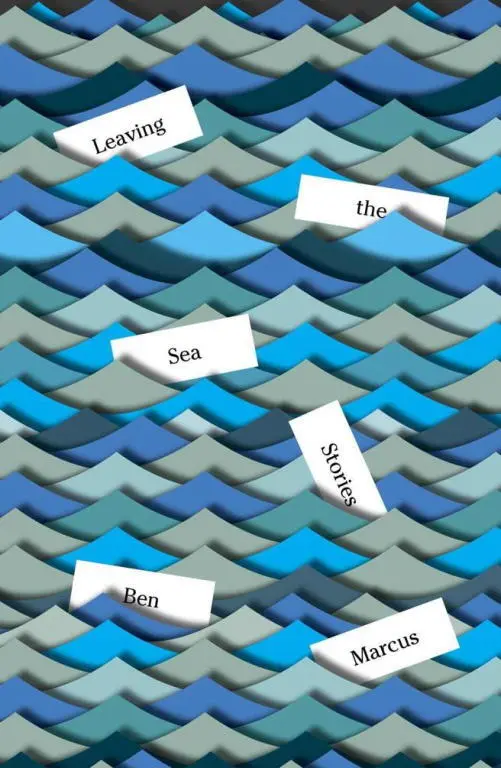
- Название:Leaving the Sea: Stories
- Автор:
- Издательство:Borzoi Books
- Жанр:
- Год:2014
- Город:New York
- ISBN:9780307379382
- Рейтинг книги:4 / 5. Голосов: 1
-
Избранное:Добавить в избранное
- Отзывы:
-
Ваша оценка:
Leaving the Sea: Stories: краткое содержание, описание и аннотация
Предлагаем к чтению аннотацию, описание, краткое содержание или предисловие (зависит от того, что написал сам автор книги «Leaving the Sea: Stories»). Если вы не нашли необходимую информацию о книге — напишите в комментариях, мы постараемся отыскать её.
In the hilarious, lacerating “I Can Say Many Nice Things,” a washed-up writer toying with infidelity leads a creative writing workshop on board a cruise ship. In the dystopian “Rollingwood,” a divorced father struggles to take care of his ill infant, as his ex-wife and colleagues try to render him irrelevant. In “Watching Mysteries with My Mother,” a son meditates on his mother’s mortality, hoping to stave off her death for as long as he sits by her side. And in the title story, told in a single breathtaking sentence, we watch as the narrator’s marriage and his sanity unravel, drawing him to the brink of suicide.
As the collection progresses, we move from more traditional narratives into the experimental work that has made Ben Marcus a groundbreaking master of the short form. In these otherworldly landscapes, characters resort to extreme survival strategies to navigate the terrors of adulthood, one opting to live in a lightless cave and another methodically setting out to recover total childhood innocence; an automaton discovers love and has to reinvent language to accommodate it; filial loyalty is seen as a dangerous weakness that must be drilled away; and the distance from a cubicle to the office coffee cart is refigured as an existential wasteland, requiring heroic effort.
In these piercing, brilliantly observed investigations into human vulnerability and failure, it is often the most absurd and alien predicaments that capture the deepest truths. Surreal and tender, terrifying and life-affirming,
is the work of an utterly unique writer at the height of his powers.
Leaving the Sea: Stories — читать онлайн бесплатно полную книгу (весь текст) целиком
Ниже представлен текст книги, разбитый по страницам. Система сохранения места последней прочитанной страницы, позволяет с удобством читать онлайн бесплатно книгу «Leaving the Sea: Stories», без необходимости каждый раз заново искать на чём Вы остановились. Поставьте закладку, и сможете в любой момент перейти на страницу, на которой закончили чтение.
Интервал:
Закладка:
Across the street stood his employees, shivering and coatless, holding their arms. Others huddled together, crying.
Edward and his employees—all fifteen of them, or it’d be fourteen now—were not accustomed to being outside together. It was Edward who made them nervous, and he knew it. He shunned the public spaces at work for this very reason, protecting his employees from the destabilizing effect of his presence, keeping to his private office whenever he could. What a kind service to offer, to keep them from having to see him up close. He tried to be nice and cordial, but it was true that in some deep way he had trouble thinking of them as human, with lives outside of the office. Was this bad, especially if he never showed it? He thought of himself as deeply empathic—if mainly toward himself. In theory he held a strong share of empathy in reserve for a stranger he had yet to meet.
His team was standing in the little patch of dirt that passed for a park. When Edward approached they fell silent. A broad swing set creaked on the other side of the square. As the boss, it seemed that he should speak. He should sum up, or lead them in prayer, or say something, perhaps, cheerful. Maybe it was too soon for that?
“Well, poor thing,” said Edward, finally.
“Did you call her family?” someone asked, and the others nodded, leaning in.
This alarmed him. Was he supposed to do that? How could he call Kristina’s family if he didn’t know the facts? At any rate he’d left the emergency contact card with the paramedics.
“They’re taking care of it,” Edward said, nodding up at the building.
But were they? He could feel his employees thinking that this was his job. He was supposed to take care of it, not some bland paramedics, inured to calamity. What if one of them had died, he imagined them thinking. Would Edward, their supervisor, neglect to call their families, leaving it to some rookie EMT who might not even be able to pronounce their names? What fucking kind of boss was he? Any one of them could have died today. They could die tomorrow, or next week. Could Edward be trusted to call their spouses or roommates or parents—to at least pretend that he cared?
After they stood there looking at their feet, someone volunteered that they’d been discussing how Kristina might have died. They focused on Edward again, and again he hated being in charge.
“Did you learn anything? What did they say?”
Edward shook his head. “I shouldn’t really comment,” he said, adopting an air of secrecy. “They asked me not to say anything. I’m sorry. I’d better not.”
Oh, was he something. For a few moments Edward’s employees could—wrongly! wrongly!—see him as a person with exclusive information, entrusted with a secret. An insider. And in exchange, what? What did he get for this lie? Well, for one, Edward would never forget what he’d said here today, how low he’d fallen. That seemed fair. A fair deal. He might as well bask in their awestruck sense of his power. Why not enjoy it for a while?
People started to drift off. Jonathan took a sandwich order, but when it grew too complicated someone suggested that they all go, and they looked at Edward expectantly. This was going to take a while. He sent them off with his blessing—explaining that he should really stay here in case they needed him—and he was left alone in the park, staring up at the window to his office, where, for some reason, the shade had been drawn.
The first job candidate showed up right on time, minutes after the hazmat truck and the mayor’s motorcade pulled away. Edward and his employees had only just been cleared to return to the building. The candidate, Elise Mortensen, was announced when Edward returned to his office, where he discovered that his documents had been disturbed. His filing cabinets were open. On his shelves the books had been tossed around. Did they think he was hiding something? A smell ran through the room, too, something floral that he hadn’t noticed in the outer offices. He didn’t have time to take stock of what had changed or to wonder what they were looking for in his office, so far from where Kristina died, when Elise Mortensen came in, adopting an exaggerated tiptoe, as if she were disturbing him, which she kind of fucking was, and asked where to sit.
Edward fumbled through the interview. He started with the dreaded opener Tell me about yourself, so he could collect his thoughts. Elise Mortensen seemed to have been waiting her whole life to answer this question and she went for it. She delivered a droning memoir that kept rising in tone, which assured Edward that it might not end until she died. He kept his eyes fixed on hers and established a pattern of interested nods, then withdrew his attention to the place where it rightly belonged. On himself.
Edward tried to piece together the morning’s events. What interest would the mayor have in Kristina’s death, and why would Frederick from the workshop be part of the mayor’s entourage? This was arguably the worst part of the morning, standing across the street watching the mayor exit his car, followed by business-suited staff whispering into their phones, and then, what the fuck, Frederick from the workshop, almost like a government official now, wearing his jumpsuit, carrying a duffel bag.
At that point Edward figured it was okay to bring his employees across the street so they could wait at the entrance. In truth it offered Edward another chance to discuss the situation with officials, perhaps reestablish his authority. This was his office! He paid rent here, and the death had happened during working hours at his business. And he, not that he wanted to broadcast this, was liable for what happened. But of course he was rebuffed at the door by a police officer, even while his employees looked on, knowing—how could they not know?—that Edward had no influence. No role to play. He was a bystander just like they were.
When the mayor came out, Frederick pointed at Edward in the crowd.
“There he is!” yelled Frederick, and the mayor’s entire entourage peered into the crowd, as if a rare animal had been sighted.
Edward froze.
“That’s the man!”
Next to Edward stood Philip, who returned Frederick’s greeting, said things were fine, considering, and what the hell, a tragedy, right, to which Frederick shrugged, pointing at the mayor with a knowing look. This wasn’t about him. Edward lowered his hand and stepped behind Philip, where it was warm and safe, waiting for the motorcade to leave.
There was a final interview that afternoon, and then he could go home. Edward thought he would die. At times like this, when he didn’t want to be seen by anyone in the office, and with the bathroom so conspicuous at the other end of the office, the entire staff watching him go in and come out, Edward peed in a jar that he kept in his drawer. He was sealing the lid when the last candidate was announced: Hannah Glazer. Oh dear God. The same Hannah, the settlement leader, who’d turned away his parents.
On his desk was her résumé, which he couldn’t focus on, but he willed himself into the conversation. As ever, it was difficult to look at her and be reminded of an enormous segment of life—the segment in which you were naked with a stunning person and she was not repulsed by you—that was not available to him. She wore tailored black clothes, her eyes clear and mean, and her hair was arranged in one of those old-fashioned styles, pasted to her head at the top and then curled out at the bottom. Quite lovely.
“What interests you about the position?” Edward started.
“You’re kidding, right?” Hannah said, glaring at him.
So he would have found no viable candidates today. A receptionist had died, and he’d have to interview for her replacement, and now he’d need to schedule another day of interviews for this position as well.
Читать дальшеИнтервал:
Закладка:
Похожие книги на «Leaving the Sea: Stories»
Представляем Вашему вниманию похожие книги на «Leaving the Sea: Stories» списком для выбора. Мы отобрали схожую по названию и смыслу литературу в надежде предоставить читателям больше вариантов отыскать новые, интересные, ещё непрочитанные произведения.









Обсуждение, отзывы о книге «Leaving the Sea: Stories» и просто собственные мнения читателей. Оставьте ваши комментарии, напишите, что Вы думаете о произведении, его смысле или главных героях. Укажите что конкретно понравилось, а что нет, и почему Вы так считаете.