Ben Marcus - Leaving the Sea - Stories
Здесь есть возможность читать онлайн «Ben Marcus - Leaving the Sea - Stories» весь текст электронной книги совершенно бесплатно (целиком полную версию без сокращений). В некоторых случаях можно слушать аудио, скачать через торрент в формате fb2 и присутствует краткое содержание. Город: New York, Год выпуска: 2014, ISBN: 2014, Издательство: Borzoi Books, Жанр: Современная проза, на английском языке. Описание произведения, (предисловие) а так же отзывы посетителей доступны на портале библиотеки ЛибКат.
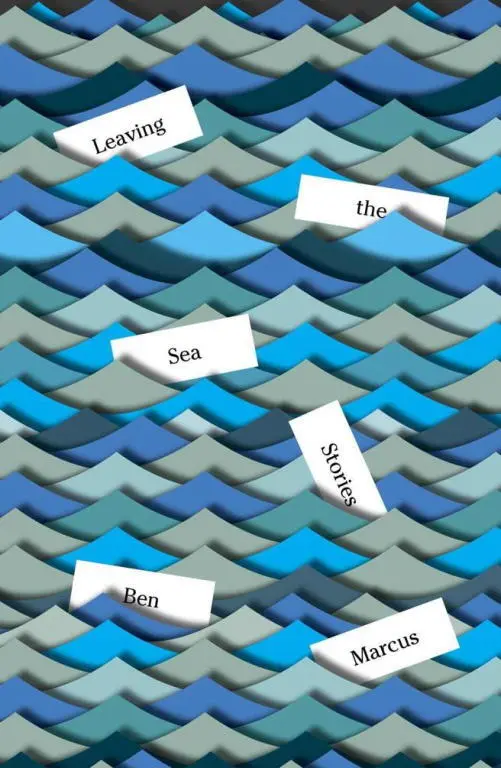
- Название:Leaving the Sea: Stories
- Автор:
- Издательство:Borzoi Books
- Жанр:
- Год:2014
- Город:New York
- ISBN:9780307379382
- Рейтинг книги:4 / 5. Голосов: 1
-
Избранное:Добавить в избранное
- Отзывы:
-
Ваша оценка:
Leaving the Sea: Stories: краткое содержание, описание и аннотация
Предлагаем к чтению аннотацию, описание, краткое содержание или предисловие (зависит от того, что написал сам автор книги «Leaving the Sea: Stories»). Если вы не нашли необходимую информацию о книге — напишите в комментариях, мы постараемся отыскать её.
In the hilarious, lacerating “I Can Say Many Nice Things,” a washed-up writer toying with infidelity leads a creative writing workshop on board a cruise ship. In the dystopian “Rollingwood,” a divorced father struggles to take care of his ill infant, as his ex-wife and colleagues try to render him irrelevant. In “Watching Mysteries with My Mother,” a son meditates on his mother’s mortality, hoping to stave off her death for as long as he sits by her side. And in the title story, told in a single breathtaking sentence, we watch as the narrator’s marriage and his sanity unravel, drawing him to the brink of suicide.
As the collection progresses, we move from more traditional narratives into the experimental work that has made Ben Marcus a groundbreaking master of the short form. In these otherworldly landscapes, characters resort to extreme survival strategies to navigate the terrors of adulthood, one opting to live in a lightless cave and another methodically setting out to recover total childhood innocence; an automaton discovers love and has to reinvent language to accommodate it; filial loyalty is seen as a dangerous weakness that must be drilled away; and the distance from a cubicle to the office coffee cart is refigured as an existential wasteland, requiring heroic effort.
In these piercing, brilliantly observed investigations into human vulnerability and failure, it is often the most absurd and alien predicaments that capture the deepest truths. Surreal and tender, terrifying and life-affirming,
is the work of an utterly unique writer at the height of his powers.
Leaving the Sea: Stories — читать онлайн бесплатно полную книгу (весь текст) целиком
Ниже представлен текст книги, разбитый по страницам. Система сохранения места последней прочитанной страницы, позволяет с удобством читать онлайн бесплатно книгу «Leaving the Sea: Stories», без необходимости каждый раз заново искать на чём Вы остановились. Поставьте закладку, и сможете в любой момент перейти на страницу, на которой закончили чтение.
Интервал:
Закладка:
Only one other time had the drill run this long. To Edward, that night seemed like years ago, when the workshop began, when it was just a few worried citizens finally admitting to each other how little they knew of the future. But probably it was only last winter. It was a viciously cold night and they’d waited in this very spot while the buses warmed up. He’d been so scared! But then Frederick’s girlish voice had rung out through a megaphone and everyone had hurried back for their critiques.
So there was still time. Frederick could call this off and get them back inside.
As the settlements gathered behind him, headed to separate buses, Edward waited and waited and waited, until finally Hannah approached, and, behind her, her settlement, mostly old-timers from Wellery Heights. He had only a moment for this, but he had to do it. There was nothing in the protocol about it, anyway. The protocol hadn’t been written this far. It was a blank chapter. They’d spoken so much about how after a certain point nothing could be known, and they were right. Edward grabbed his father, who looked startled, and then the two of them opened their mouths soundlessly at each other. They couldn’t hear anything. It was his mother Edward needed to know about. His mother. He shrugged where and he mimed other things, things to indicate his mother, which anyone else from any country in the world, during any kind of crisis, would understand, but it was no use, it was stupid. Or his father was stupid, because he either did not get it or did not want to, smiling dumbly at Edward, reflecting the mime back at him as if it was a game. Finally Edward grabbed his father’s left hand, isolating the ring finger, and held it up to him, tapping on the ring.
Do you get it now, you stupid old man? Where is she?
Edward’s father smiled, put his palms together, closed his eyes, and leaned his head against his hands. A universal sign. His mother was home sleeping. His father had left her there asleep, and don’t worry, she was doing fine.
His mother was asleep, alone, at home. In a city that might soon be empty. She was fine.
The buses traveled south. Frederick had been wrong about the highway. It was not an ugly variable. It didn’t even present a problem. Was something supposed to shoot out at them from the trees? He was no longer sure what, exactly, he was supposed to fear. In a caravan the buses climbed the on-ramp, entering a freeway that seemed reserved for them alone. They drove for hours. The driver was in radio communication, but otherwise the bus was quiet. Edward sat by himself in a rear seat, staring from the window. At this point, he reasoned, the drill should have been called. They’d done it. They’d proven they could leave quickly, if necessary. But now what? They’d never rehearsed this far, so what on earth could they be testing? Wasn’t it a pain in the ass now that they were so far from home, and how exactly were they going to get back? The buses, of course, could be ordered to turn around. But as the sun started to rise, and as muffins wrapped in brown paper were sent back, along with juice boxes and clear packs of vitamin pills, that didn’t seem so likely.
During the second day of driving, after he’d slept and woken and then slept a little bit more, he heard a commotion at the front of the bus and the bus steamed and seized and buckled as it started to slow down and pull off the highway.
Thom slid into the seat next to him.
“Holy fuck, right?”
“What happened?” asked Edward, still waking up.
“Sharon.”
As the bus lurched to a stop, Edward tried to look, but there were too many people mobbed together.
“Is she okay?” he asked.
Thom shook his head. “I don’t think so. She fell out of her seat. All of a sudden. I only got a quick look. But, fuck, man, I think she’s dead.”
It was a pretty sight. Ten—or was it more—glittering yellow buses pulled over on the side of the highway. Edward’s was the only bus that had discharged its passengers, and this was spoiling a lovely image: ragged, tired travelers wandering up and down the embankment while the passengers from the other buses, from behind darkened glass, looked on. Edward found a soft, dry place to sit. What a drill this was! Something for the record books. In a strange way he was excited for the critique. How would you begin to pick this apart? He wondered, surveying the fleet, which of the buses carried his father. Sharon had been removed, conveyed on a stretcher by some younger fellows, who’d hiked her into the woods and returned already. Without Sharon. Without even the stretcher. They were sharing a thermos down in the grass. One of them sang something. Edward wasn’t sure what the holdup was now, even while Frederick and some others, including the mayor, huddled in conference down in the shadow of the last bus.
It wasn’t long before a signal was given and the buses revved up again. Edward stood and joined the orderly line his settlement had formed to board their bus, but the door didn’t open and their driver never appeared. Where was he, and who was supposed to drive them now?
Frederick and his crew had already boarded their buses. One by one the other buses wheezed into motion, crawling from the side of the road to join the highway. His neighbors reacted differently to the situation that dawned on them, but Edward stood out on the shoulder to watch. Of course the windows of the buses were dark, so he couldn’t see, but in one of them, perhaps pressed against the glass, perhaps waving at him this very moment, waving hello and, of course, good-bye, was his father. So Edward, just in case, raised his own hand, too. Raised it and waved—thinking, Good-bye, Dad, at least for now —as the other buses built up speed down the highway and disappeared from sight, leaving the rest of them alone in the grass by the side of the road.
PART 4
The Father Costume
My father’s costumes were gray and long and of the finest pile, sometimes clear enough for us to see through, though there was no reason to look too closely at that man’s body. He preferred not to move. He was not one for excursions. My brother and I accomplished most of the required motion for him: we collected and described the daily food, oiled the Costume Gun, gathered yarn each morning after a storm, and donated any leftover swatches of fabric into our mother’s kill hole out on the back platform.
My father threw handfuls of our mother’s fabrics in the morning and studied how they fell, diagrams in cloth that could have meant anything. His body was hunched and foreign. He grimaced with each gesture, his face often decorated with cotton bracings. When the disarray proved baffling to him, he brought in my brother for consultations. I sat on the bench and watched them crouch at their work. I could not read fabric. I had a language problem. My brother spoke a language called Forecast. It consisted of sounds he barked into a stippled leather box. When my father wrapped my brother’s hands in cotton waffling, my brother could tap out a low-altitude language on the floor, short thuds of speech that my father held his listening jar to. On those evenings when the sky was stretched too tight and the birds struck against it like pebbles on our roof, my brother slept off his Forecast expulsions in a sling hanging from our door. He cried softly inside his mesh bag while I dotted our windowsills with listening utensils, in case a message came in the night.
It would be so nice to think that a boat was not involved, that instead we lugged our things overland in wagons. At least overland we might have been sighted from the air. We would at least have not encountered so many empty platforms, floating alone at sea. My father might have been less tempted to perform so many jettisons.
Читать дальшеИнтервал:
Закладка:
Похожие книги на «Leaving the Sea: Stories»
Представляем Вашему вниманию похожие книги на «Leaving the Sea: Stories» списком для выбора. Мы отобрали схожую по названию и смыслу литературу в надежде предоставить читателям больше вариантов отыскать новые, интересные, ещё непрочитанные произведения.







Обсуждение, отзывы о книге «Leaving the Sea: Stories» и просто собственные мнения читателей. Оставьте ваши комментарии, напишите, что Вы думаете о произведении, его смысле или главных героях. Укажите что конкретно понравилось, а что нет, и почему Вы так считаете.