Ben Marcus - Leaving the Sea - Stories
Здесь есть возможность читать онлайн «Ben Marcus - Leaving the Sea - Stories» весь текст электронной книги совершенно бесплатно (целиком полную версию без сокращений). В некоторых случаях можно слушать аудио, скачать через торрент в формате fb2 и присутствует краткое содержание. Город: New York, Год выпуска: 2014, ISBN: 2014, Издательство: Borzoi Books, Жанр: Современная проза, на английском языке. Описание произведения, (предисловие) а так же отзывы посетителей доступны на портале библиотеки ЛибКат.
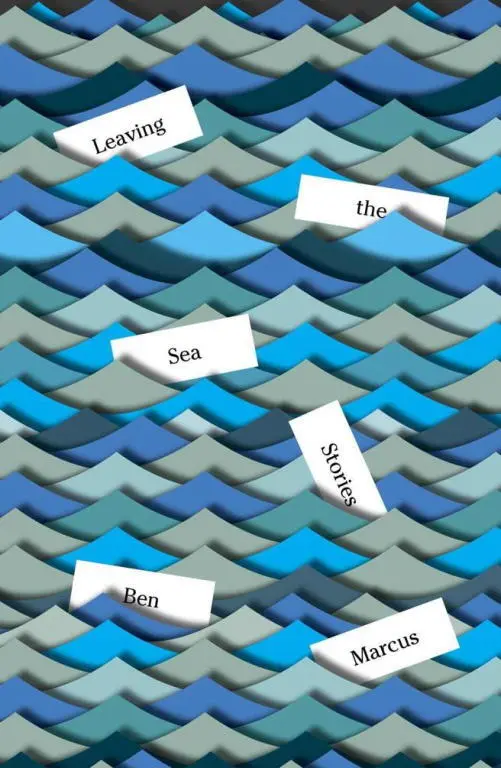
- Название:Leaving the Sea: Stories
- Автор:
- Издательство:Borzoi Books
- Жанр:
- Год:2014
- Город:New York
- ISBN:9780307379382
- Рейтинг книги:4 / 5. Голосов: 1
-
Избранное:Добавить в избранное
- Отзывы:
-
Ваша оценка:
Leaving the Sea: Stories: краткое содержание, описание и аннотация
Предлагаем к чтению аннотацию, описание, краткое содержание или предисловие (зависит от того, что написал сам автор книги «Leaving the Sea: Stories»). Если вы не нашли необходимую информацию о книге — напишите в комментариях, мы постараемся отыскать её.
In the hilarious, lacerating “I Can Say Many Nice Things,” a washed-up writer toying with infidelity leads a creative writing workshop on board a cruise ship. In the dystopian “Rollingwood,” a divorced father struggles to take care of his ill infant, as his ex-wife and colleagues try to render him irrelevant. In “Watching Mysteries with My Mother,” a son meditates on his mother’s mortality, hoping to stave off her death for as long as he sits by her side. And in the title story, told in a single breathtaking sentence, we watch as the narrator’s marriage and his sanity unravel, drawing him to the brink of suicide.
As the collection progresses, we move from more traditional narratives into the experimental work that has made Ben Marcus a groundbreaking master of the short form. In these otherworldly landscapes, characters resort to extreme survival strategies to navigate the terrors of adulthood, one opting to live in a lightless cave and another methodically setting out to recover total childhood innocence; an automaton discovers love and has to reinvent language to accommodate it; filial loyalty is seen as a dangerous weakness that must be drilled away; and the distance from a cubicle to the office coffee cart is refigured as an existential wasteland, requiring heroic effort.
In these piercing, brilliantly observed investigations into human vulnerability and failure, it is often the most absurd and alien predicaments that capture the deepest truths. Surreal and tender, terrifying and life-affirming,
is the work of an utterly unique writer at the height of his powers.
Leaving the Sea: Stories — читать онлайн бесплатно полную книгу (весь текст) целиком
Ниже представлен текст книги, разбитый по страницам. Система сохранения места последней прочитанной страницы, позволяет с удобством читать онлайн бесплатно книгу «Leaving the Sea: Stories», без необходимости каждый раз заново искать на чём Вы остановились. Поставьте закладку, и сможете в любой момент перейти на страницу, на которой закончили чтение.
Интервал:
Закладка:
The day was mostly a crude alphabet of sounds, like one of the Southern languages recited through a gauze filter. It made my father cross. He rowed crudely, chopping at the water as if it were ice, and we slid away from our home in jerking strides. Animals may have been responsible for the noises we heard, but I saw little that was living, only clean geometries of clouds above a rigid tree line, and a shore that receded the more you stared at it. We sailed the narrow waterway until the houses grew small and pale, whitish blurs on the horizon, and the water thickened beneath us.
For hours we saw only my father’s back, tilting against the long oars. On the shore were long descriptions scrolling in the tree line, sentences indecipherable without the proper cloth filter. We had only so much burlap to spare, and the messages did not seem crucial. We were always choosing what we needed to know, yet I had trouble leaving those sentences unread. I thought they might have been placed there for us. My brother moved our costume to keep me from seeing the shore. I saw only the wake behind us, a trail of foam that produced a language of bubbles so intimate I was ashamed to decipher it.
When the sun was directly above us and our shadows were deep inside our own bodies, my father produced the first parcel. There was a cheese that we had been saving. There was a bread. The bread was wrapped in a stiff sheet of wool. It was given to me to undress it. First I held my hands in the water. If I closed my eyes, the water felt as loose and grainy as soil, with bits that broke gently against my touch. My hands were smooth and glistening when I removed them, and the bread unraveled easily. We kept the items of the parcel near our persons, in contact always with our costumes, in case witnesses from the far shore had been employed. In case, my father said, someone was given a reason to come out there after us. We used the cheese and bread without much motion. Someone watching could easily have assumed that we were sleeping. After we ate, I shot a thin piece of wool into the water as an offering.
I have a photo of my brother that is simply a picture of an empty field. I am collecting empty spaces for him that he might like, spaces safe enough for entry. There is a scratchy yellow grass growing wild, a dried white mud, nothing much alive in the air. Trees with shriveled limbs corkscrew over the field, providing a cage of wooden protection. No people there, least of all my brother, least of all even an artifact of his several costumes. There is no clothing. I could throw this photo into water, to feed the image enough for my brother to grow in it. It seems a safe enough place for him to enter, a place with none of the warning signs that in the end kept my brother from going anywhere. He could live in this field, if only I could make him grow there.
We rowed on because my father told us to. Words were exchanged that I could not use. My brother had spent his ration of bread to brace his mouth for brand-new utterances that hurt me to listen to. My father had an angry body that he kept turned away from us. I held my head low and watched the water flowing around us. Signs posted in the channel told of families that had come and gone. Cursive script on wooden placards, counterweighted with buoys, like simple billboards on a road. Short, orbular lights mounted on the signs cast oily images of the various fathers on the water, spotlights of men’s faces as if projected from the bellies of birds. The current was troubled enough to dissolve these fathers’ faces as it pulled us along, until we were sailing directly over wavy versions of these men as we tried not to read of what had happened to them, who they were, what they did, why they failed.
The signs, in the end, gave way simply to sticks and platforms as we gained the ocean, weeds coiling up out of the water around them. We saw no more writing for hours. My head became blank and I remembered an old song a woman used to sing. It was a song built of pauses and breath, with notes that were just the words a person might use to procure food, yet once I remembered it, it seemed crucial to my own breathing, and I worried that if I forgot to keep time with the song, to hum it always, I might fail to breathe, I might lose my own time for good.
It was early afternoon by the time my father showed his full face to me. I did not care to see it. It was too big. Anyone could have been inside it. He required me to see him there in our boat on the water, and I obliged as much as I could. My brother, I suspect, did his best to look away. I felt the costume pulling at me, tight as a muscle.
The second parcel in my father’s bag contained a metronome, with a hollow darning needle that served as the wand. He placed it near my brother, adjusted the dial to Suffocate, and caused my brother, after several spasms of resistance, to stop breathing. Our boat felt lighter immediately, and we began to pick up speed, slicing swiftly through a water channel that suddenly seemed as light as air.
If it were up to me, I would dress my father in a long, clear sleep costume. I would knit linens from my mother’s abandoned luggage and spray them from the Costume Gun onto my father. I would weight my hands with heavy blocks of wool, which I would toss in the water to create a retention current, to keep my father from rowing away. A set of spirals in the water that would prove inescapable to him. If it were up to me, I would soak my father’s hands in milk, then fit them with gloves of hemp. I would use the leftover milk to make a writing. My father I would fix to a platform on the water until the animals came for him. If I ever saw my father again, I would let the animals come for him, even if I had to costume the animals myself with special attack clothing—father-hunting shirts, father-killing hats, father-chasing corsets—even if I had to teach them how to swim after someone as fast, as expertly clothed, as my father. I would teach them. If my father would not be disrobed, I would wait on my platform until animals came to help. It would be simply a matter of time.
The metronome produced an English sound. My father had stopped rowing. He was collecting small writing samples from the water. I was sharing a costume with a boy who could not breathe. It was like having a body that was partly cold and numb, a part of my person being now just furniture I carried with me. My brother’s head was dry. I could hear it scratching against the facial cloak on his side of the costume, the sound a dog might make if it was buried alive. I tried to adjust some zippers and buttons, but the change only hastened my own breathing, until I worried I might hyperventilate and be thrown from the costume, which could only tolerate a certain number of breaths per minute. During each expression of the metronome, I beckoned to my brother using special, waterproof sounds, which I was careful to conceal from my father. He was busy fitting vials of a possible fluid into the compartments on his vest. A fluid filled with writing. I had seen him wear glass only once before. During one of the famous years, when children operated the electricity console in our town, he had lined his chest with glass and set about to alter the kill hole. We watched him from the window, his body stretched thin and long behind his special outfit. This time, his glass costume consisted of short, stubby bullets filled with fluid. As much as I squinted at him, I could see nothing behind it.
The two of us would never be more at sea. I was my father’s only son. Some town registry should acknowledge the change. Looking around me, I thought I could produce a drowning, with a little effort. We exchanged one sector of nowhere for another. Travel seemed exclusively contrived to make houses disappear. There was nothing out there but water. At the most, I saw the empty platforms, like lily pads, scattered throughout the waves. But no land anywhere.
Читать дальшеИнтервал:
Закладка:
Похожие книги на «Leaving the Sea: Stories»
Представляем Вашему вниманию похожие книги на «Leaving the Sea: Stories» списком для выбора. Мы отобрали схожую по названию и смыслу литературу в надежде предоставить читателям больше вариантов отыскать новые, интересные, ещё непрочитанные произведения.



Обсуждение, отзывы о книге «Leaving the Sea: Stories» и просто собственные мнения читателей. Оставьте ваши комментарии, напишите, что Вы думаете о произведении, его смысле или главных героях. Укажите что конкретно понравилось, а что нет, и почему Вы так считаете.