Ben Marcus - Leaving the Sea - Stories
Здесь есть возможность читать онлайн «Ben Marcus - Leaving the Sea - Stories» весь текст электронной книги совершенно бесплатно (целиком полную версию без сокращений). В некоторых случаях можно слушать аудио, скачать через торрент в формате fb2 и присутствует краткое содержание. Город: New York, Год выпуска: 2014, ISBN: 2014, Издательство: Borzoi Books, Жанр: Современная проза, на английском языке. Описание произведения, (предисловие) а так же отзывы посетителей доступны на портале библиотеки ЛибКат.
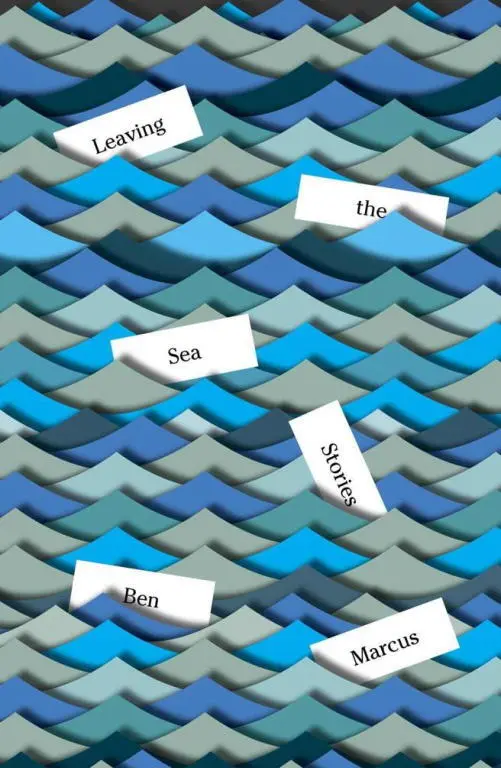
- Название:Leaving the Sea: Stories
- Автор:
- Издательство:Borzoi Books
- Жанр:
- Год:2014
- Город:New York
- ISBN:9780307379382
- Рейтинг книги:4 / 5. Голосов: 1
-
Избранное:Добавить в избранное
- Отзывы:
-
Ваша оценка:
Leaving the Sea: Stories: краткое содержание, описание и аннотация
Предлагаем к чтению аннотацию, описание, краткое содержание или предисловие (зависит от того, что написал сам автор книги «Leaving the Sea: Stories»). Если вы не нашли необходимую информацию о книге — напишите в комментариях, мы постараемся отыскать её.
In the hilarious, lacerating “I Can Say Many Nice Things,” a washed-up writer toying with infidelity leads a creative writing workshop on board a cruise ship. In the dystopian “Rollingwood,” a divorced father struggles to take care of his ill infant, as his ex-wife and colleagues try to render him irrelevant. In “Watching Mysteries with My Mother,” a son meditates on his mother’s mortality, hoping to stave off her death for as long as he sits by her side. And in the title story, told in a single breathtaking sentence, we watch as the narrator’s marriage and his sanity unravel, drawing him to the brink of suicide.
As the collection progresses, we move from more traditional narratives into the experimental work that has made Ben Marcus a groundbreaking master of the short form. In these otherworldly landscapes, characters resort to extreme survival strategies to navigate the terrors of adulthood, one opting to live in a lightless cave and another methodically setting out to recover total childhood innocence; an automaton discovers love and has to reinvent language to accommodate it; filial loyalty is seen as a dangerous weakness that must be drilled away; and the distance from a cubicle to the office coffee cart is refigured as an existential wasteland, requiring heroic effort.
In these piercing, brilliantly observed investigations into human vulnerability and failure, it is often the most absurd and alien predicaments that capture the deepest truths. Surreal and tender, terrifying and life-affirming,
is the work of an utterly unique writer at the height of his powers.
Leaving the Sea: Stories — читать онлайн бесплатно полную книгу (весь текст) целиком
Ниже представлен текст книги, разбитый по страницам. Система сохранения места последней прочитанной страницы, позволяет с удобством читать онлайн бесплатно книгу «Leaving the Sea: Stories», без необходимости каждый раз заново искать на чём Вы остановились. Поставьте закладку, и сможете в любой момент перейти на страницу, на которой закончили чтение.
Интервал:
Закладка:
We were going to row until evening. I was wearing clothing enough for two, but there was just one of us now. In tribute, my father broadcast audiotapes of my brother for us to listen to, mostly weeping sounds from when he was younger. He hooked the small speakers of the machine to the outside of the boat and aimed the sound of my brother directly into the water, using a volume mechanism derived from my mother’s old sewing kit. A loose, circular current reflected the sound, leaving frothing pools in the water as we sailed through. Other boats might later trigger these sorrow vectors of my brother’s, sailing through his weeping pools. He would cry for them, if they could find the right patch of water. If they could sail into it.
Sadness could be stored in an area, sealed in a small spot of water. Water could be the costume for what my brother felt.
I spoke to my father’s back with my hands, shielding my speech with a canvas visor. My hands cast the wrong sorts of shadows on the bottom of the boat, a set of lines so precise that they could have been simple English sentences asking for help. It worried me to think my father might misunderstand me. I stroked the empty part of my clothing and scanned the vast, blank water for land. There was nothing anywhere, just the water rippling beneath our boat, which made a low, smooth Spanish sound.
If he heard or saw my speech he did not acknowledge it. He had opened the third parcel, a collection of lenses, which he braced below our sails with a system of rigging I could not comprehend. As I looked up, I saw through the distortion of the lenses a sky and sun that were grotesquely oversized, magnified beyond repair, swollen and bloated and not possible to regard for long. My only thought then was that if the above and beyond were rendered so large, if he had dilated those items of our world that were already massive, and his lenses worked their exaggerations in reverse, how small indeed would the two of us look sailing below in our boat? Had we become tiny enough to no longer be seen? Was my father, with his third parcel, creating a disappearance? Was it a new costume of nothing?
If it were up to me, I would not come from a place where fathers leave their houses by boat. Where fathers kill a costume and leave heaps of cloth like grave sites in their wake. I would choose a world of straight grass roads, with only famous years, with only days of actual light, where a metronome might be silenced by the right kind of sunlight. I would choose a house free of kill holes where a mother still stood upright and walked the rooms, using a soothing medical voice entirely free of cloth. There would be pieces of time produced through the furnace of the house, and the word memory would have an angry meaning. People would have memories to turn red, to fume, to produce a special smoke. If it were up to me, a father’s costume could be filled with special English air and set afloat outside a house. This air-filled costume could be fed with chunks of hardened time so that the family inside would not die. The costume would be called a Day Eater. Growing old would be its sacrifice. The Bird Metronome would keep the costume clean. If the chunks became depleted, the costume could feed on the father himself, who would still be located somewhere deep inside the costume, far from sight, in the recesses of a sleeve, for instance, where a specialized darkness might cover the father’s body in a thick, gray film.
By sunset, my brother was cast into the water. A hole blown in our costume, his body dragging behind us like a raft. My father would only hand me the needle and thread. I did not know where to start stitching. I could not perform a mending on my own back, on parts I could hardly see or touch. Nearly everything on that boat could have been sewn up. Cold air was striking the new vacancy in my costume. My father adjusted the metronome to Sleep, a rhythmic shushing, but I sat in the back and watched my brother bob in the waves as we lurched away from him.
There was only one small sight hole not covered by a lens, a window that would not translate the world behind it. It was here that my father started passing items through, buttons and photos mostly, some keys, and tiny colorless rags. They glistened and rolled in our wake like old jewels, the key objects of our home donated now to the ocean. Some of them he handed to me first. As I touched every small thing from our old house, I felt a hard drowsiness, as if these objects themselves were drugged and could produce a stupor in me if I so much as looked at them. I handed them out of the boat as fast as I could.
We slept on and off that way, protected by the canopy of lenses. Beneath them we must have looked like nothing at all, an empty boat adrift at sea. We were not bothered. Even the natural sounds of the sea were repelled by our contraption.
In the morning I began sewing a eulogy for my brother out of some white thread we had saved. I made the eulogy as thin as typing on a page, crinkled letters stitched together as if the words of a book could be tweezered in a thread as long as a man’s body. I did not know what I wrote. My hands carried all of my feeling, if there was any, but they moved confusingly with the needle and thread, and I preferred not to watch them at work on something I could never describe. I knew that this stretch of water that held us deserved a writing, and that the writing should record the life of maybe the last speaker of Forecast, a person who was quieted by a family metronome and buried at sea. I made a writing of thread to honor my brother and dipped the thread in the water. My father took only a mild interest, stopping briefly from his rowing to hold some of the sentences inside his big work gloves. His visor was down over his face, either as a reading filter or to hide himself from me, I was not sure. I let him hold the writing like that and did not trouble him with a direct gaze. But as our boat began to list and creak, he attached some of the sentences to his belt, sprayed them fast with a hot jet from the Costume Gun, and got back down to his work.
I wish I could say that my father had a steady size, a stable shape. Something finite to his person. That he did not grow larger when the lens allowed it, a ballooning man at the bow of a long boat. Who used his size as a sign that time had passed. A body not to be touched, to be seen only through glass. I would prefer, if I could choose, to remark on a man such as my father receding from sight instead, going small, losing color and voice and power, as if one could achieve his disappearance through squinting alone, through the scratching of glass, the melting of a costume. Using equipment such as Father Disappearing Goggles. As if not looking at him meant that he could not be looked at.
I wish I did not have to say the word lens again. Or boat, or water . I would prefer an ocean scenario where certain words were restricted, due to conditions of climate. Where whole grammars were off-limits, due to cloth shortages. A scenario where the mouth operated under quota. Where there was a quota of water as well, to keep it from repeating, from never ending.
Deep in that next night on the water I heard noises scraping away nearby. The sound of a partition being built. A father at work. The old-fashioned sound of glass being stretched through the middle of a boat. I used the hem of my own garment as a divining lens, but it only enriched the darkness, silenced the clatter, and I decided to wait for a moment of accurate sunlight, if one would come to such a remote zone of ocean—where even the small platforms for men went unoccupied—to discover the operation my father seemed to have set for himself after I had gone to sleep. In the meantime, I chewed on a piece of sweet rope to calm myself.
It was a small night. Many people must have died for lack of space. The weather was tuned to a Shrink setting. The air was swollen. Beneath us, waves slapped at the hull in a plain, repetitive code. If I squinted, I could make out small, sharp words in the code, English words as if formed by a man with a beak for a mouth, singing through a cotton screen. He was another man I did not want to know. I found it was better not to listen. They were not words I very much cared to hear. But as I slid around inside my oversized costume, the world grew quiet again and soon I could sleep, a darkness over my body as thick and final as one of the very first wools.
Читать дальшеИнтервал:
Закладка:
Похожие книги на «Leaving the Sea: Stories»
Представляем Вашему вниманию похожие книги на «Leaving the Sea: Stories» списком для выбора. Мы отобрали схожую по названию и смыслу литературу в надежде предоставить читателям больше вариантов отыскать новые, интересные, ещё непрочитанные произведения.






Обсуждение, отзывы о книге «Leaving the Sea: Stories» и просто собственные мнения читателей. Оставьте ваши комментарии, напишите, что Вы думаете о произведении, его смысле или главных героях. Укажите что конкретно понравилось, а что нет, и почему Вы так считаете.