Ben Marcus - Leaving the Sea - Stories
Здесь есть возможность читать онлайн «Ben Marcus - Leaving the Sea - Stories» весь текст электронной книги совершенно бесплатно (целиком полную версию без сокращений). В некоторых случаях можно слушать аудио, скачать через торрент в формате fb2 и присутствует краткое содержание. Город: New York, Год выпуска: 2014, ISBN: 2014, Издательство: Borzoi Books, Жанр: Современная проза, на английском языке. Описание произведения, (предисловие) а так же отзывы посетителей доступны на портале библиотеки ЛибКат.
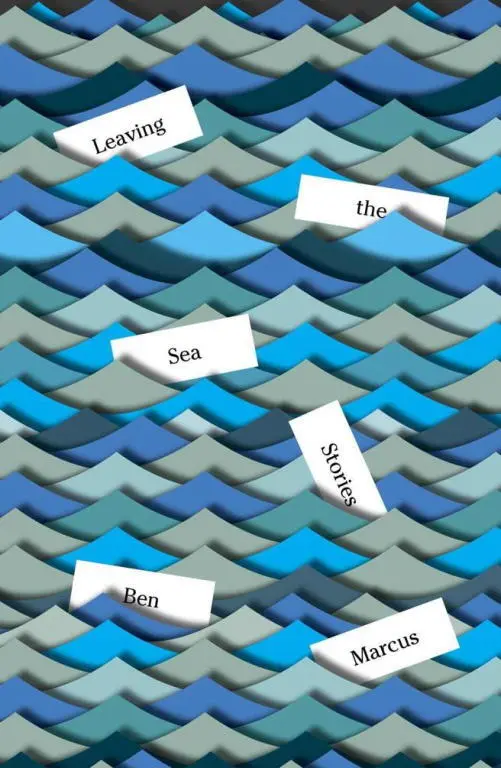
- Название:Leaving the Sea: Stories
- Автор:
- Издательство:Borzoi Books
- Жанр:
- Год:2014
- Город:New York
- ISBN:9780307379382
- Рейтинг книги:4 / 5. Голосов: 1
-
Избранное:Добавить в избранное
- Отзывы:
-
Ваша оценка:
Leaving the Sea: Stories: краткое содержание, описание и аннотация
Предлагаем к чтению аннотацию, описание, краткое содержание или предисловие (зависит от того, что написал сам автор книги «Leaving the Sea: Stories»). Если вы не нашли необходимую информацию о книге — напишите в комментариях, мы постараемся отыскать её.
In the hilarious, lacerating “I Can Say Many Nice Things,” a washed-up writer toying with infidelity leads a creative writing workshop on board a cruise ship. In the dystopian “Rollingwood,” a divorced father struggles to take care of his ill infant, as his ex-wife and colleagues try to render him irrelevant. In “Watching Mysteries with My Mother,” a son meditates on his mother’s mortality, hoping to stave off her death for as long as he sits by her side. And in the title story, told in a single breathtaking sentence, we watch as the narrator’s marriage and his sanity unravel, drawing him to the brink of suicide.
As the collection progresses, we move from more traditional narratives into the experimental work that has made Ben Marcus a groundbreaking master of the short form. In these otherworldly landscapes, characters resort to extreme survival strategies to navigate the terrors of adulthood, one opting to live in a lightless cave and another methodically setting out to recover total childhood innocence; an automaton discovers love and has to reinvent language to accommodate it; filial loyalty is seen as a dangerous weakness that must be drilled away; and the distance from a cubicle to the office coffee cart is refigured as an existential wasteland, requiring heroic effort.
In these piercing, brilliantly observed investigations into human vulnerability and failure, it is often the most absurd and alien predicaments that capture the deepest truths. Surreal and tender, terrifying and life-affirming,
is the work of an utterly unique writer at the height of his powers.
Leaving the Sea: Stories — читать онлайн бесплатно полную книгу (весь текст) целиком
Ниже представлен текст книги, разбитый по страницам. Система сохранения места последней прочитанной страницы, позволяет с удобством читать онлайн бесплатно книгу «Leaving the Sea: Stories», без необходимости каждый раз заново искать на чём Вы остановились. Поставьте закладку, и сможете в любой момент перейти на страницу, на которой закончили чтение.
Интервал:
Закладка:
She sent back some of the water she had swallowed and it was clear that she had related to the water by letting it down her throat. This was water that had trafficked through her person to a place I had not been allowed to see. It had more access. I was jealous of everything she ate and drank. The water she sent back to me came in the form of rain. This was when changes in the air were known as weather, when low-flying bullets were still called friends, and periods of suffering were broken up into intervals called days. Back then, the sun still honored the world’s objects by letting them contribute the occasional shadow to the surface of the world. Every day something fell on me and my temperature changed. Temperature was another way to remind you that you weren’t dying quickly enough; it let you feel too viciously alive. These changes of temperatures were called moods and they had interesting foreign names, but I no longer recall them. I have no memory for anything that happens outside of my body.
I cannot recall the precise words for the phrase: “I’m sorry.”
When I learn these words again, I will never stop saying them.
Fear the Morning
His name had been scratched off his documents years ago. There had been little reason since then to refer to himself, and his rigorous daily schedule kept him from thinking what he might be called if someone addressed him.
In the morning he would make a plate of eggs and dot it with hard cheese. He ate until he was tired, then put his plate in the sink, combed his dry, curly hair until his scalp hurt, then put on his long coat and went out for his tour. Every day the tour followed a different track away from his house, sometimes climbing a hill, other times descending one. He did not wish to see the same people. Their faces troubled him. Any one of them might be the very person waiting to replace him. If he could not avoid a greeting, he said “Hello,” and breathed down at his feet while he walked, listening for their departing steps behind him.
Under the coat was a naked body that he fussed at with a special lotion. He thought of it as his own body. A pocket of the coat was torn through at the bottom, allowing his hand to spread lotion while he walked. If he saw a person, his feeling faded, no matter how fast his hands moved. People were no good for his feeling, but he could not have the feeling alone at home, either, so he risked sighting them at large in the world around his home. He preferred to see trees, but forests were no good. Too many trees suggested too much possibility, and his feeling faded. He had to be moving along at a swift pace, with trees looming in his periphery but not surrounding him, clusters of green growth like clouds of algae bursting in the air. Then he could massage his area until his stomach steamed with friction and he became hungry for lunch.
He took his meals in the center of town. Ham was his preferred dish, especially in the winter, when it was shaved transparently thin and rolled inside flavored paper straws. Usually he washed it down with a steeped citrus drink, depending on the season. He liked berry drinks, but his town rarely produced berries, and if a berry-flavored water was ever made, it was bitter and gritty in his mouth. Mostly his town sold long hollows of bread lathered in fruit. The meat was flown in from the north. He ate a meat that had traveled high in the air.
After lunch, he walked home for his appointment in front of the television, where he watched a daily show that concerned people who fought to board a very small boat. Once aboard, they had to row themselves to a pre-agreed target, often an island, but sometimes a town that fronted a river. He had his favorite characters, usually the redheads, because they were seaworthy and never backed down from a fight. But he was more interested in the water and how the water made everybody on the show look sleepy. He liked to see people bursting out of it, scrambling onto the lip of the boat, having their hands beaten by the passengers who had already secured a berth, then slipping back into the water. Sometimes the people said things just as their heads entered the water, so the words were partially muffled, and he tried to give his words that same kind of sound. When he filled his mouth with bread, he could sound like one of the strong redheads slipping underwater after a struggle.
In the unspoken-for hours in his afternoons, he delivered phone calls from a hard, gray phone that had been carved into his wall. There was a code he could press into his phone that changed his behavior when he talked. If he prefaced the person’s number with this code, he could speak smoothly and at length from a set of feelings that were not his own. He never wanted to forget these three numbers, so he wrote them on a little white sticker and stuck it to his phone. The numbers he dialed were from a special phone book purchased at a store outside of town. He believed it gave him access to more extraordinary people than the ones he had to see on his morning tours. When someone answered on the other line, he opened the conversation by apologizing to them, using their name and a special, sorrowful voice, which often led them to believe he was someone else. His phone book seemed to have many numbers of people who were waiting by their phones for a man to call and apologize to them. In the afternoons, before his special dinners, he was often this man. Minutes would go by before the people discovered he was someone else, and even if this made the people angry, he often learned about who he had been, and he felt like someone else for a little while, which was so hard to feel for very long, and always made him a little bit hungry.
He had to signal for his dinner with a special light he pointed from his window. Then there might be a crackling knock at the door, as if someone had stepped on a small bird. Sometimes the knock on the door came before he signaled with the light, but he knew at least not to eat his dinner until he flashed his signal.
Dinner was never much other than a plate of potatoes run under a broiler until it blistered with heat. The woman who brought his food stood near him and touched his cheek, and he would endure this gesture until she had left the plate on the table and closed his door behind her.
Once he ate his potatoes, he knew that very little could happen, and that, with some special effort, and much thought, he could arrange things so that even less might happen, until possibly nothing would, a circumstance he might very well be rewarded for. It was a matter of skill. He would perfect this skill until he had arranged for a situation that would go on for as long as he wanted it to, in which absolutely nothing occurred. Even if people defied his wish, and walked the streets and roads in greatcoats spreading lotions over the territory, he knew that no one would see them, or, if they did, they would never remember it. The disruption would seem dreamlike, with artificial colors. The people would be made of bark.
His bedtime came when the potatoes still sat high in his stomach but he could not keep his eyes open. He unrolled a flannel sleep shirt. He ran a toothbrush through his mouth. He coughed his special words into the speech hole in his bedroom.
Last came the only ritual that might help him disappear. If he pressed the three-digit code into the phone again, he could, with any luck, become someone else before he went to sleep, which meant he could give the gift of rest to his other person, the one that he secretly oiled with his hands while out touring, the one he was seducing into taking his place in the great world. He could give his other person a chance to dream and sleep and wake up and toss and turn in the sheets. Then maybe there was a better likelihood that, instead of himself, it would be the other person who would wake up, and something different might happen, something that had not happened yet. He would know what to call himself then. His name would sound very much like an engine does. The other person would be in charge now, and he’d have a very different idea of how things should be done. In this way, he, the first person, the one who had started this, and kept it going day after day with almost no help from anyone else in the world, with the small exception of the woman who brought his dinner, could take a break himself, and hide out close to the new man’s skin, right there on his body, under the long coat that moved near the world’s trees, where the lotion was smooth and soft, and no light could get in. This was where he wanted to be. This was why he entered a code into the phone and slid deep into his soft, clean bed, waiting for morning.
Читать дальшеИнтервал:
Закладка:
Похожие книги на «Leaving the Sea: Stories»
Представляем Вашему вниманию похожие книги на «Leaving the Sea: Stories» списком для выбора. Мы отобрали схожую по названию и смыслу литературу в надежде предоставить читателям больше вариантов отыскать новые, интересные, ещё непрочитанные произведения.








Обсуждение, отзывы о книге «Leaving the Sea: Stories» и просто собственные мнения читателей. Оставьте ваши комментарии, напишите, что Вы думаете о произведении, его смысле или главных героях. Укажите что конкретно понравилось, а что нет, и почему Вы так считаете.