Ben Marcus - Leaving the Sea - Stories
Здесь есть возможность читать онлайн «Ben Marcus - Leaving the Sea - Stories» весь текст электронной книги совершенно бесплатно (целиком полную версию без сокращений). В некоторых случаях можно слушать аудио, скачать через торрент в формате fb2 и присутствует краткое содержание. Город: New York, Год выпуска: 2014, ISBN: 2014, Издательство: Borzoi Books, Жанр: Современная проза, на английском языке. Описание произведения, (предисловие) а так же отзывы посетителей доступны на портале библиотеки ЛибКат.
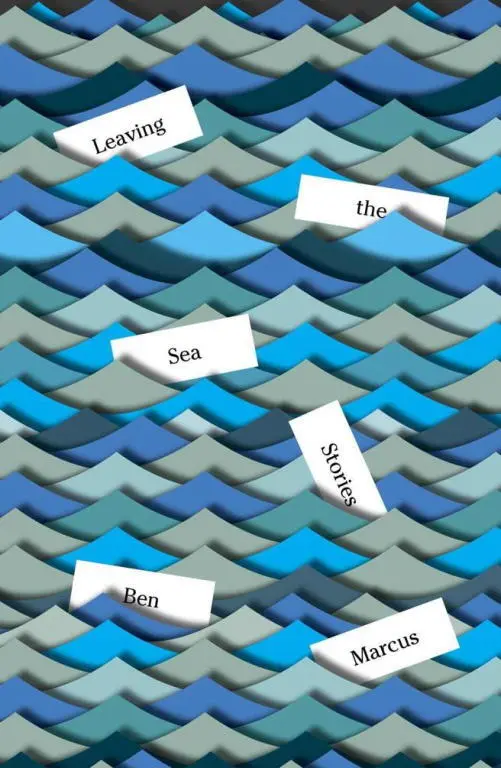
- Название:Leaving the Sea: Stories
- Автор:
- Издательство:Borzoi Books
- Жанр:
- Год:2014
- Город:New York
- ISBN:9780307379382
- Рейтинг книги:4 / 5. Голосов: 1
-
Избранное:Добавить в избранное
- Отзывы:
-
Ваша оценка:
Leaving the Sea: Stories: краткое содержание, описание и аннотация
Предлагаем к чтению аннотацию, описание, краткое содержание или предисловие (зависит от того, что написал сам автор книги «Leaving the Sea: Stories»). Если вы не нашли необходимую информацию о книге — напишите в комментариях, мы постараемся отыскать её.
In the hilarious, lacerating “I Can Say Many Nice Things,” a washed-up writer toying with infidelity leads a creative writing workshop on board a cruise ship. In the dystopian “Rollingwood,” a divorced father struggles to take care of his ill infant, as his ex-wife and colleagues try to render him irrelevant. In “Watching Mysteries with My Mother,” a son meditates on his mother’s mortality, hoping to stave off her death for as long as he sits by her side. And in the title story, told in a single breathtaking sentence, we watch as the narrator’s marriage and his sanity unravel, drawing him to the brink of suicide.
As the collection progresses, we move from more traditional narratives into the experimental work that has made Ben Marcus a groundbreaking master of the short form. In these otherworldly landscapes, characters resort to extreme survival strategies to navigate the terrors of adulthood, one opting to live in a lightless cave and another methodically setting out to recover total childhood innocence; an automaton discovers love and has to reinvent language to accommodate it; filial loyalty is seen as a dangerous weakness that must be drilled away; and the distance from a cubicle to the office coffee cart is refigured as an existential wasteland, requiring heroic effort.
In these piercing, brilliantly observed investigations into human vulnerability and failure, it is often the most absurd and alien predicaments that capture the deepest truths. Surreal and tender, terrifying and life-affirming,
is the work of an utterly unique writer at the height of his powers.
Leaving the Sea: Stories — читать онлайн бесплатно полную книгу (весь текст) целиком
Ниже представлен текст книги, разбитый по страницам. Система сохранения места последней прочитанной страницы, позволяет с удобством читать онлайн бесплатно книгу «Leaving the Sea: Stories», без необходимости каждый раз заново искать на чём Вы остановились. Поставьте закладку, и сможете в любой момент перейти на страницу, на которой закончили чтение.
Интервал:
Закладка:
The ancients were so disloyal that they died and never thought of their loved ones again. Homer called dead people “traitors.” The greatest loves were simply forgotten, and the bodies of leaders and slaves alike began to melt. The love between two people has never been stored in a vial and sold in a shop, yet sometimes she and I, the two of us, on the threshold of no longer caring for each other, a precipice called the Waking Moment, lay together in the bed shaking at each other’s bodies as though we only had water inside us that could be easily poured away. We used a wringing technique called a hug and squeezed at each other with great force, hoping that somewhere on a floor beneath us there was a drain big enough to take the water part of this stranger we had been loving and wash them away, quite far from us, and then further still, until we could only hear the faintest sound, which we might mistake for a river.
Leaving the Sea
It was before I discovered I could survive on potatoes and salted water, before my wife started going for long walks into the thicket, before our house started leaning, started hissing when the wind came up after sunset, a house no different from a gut-shot animal listing into the woods, a woods no different from a spray of wire bursting through the earth, an earth no different from a leaking sack of water, soft in the middle and made of mush, when my children used their spoons to make a noise if I spoke to them, clashed their spoons in my face when I spoke, stood small before me using their utensils like swords, whether my words were hummed or sung or shouted, whether I was kind or cold of voice, which was before I felt the cold finger hanging between my legs, a bit of ice high on my inner thigh, a patch of clammy coolness, instead of a hot and ample limb that could dilate if I so much as smelled her, when smell was a theft of wind, when wind was a clear blood leaking from trees, before my mother began saying it was so difficult whenever she tried to navigate so much as some stairs, a sidewalk, the doorway to a home, before I likened waking up to a car crash, equated walking to a free fall, working in the yard to grave digging, cooking food for the family to slathering glue on the walls, dotting the glue with beads, with jewels, when I likened weeping to camouflage, opening mail to defusing a bomb, when my wife began to say “Only if you really want to,” before I developed the habit of pretending I wasn’t looking at her, when the eye was an apology hole, when the face was a piece of wood under the couch, when the couch kept the body from crashing through the floor and beyond, when beyond was something I had yet to think about at night, when unspeakable movies played through my head, before I went to such lengths in town meeting situations to cheat my face to show my good side to whomever might be caring to look, to anyone even accidentally looking my way, believing that if only my face was viewed from certain angles then I would win something and something would come true for me and the words that broke the seal of saliva between my lips might mean something to someone and be actually useable, the way a shirt is useable as a barrier, the way a piece of wood is useable as a weapon, before I realized that my good side was competing fearsomely to duplicate my bad side, matching and maybe surpassing it, so that the bad side of my profile appeared to be on the advance, folding over the border presented by my nose and mouth and brow, rising up my head like a tide, when a tide did not refer to the advance of water, when most words had yet to wither, when their meaning was simply not known, before I flexed my arms if my wife happened to pay out the hug I sometimes still suffered to ask for when we encountered each other in the hallway, and then noticed that she noticed me flexing my arms, yet hoped anyway that I could harden myself under her grasp and impress her with my constant readiness, when I tensed my stomach if she gestured to touch it, in case her fingers sank into me as though I were a dough, so that if she was ever near me I would contract, clutch, convulse, at first deliberately, then later out of habit, a set of twitches triggered first by her presence, then her smell, then just evidence of her person: shirts, purse, keys, photos, her name, seizure-inducing, threats to my body, when I had yet to conceal the terrible territory known as my bottom to anyone who might see it, including the children and adults and dogs of this world, whom I pitied by wearing big pants, even to bed, letting my shirts drape over my waistline to serve as a curtain for the area, when clothing served as a medical tent, an emergency service, before the phone started ringing one time only, the doorbell chiming off-key in the morning to reveal no one standing at the door, mail appearing with empty pages inside, little stones clicking against the window, footsteps fading on the lawn, scuffling sounds, rustlings in the hedge, all of us always at the table, in our beds, our rooms, at the door, somewhere, unfortunately always locatable, lost-proof, when there was never any going below the radar or keeping off the map, every person and noise accounted for, before I could hear everybody swallowing the food that I made, could hear the corpse sounds their mouths made, as though everyone were eating a microphone, the food going into their bodies and dropping there in the dark like stones, when I planted objects inside these people who were supposed to be my family, who had conspired to look enough like me to serve as a critique of my appearance, and these objects were not being digested, rather they were eavesdropping, spying for me as I positioned myself elsewhere, sitting on the couch with cookbooks or catalogs or magazines or books, when reading was the same as posing for a picture, modeling yourself for the book so that you will be seen as you wish to appear, when looking at pictures was the same as swimming underwater, before I discovered the flaw with my teeth that I confirmed every time a mirror was near, checked as often with my tongue, whenever I needed a reminder that my chew pattern looked like footprints, discovered others checking it, their eyes never on my eyes but always cast down at my mouth, confirming the flaws of my face, the vein in my nose that looked penciled in, the unfortunate curve to my fingers that blunted my hands and promised no hope that they could ever again keep hold of a cup, a bowl, a plate, some money, some hair, before my private limb was diagnosed as crooked, before I ever, as a regular practice, got down on my hands and knees, took myself out of the world of the standing people, surrendered my altitude, dropped down into table position, burying toys and letters in the yard, chipping at asphalt with a spoon, cleaning the hidden parts of the toilet, chasing my children on all fours outside in games where Daddy is a bear or dog, so that they could jump on me and ride on me and kick into the place where I would have gills if I were something better that had never tried to leave the sea, something more beautiful that could glide underwater and breathe easily, on my hands and knees at work looking for files or papers or reports, on my hands and knees crawling up to my wife in the bath, on my hands and knees in the closet, in the kitchen, in places like home where the action seems best viewed from ground level, where the action has ceased and a person can retire from view, right where the dirt starts and the air ends, the last stop for falling things, where things come to rest and get lost, on all fours as a strategy against vertigo, to be someone who has already toppled and can fall no further, is already down, low, at sea level, but not yet underwater, so that someone could come up to me and accurately say, “Man down!” before it was safer to be a person, one who had to go by automobile to view the people known as his parents, before viewing times were established with respect to his parents, days of the week with certain times and restrictions, such as when the two of them would be sleeping, or priming their bodies for sleep, or dragging themselves out of bed for the purpose of sitting there on their couch on display to my children, who could arrive at the location that contained my parents and examine them, a procedure that passed for a conversation, for play, for affection, a deep examination of these old people who were somehow, and dubiously, affiliated to them, which was well before the man came, before the man came, before the man came, knocking at the door one night, a tight report against the wood, letting himself in, sitting with us at the dinner table in the fashion of family, the man a smiler with a better face than mine, getting down from the cupboard a plate for himself, extracting his own place setting from the drawer, which was the first drawer he tried, walking right to it, so familiar, sitting with the kids, talking to the kids, whispering to the kids until they put down their spoons and laughed and used their faces for the man, before he brought his arm up under my jaw one night when I fumbled out of bed to pee, leaving me not even on my hands and knees but on my back, not gasping or hurt or scared, just disappointed, to be on my back in my own house, so that nights thereafter when I groped over to the bathroom to pee even a drop, or stand there with closed eyes and wait until I discovered I had no muscle for the peeing my body was telling me I needed to do, I would keep my arms up to keep from being struck, walked with my guard up, averting my head, waiting to be felled, when even in the daytime around the house I was ready with my arms to block what was coming at me, before I discovered him in my place in bed one evening upon returning from the bathroom, a successor where my body had been, holding on to my sleeping wife, when sleeping refined your argument against your spouse, and looking at me from a face that once might have been mine, still well before our house felt thin, not windproof or lightproof or people-proof, but a removable thing that we could not weigh down enough, because, as the man said, we were hollow, though I might not have heard him, since this was still before I heard the airplane, before everything overhead sounded like an airplane, even when I could locate no airplane, just the most booming sound overhead, which stopped getting louder or quieter, as though an airplane were circling, but doing so invisibly, when invisibility indicated objects so close you felt them to be part of your own body, before I started hearing the big sound in the house when I turned on the faucet, the radio, the lights, when I opened doors or windows or jars of sauce to shush the white and gluey food I was offering everybody, and there came the sound, when everything I did seemed to invite more sound in, my motion itself a kind of volume knob, my body a dial, which if I used it would effect a loudness in the house that made life unsuitable, myself unsuitable, the world too loud to walk through, tasks such as walking, a loudness, washing, a loudness, speaking, a certain loudness produced by the machinery of the mouth, dressing for bed, a loudness like preparing for war, lying in bed, an earsplitting, terrible loudness, the noise of waiting for sleep, asking the children to be quiet, itself too much of a hypocritical loudness, my breathing itself, only my breathing, a loudness I could no longer bear, my breathing, my breathing, too loud for me to keep doing it. I was going to deafen myself if I kept doing it, breathing was going to render my head too packed with hard sound, it was too altogether terribly loud. Something very much permanent needed quickly to be done. A new sort of quiet was required. A kind of final cessation of breathing. A stifling. To be accomplished, no doubt, with those often out-of-reach weapons called the hands.
Читать дальшеИнтервал:
Закладка:
Похожие книги на «Leaving the Sea: Stories»
Представляем Вашему вниманию похожие книги на «Leaving the Sea: Stories» списком для выбора. Мы отобрали схожую по названию и смыслу литературу в надежде предоставить читателям больше вариантов отыскать новые, интересные, ещё непрочитанные произведения.










Обсуждение, отзывы о книге «Leaving the Sea: Stories» и просто собственные мнения читателей. Оставьте ваши комментарии, напишите, что Вы думаете о произведении, его смысле или главных героях. Укажите что конкретно понравилось, а что нет, и почему Вы так считаете.