Ben Marcus - Leaving the Sea - Stories
Здесь есть возможность читать онлайн «Ben Marcus - Leaving the Sea - Stories» весь текст электронной книги совершенно бесплатно (целиком полную версию без сокращений). В некоторых случаях можно слушать аудио, скачать через торрент в формате fb2 и присутствует краткое содержание. Город: New York, Год выпуска: 2014, ISBN: 2014, Издательство: Borzoi Books, Жанр: Современная проза, на английском языке. Описание произведения, (предисловие) а так же отзывы посетителей доступны на портале библиотеки ЛибКат.
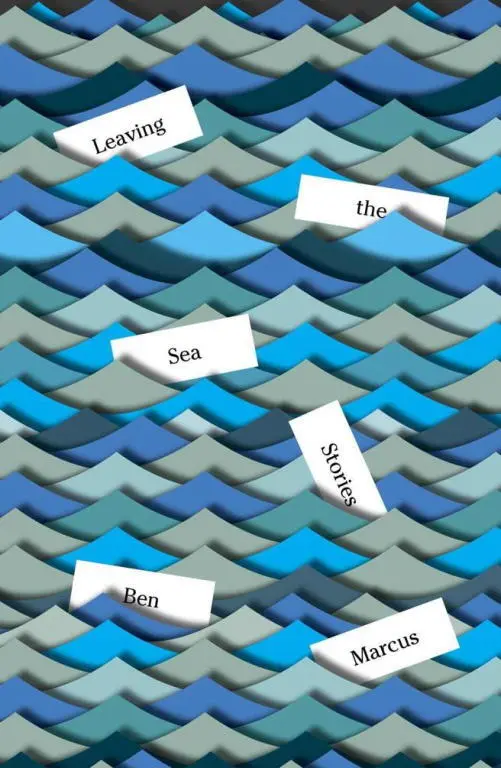
- Название:Leaving the Sea: Stories
- Автор:
- Издательство:Borzoi Books
- Жанр:
- Год:2014
- Город:New York
- ISBN:9780307379382
- Рейтинг книги:4 / 5. Голосов: 1
-
Избранное:Добавить в избранное
- Отзывы:
-
Ваша оценка:
Leaving the Sea: Stories: краткое содержание, описание и аннотация
Предлагаем к чтению аннотацию, описание, краткое содержание или предисловие (зависит от того, что написал сам автор книги «Leaving the Sea: Stories»). Если вы не нашли необходимую информацию о книге — напишите в комментариях, мы постараемся отыскать её.
In the hilarious, lacerating “I Can Say Many Nice Things,” a washed-up writer toying with infidelity leads a creative writing workshop on board a cruise ship. In the dystopian “Rollingwood,” a divorced father struggles to take care of his ill infant, as his ex-wife and colleagues try to render him irrelevant. In “Watching Mysteries with My Mother,” a son meditates on his mother’s mortality, hoping to stave off her death for as long as he sits by her side. And in the title story, told in a single breathtaking sentence, we watch as the narrator’s marriage and his sanity unravel, drawing him to the brink of suicide.
As the collection progresses, we move from more traditional narratives into the experimental work that has made Ben Marcus a groundbreaking master of the short form. In these otherworldly landscapes, characters resort to extreme survival strategies to navigate the terrors of adulthood, one opting to live in a lightless cave and another methodically setting out to recover total childhood innocence; an automaton discovers love and has to reinvent language to accommodate it; filial loyalty is seen as a dangerous weakness that must be drilled away; and the distance from a cubicle to the office coffee cart is refigured as an existential wasteland, requiring heroic effort.
In these piercing, brilliantly observed investigations into human vulnerability and failure, it is often the most absurd and alien predicaments that capture the deepest truths. Surreal and tender, terrifying and life-affirming,
is the work of an utterly unique writer at the height of his powers.
Leaving the Sea: Stories — читать онлайн бесплатно полную книгу (весь текст) целиком
Ниже представлен текст книги, разбитый по страницам. Система сохранения места последней прочитанной страницы, позволяет с удобством читать онлайн бесплатно книгу «Leaving the Sea: Stories», без необходимости каждый раз заново искать на чём Вы остановились. Поставьте закладку, и сможете в любой момент перейти на страницу, на которой закончили чтение.
Интервал:
Закладка:
Origins of the Family
Aman and woman sometimes gather in the evening to discuss their future projects together, a conversation that takes place in a hushed, bone-free room. They tap the walls and call out some of the more popular names for people, to make sure they are alone. The names they recite are shaped inside a bone hollow called a mouth. Their conversation most often freely circles the shame zone that hovers over the table. They take turns arranging the net of bones their skin is concealing so their bodies appear to move. She lifts a small bone resembling a finger, he slides a long, heavy one into place over a chair and expels hot temperature called breath. When they discuss children, they are trying to discover if they can create a new set of bones together. Their difficulties are architectural: can the house support the bones, or will structural changes be required? They submit sketches across the table, editing each other’s ideas about the new person. When they rehearse the names they might call it, and illustrate their visions of its ultimate shape and color, each of them listens privately for a vibration in their bones, pressing their fingers into their flesh to determine what they might feel.
Bones prevent the heart from beating so loudly it would deafen the person. They were first called listening sticks, because they absorbed the body’s sounds and allowed men and women to hear their own voices during intricate skirmishes in the home. This is why settlers erected mothers-of-bone in loud rooms such as the kitchen. Only later did people bag and animate the mothers so that they might move from room to room, accomplishing broader functions within the family. Boneless people did and said little. They were not capable of fighting. They could hide inside each other’s bodies. Without bones, a person, upon entering a room, would deafen the people stationed there. He would have to throw blankets in advance of his body, to baffle the sound he was bringing, an application of fabric that amounted to laying a heavy rug in a room, but sharp-bodied girls could be smothered in this way. Sometimes instead of blankets he would throw another person into the room ahead of him, which was referred to as “turning on the light.” These people were said to have a blinding effect, particularly if they arrived unannounced and appeared to be strangers. Loud people have thin, hollow bones. They can be broken in half and discarded into a pit. They snap as easily as children do, but they will not burn as long in a fire. If a loud person tries to store his voice in a jar, he will not be able to, unless the jar is a mouth worn on the face of someone in his family, which he must prize open with his fingers while shouting deep into the hole there.
One year, people stacked bones outside their houses to absorb the sound of the police, who were talking loudly and pounding on the door. If no bones were available, an entire person was used, who would be escorted away and locked in a room. Every family kept a young person for this purpose. Often they sent him out on thieving missions smeared with a special scent, to attract the police’s attention. Now the police are required to carry a small bone in a polished black toy bucket called a holster. If they wish to be heard, they must hurl the bone away from themselves into a field, creating a current of deafness in the air that passes for weather so mild, even birds can fly in it. When birds actually manage to lift off without instantly listing into the colder turbulence that circles a house, where they might crack open over a roof, it indicates the looming presence of the law, and many family conversations grow nervous at the first sign of birds, with fathers sticking their hands out into the air, to test it for sound. When men cough or talk into their hands, they are praying to their own bones, hoping to change their minds about something. The police ride velvet-covered bone cages called horses. Horses are sad because they hear their own bodies sloshing and cracking. They produce an aggressive, highly pitched physical weeping known as galloping, and in this way spread their feeling across large fields of grass.
People have bones so insects won’t flood their limbs and inflate their bodies to normal size. A person who is insect-controlled often sits and drinks tea, though an insect fluid called blood flows quickly beneath her skin. She has an accurate walking style and can converse in one or more languages. She sleeps lying down, and uses a filter called hair to attract her mates. The small people in her house call her “Mom,” and she answers them by collapsing the tension in her face, a surrendering of control that passes for listening. When she pursues an upper-level-difficulty slalom run of housekeeping throughout her house, she has most likely failed to seal her bones from escape with fixatives called clothing. Her actions become commanded for the good of something larger, such as a naked man who resembles her father, although he might be younger and smaller and weaker, as if playing the part of her husband, though not convincingly. Her motion is voice-activated. When he addresses her, she stands on her toes and lets her arms raise up at her sides. She does a forward bend in the morning to be sure her blood pools at the top of her head. If you sliced her arm open, you would hear a faint buzzing. She has one pair of eyes, and they are often tired and red. When she uses her arms to prop up a document of regret known as a book, her bones form an ancient shape, and a brief, flashing signal is sent out through the window into the fields beyond her house, where the hive is.
If you possess the long, white tubing implements meant to prevent people from squeezing through small holes and disappearing, you have boning material, and you can begin to secure people to your team, insuring them against sudden departure. Bones of this sort were devised by Father so his children could not hide from him. They would no longer be able to collapse their dimensions and defy the restrictions he had built into his house. He had grown tired of a pocket-sized person devoid of shape who could not be broken. He wanted a guarantee, a chance to break something he could not fix. “Having a talk” with Father meant submitting oneself to the insertion of these bones, no matter how much it tingled.
When children fall into a well after being yelled at, it is not the power of their father’s voice that has sent them there, but their desire to enter a long, hollow bone in the earth and become cleansed of sound. They would prefer to hide within their own bodies. When children are yelled at by Father, their skin tightens into a grimace over their faces because their bones have grown swollen with his voice. Most facial expressions result when the bones of the head respond to the difficult sounds produced in the outside world. Churches were originally built of bone as an answer to hard noises that troubled people, but the small fathers and mothers who were envious of the unused space around their own bodies entered the churches with hammers and cups. They positioned themselves near the walls and took stones from them, attempting to grow taller, wider, bigger. When you pray with your hands against your face, you are trying to add bone mass to your head, which has most likely become weak and crackable, thinning out over time. When a priest lays his hands over his congregation, he presses his thumb into the soft part of a person’s pudding until the person weeps his full share.
Bodies are hidden in the earth after they have finished breathing so that our towns will appear more peopled to the birds that fly over them, scanning for a weakness in our communities. Their vision does not tell them who is living or dead. They only see the depth of our ranks, namely, how many persons deep we are, what type of hard, white scaffold supports the town, whether our underground people have an organized or chaotic shape. The more buried bodies, the better. The dead, if buried together, create the illusion of an army. A latticework structure is offered for those who still stand aboveground, who must walk over the bones of former people with no guarantee that the earth will not collapse beneath them.
Читать дальшеИнтервал:
Закладка:
Похожие книги на «Leaving the Sea: Stories»
Представляем Вашему вниманию похожие книги на «Leaving the Sea: Stories» списком для выбора. Мы отобрали схожую по названию и смыслу литературу в надежде предоставить читателям больше вариантов отыскать новые, интересные, ещё непрочитанные произведения.








Обсуждение, отзывы о книге «Leaving the Sea: Stories» и просто собственные мнения читателей. Оставьте ваши комментарии, напишите, что Вы думаете о произведении, его смысле или главных героях. Укажите что конкретно понравилось, а что нет, и почему Вы так считаете.