Ben Marcus - Leaving the Sea - Stories
Здесь есть возможность читать онлайн «Ben Marcus - Leaving the Sea - Stories» весь текст электронной книги совершенно бесплатно (целиком полную версию без сокращений). В некоторых случаях можно слушать аудио, скачать через торрент в формате fb2 и присутствует краткое содержание. Город: New York, Год выпуска: 2014, ISBN: 2014, Издательство: Borzoi Books, Жанр: Современная проза, на английском языке. Описание произведения, (предисловие) а так же отзывы посетителей доступны на портале библиотеки ЛибКат.
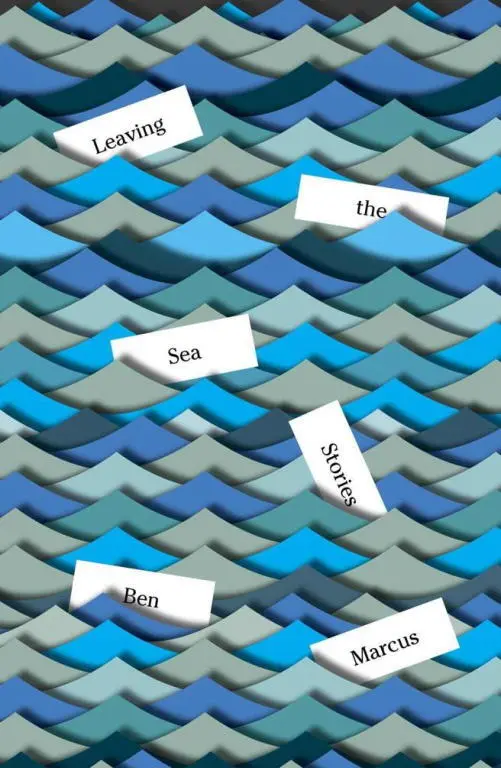
- Название:Leaving the Sea: Stories
- Автор:
- Издательство:Borzoi Books
- Жанр:
- Год:2014
- Город:New York
- ISBN:9780307379382
- Рейтинг книги:4 / 5. Голосов: 1
-
Избранное:Добавить в избранное
- Отзывы:
-
Ваша оценка:
Leaving the Sea: Stories: краткое содержание, описание и аннотация
Предлагаем к чтению аннотацию, описание, краткое содержание или предисловие (зависит от того, что написал сам автор книги «Leaving the Sea: Stories»). Если вы не нашли необходимую информацию о книге — напишите в комментариях, мы постараемся отыскать её.
In the hilarious, lacerating “I Can Say Many Nice Things,” a washed-up writer toying with infidelity leads a creative writing workshop on board a cruise ship. In the dystopian “Rollingwood,” a divorced father struggles to take care of his ill infant, as his ex-wife and colleagues try to render him irrelevant. In “Watching Mysteries with My Mother,” a son meditates on his mother’s mortality, hoping to stave off her death for as long as he sits by her side. And in the title story, told in a single breathtaking sentence, we watch as the narrator’s marriage and his sanity unravel, drawing him to the brink of suicide.
As the collection progresses, we move from more traditional narratives into the experimental work that has made Ben Marcus a groundbreaking master of the short form. In these otherworldly landscapes, characters resort to extreme survival strategies to navigate the terrors of adulthood, one opting to live in a lightless cave and another methodically setting out to recover total childhood innocence; an automaton discovers love and has to reinvent language to accommodate it; filial loyalty is seen as a dangerous weakness that must be drilled away; and the distance from a cubicle to the office coffee cart is refigured as an existential wasteland, requiring heroic effort.
In these piercing, brilliantly observed investigations into human vulnerability and failure, it is often the most absurd and alien predicaments that capture the deepest truths. Surreal and tender, terrifying and life-affirming,
is the work of an utterly unique writer at the height of his powers.
Leaving the Sea: Stories — читать онлайн бесплатно полную книгу (весь текст) целиком
Ниже представлен текст книги, разбитый по страницам. Система сохранения места последней прочитанной страницы, позволяет с удобством читать онлайн бесплатно книгу «Leaving the Sea: Stories», без необходимости каждый раз заново искать на чём Вы остановились. Поставьте закладку, и сможете в любой момент перейти на страницу, на которой закончили чтение.
Интервал:
Закладка:
I awoke hard and wrong, beams of heat around me, air that felt suspiciously like my own breath circling my face.
In the space between us, my father’s nighttime work was revealed. He had erected a new skin of lenses, rendering himself, and everything, a distortion on the other side of the glass. It was not clear which of us was costumed in it. I saw only smudges and blurs, the glass clearly bent in such a way as to translate the objects beyond me out of recognizability. I was encased in lens. A Translation Costume my father had snuck up on me while I slept. A coercive suit of clothing that blinded me. Shadows, at the most, roved the skin of my new suit.
As much as I carved into the soft glass with a darning needle that my father must have left for me, I could not break the surface. As much as I pressed my face into the soft glass, I could see only smudges of him, a painting of a man melting in the distance. At my feet was a pile of things, among them my brother’s stippled leather box, containing his Forecast sounds, and a sweaty old Costume Gun. I fired a mild jet from the gun at the lens but achieved only a vague pain in my chest, a cramping. I aimed the gun at myself to no effect.
There is a certain jostling stability beneath me now, though it could be a trick of the costume. I may indeed have been jettisoned to my own platform. It is possible that I can detect certain swells of ocean, a system of waves at work on some task I’ll never understand.
Or I am meant to detect this, I am meant to feel this.
There may be a father operating on the other side of the glass. I sometimes imagine him there as a small man chiseling into a solid block of cotton. Carving a head, maybe.
I do not imagine him often.
Most days I am content to hold my brother’s leather box. I open it occasionally, releasing its Forecast sounds, which slide into my climate like my brother’s very own breath, as if we still shared a costume. And though I do not understand the words, I enjoy their defeat of silence. I can picture the costume the words would make, as big as a family, with soft exits, filled with writing, allergic to glass. A costume you would not know you were wearing. So subtle. So soft. Beyond clear. Made only of his little words.
Although I do not understand my brother’s words, I know them to be the right ones, the ones that someone had to say. I am happy that they are mine now.
There are so many words I won’t say again. I will not say “brother.” I will not say “house,” or “kill hole.” Many of the statements I could make could be smothered by the proper combination of cloths. Silence is simply a condition of clothing. My father has seen to a final deaf costume.
There is little to do now but regard the patches of water, which may really be clouds. Despite their color, despite their size, despite the voice inside them. Clouds which may really be him, my father, moving around out there beyond me, outside of my clothing, where apparently a world still operates. However dim. However feebly.
PART 5
First Love
Icould not sleep until I had labored through a regular lust application performed with motion, gesture, and languageflower. There was no script or dance step to the discipline. I administered it to her whether she was home in the head or away, no matter the score between her heart and the world, whether she swooned or cringed when I held her, or if she gazed into space or feigned sleep.
She received my application with short, gasping tones she made with her own breath. The tones could have been stolen from a song. Every sound she made was borrowed from what was once known as music. It was not clear whether I should have responded with sounds of my own, which I had once used to draw people closer to my body, or any noise I could make to harmonize her noise into something passing for speech, which might then tell us what to do. Her sounds emerged most forcefully when the motion of my lust was pistonlike, an event that often featured my person volleying above hers, as if flying in place, she pinned beneath me, wilting in my shadow; or me behind her, as though driving a chariot, while she carved a location for herself into the bedclothes.
When we pursued the discipline, we fought toward the seizure known as nighttime. Nighttime promised a better statistic of invisibility. It was our primary collaboration, to arrive where we wouldn’t be seen. We fantasized about a place where we could be wet and boneless, where no one would dare attribute a feeling to us. The safest thing to say about water is that it has no bones, unless a person has been trapped in it.
She would announce her seizure some seconds before it occurred. She used American sounds known as phrases. She said: Here I come; and: Good lord. I imagine the sounds she made once passed for words. When I announced my seizure, often by reciting her name, she held my hand. The sun was briefly refuted and I achieved a dark area. At such times I could see the two of us walking through a garden, looking at the world as though for the first time, believing that the flaring, bright obstacles that kept us from seeing deep into the earth were actually only called flowers.
In daylight she wore motion-limiting weights called shoes. She had a wet mistake buried in her chest. It should never have been put there. Someone had concealed a weapon, which helped her manifest a wound. She tried to sweat it free by performing a function called crying. The five knives of her hand were once called fingers. She stabbed her face every time she tried to eat; the cuts released small blasts of clear air that made the day feel cool. The flag of sadness that concealed her arms was known as a sleeve. The flag flew the colors of her body, which there is no longer another name for. The word body used to refer to the evidence left behind that someone had died.
The first time you meet a potential partner presents an opportunity that will never come your way again, the chance to handle them freely, to smell their parts, to disrobe or possibly dismantle them, to mount their hind, to bark at them, to pull back their hair or grip at their scruff and whinny, to rope them to a post, to insert a wire into their back and control them through radio, to scull or tack in their perimeter, to kiss them gently, to hold their face and kiss their cheeks and shelter them from the wind with your wide, hard body.
Your appearance and behavioral strategy play a part in gaining this access to someone new, so it is imperative to keep your person clean and keep his tank and limbs filled with the appropriate fluid, seasonally correct and rich in emotion, to be sure his shoes are hard on top and solid for the long haul, to mind that your own person is posture perfect and can aim his body true, accounting for the possible refractions of light that occur between the people of today, also known as the new wolves.
The shovels we use to cleave the air in two—and possibly reveal a person we might fail against—were once abbreviated as hands. This was when we had two shovels each, and we apparently used them to scoop up objects we thought we needed, or to toss away those that did not please us. When we faced off with a person, the sound of our four shovels colliding produced a shield of silent, wind-free air known as home. This was when there were only two choices how to behave, on or off. We would apparently put some objects into our mistake tunnel, which was still the main opening in the face, and the tunnel was able to convulse around them and propel them deep into the body’s grave, which was then called, I think, a belly. The tunnel often became wet, but it had dry sticks in front known as teeth, to provide a final reflection of every object we buried in our bodies. Those people who wanted to consume us could then take an inventory of our assets simply by staring us in the mouth or, more obviously, putting their mouths over ours in an investigation known as kissing. Whenever she kissed me, she was prying for secrets.
Читать дальшеИнтервал:
Закладка:
Похожие книги на «Leaving the Sea: Stories»
Представляем Вашему вниманию похожие книги на «Leaving the Sea: Stories» списком для выбора. Мы отобрали схожую по названию и смыслу литературу в надежде предоставить читателям больше вариантов отыскать новые, интересные, ещё непрочитанные произведения.









Обсуждение, отзывы о книге «Leaving the Sea: Stories» и просто собственные мнения читателей. Оставьте ваши комментарии, напишите, что Вы думаете о произведении, его смысле или главных героях. Укажите что конкретно понравилось, а что нет, и почему Вы так считаете.