Ben Marcus - Leaving the Sea - Stories
Здесь есть возможность читать онлайн «Ben Marcus - Leaving the Sea - Stories» весь текст электронной книги совершенно бесплатно (целиком полную версию без сокращений). В некоторых случаях можно слушать аудио, скачать через торрент в формате fb2 и присутствует краткое содержание. Город: New York, Год выпуска: 2014, ISBN: 2014, Издательство: Borzoi Books, Жанр: Современная проза, на английском языке. Описание произведения, (предисловие) а так же отзывы посетителей доступны на портале библиотеки ЛибКат.
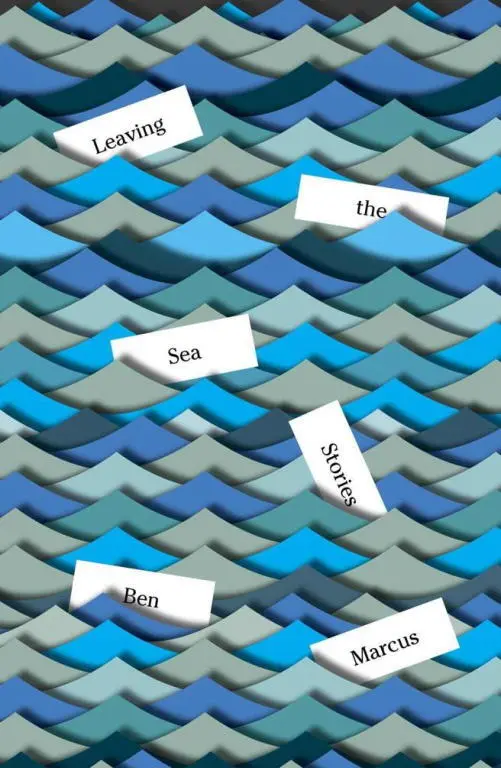
- Название:Leaving the Sea: Stories
- Автор:
- Издательство:Borzoi Books
- Жанр:
- Год:2014
- Город:New York
- ISBN:9780307379382
- Рейтинг книги:4 / 5. Голосов: 1
-
Избранное:Добавить в избранное
- Отзывы:
-
Ваша оценка:
Leaving the Sea: Stories: краткое содержание, описание и аннотация
Предлагаем к чтению аннотацию, описание, краткое содержание или предисловие (зависит от того, что написал сам автор книги «Leaving the Sea: Stories»). Если вы не нашли необходимую информацию о книге — напишите в комментариях, мы постараемся отыскать её.
In the hilarious, lacerating “I Can Say Many Nice Things,” a washed-up writer toying with infidelity leads a creative writing workshop on board a cruise ship. In the dystopian “Rollingwood,” a divorced father struggles to take care of his ill infant, as his ex-wife and colleagues try to render him irrelevant. In “Watching Mysteries with My Mother,” a son meditates on his mother’s mortality, hoping to stave off her death for as long as he sits by her side. And in the title story, told in a single breathtaking sentence, we watch as the narrator’s marriage and his sanity unravel, drawing him to the brink of suicide.
As the collection progresses, we move from more traditional narratives into the experimental work that has made Ben Marcus a groundbreaking master of the short form. In these otherworldly landscapes, characters resort to extreme survival strategies to navigate the terrors of adulthood, one opting to live in a lightless cave and another methodically setting out to recover total childhood innocence; an automaton discovers love and has to reinvent language to accommodate it; filial loyalty is seen as a dangerous weakness that must be drilled away; and the distance from a cubicle to the office coffee cart is refigured as an existential wasteland, requiring heroic effort.
In these piercing, brilliantly observed investigations into human vulnerability and failure, it is often the most absurd and alien predicaments that capture the deepest truths. Surreal and tender, terrifying and life-affirming,
is the work of an utterly unique writer at the height of his powers.
Leaving the Sea: Stories — читать онлайн бесплатно полную книгу (весь текст) целиком
Ниже представлен текст книги, разбитый по страницам. Система сохранения места последней прочитанной страницы, позволяет с удобством читать онлайн бесплатно книгу «Leaving the Sea: Stories», без необходимости каждый раз заново искать на чём Вы остановились. Поставьте закладку, и сможете в любой момент перейти на страницу, на которой закончили чтение.
Интервал:
Закладка:
If I could choose, I would picture my family stopping for small circles of bread in a safe location by a lake. Trapdoors would be carved into the soil there. We would spread our blankets and curtsy down to the food. I would send my father out on a scouting mission while my brother and I ate our bread. He would return to us with a bag of sharp utensils, his mouth sore and bleeding. He would report of mountains in the distance, a possible road. If I could control the outcome, we would not have believed him as he stood there telling his story. We would have remained near the safety of the lake, performing elaborate superstitions under cloth. My brother and I would have attacked my father with chopping motions until he had been silenced. Keeping maybe some of his hair, just in case. Keeping his costume, should we need to become him one day. When the time came. When my father’s space was hollow enough for another body, possibly one of our own, to fit into it.
I wish I could say it was not a house we lived in, but admitting to the house is crucial. It gives a certain picture that will be required, in the end, when we are dead: my father, brother, and me, ducking under bags of sharp salt suspended from the rafters to keep the indoor birds sufficiently wounded, too tired to fly away. A house where birds performed a required orbit that affected how a man aged. A house where the flight of a bird might keep your costume young. Our windows fashioned of lens material for the sun to photograph us.
It is a necessary picture, the three of us walking in a crouch, our faces sometimes cut. It will be fine to be remembered that way. I prefer a picture to a written report. A written report would be sure to fail my family. If the sun has witnessed our behavior, perhaps one day we will reappear on some horizon, and we will again walk the earth and inhale some of the world’s harder wind, to keep it off the bodies of those people not yet born.
The day in question was not much of a day. The sun paused at the horizon until a cluster of hard, black birds burst from the woods. They tore a path into the sky that the sun could fill, and the sun then commenced to stretch the space around it until something passing for daylight occurred. A smarter family would not have been fooled. A smarter family would have pursued a longer concealment within a cloth camouflage. But it was an accurate enough form of light; it showed the smallest, softest version of my father I had ever seen.
My father woke early and opened four jars in the doorway. He tuned the radio dial to Englishville and we heard a series of recent horizon songs made with a slow, old-fashioned breathing style. In between the music, one of the more famous years was being described by a girl whose voice had to project through a wooden mouth. Her mother apparently had designed the mouth of an old man, so the girl could not be recognized. The antenna of our radio had been soaking in honey overnight. After wiping down the tip, my father pushed it through the ceiling until the music became louder.
The three of us crouched down at the writing hole in the center of the room. It was moist that morning, rimmed with foaming soil, so my father fitted the mouth with scraps of linen and then reached his arm deep into the hole. We each took our turn. Above us the sky sounded like a waterfall. My brother held his breath and smiled when his arm went in the hole, as if he could stay like that forever. The radio would not keep still, buzzing on the countertop as if an animal were trapped inside it. Some other family must have died that day, because our house had too much electricity. If too many people died, there would be lightning in our room. If the men on our road stopped breathing, we would be blinded. We would not be able to honor the kill hole. A fine spray of crumbs blew from the speaker until the air in the room seemed filled with insects.
We packed our things into clear burlap sacks. Father took down the wind sock and inhaled the last remnants of yesterday’s air for strength. He passed the sock to my brother, who lazily wiped his face with it before fitting it onto an unused portion of his costume. He spoke three Forecast sentences into his scarf before kissing it and wrapping it around his neck. The language made me drowsy. The three of us rolled our bodies in the Costume Smoother and checked ourselves for wind drag. Father unplugged the four corners of the house and kicked at the baseboards to set the decay timer. He coordinated his kicks with the Bird Metronome until the room became recalibrated and silent, more hushed than I had ever heard it, which made me want to stay there and hold my breath, to take a silence bath, to rub my sleeves and groom myself clean in that brand-new air.
There was nothing for us to do then but wait. I watched my father greasing our windows with oil, drawing pictures of us against the glass with precise, thin lines. In the picture, from what I could decipher, my father was standing in full costume, tearing a piece of bread in half for my brother and me, who were crouched on our heels with our hands raised. It would be a long time before someone looking into the house with a Cloth Diviner could determine that we had left the premises, that the picture of these three men exchanging bread was merely a decoy, erasable, made of oil. With the right manipulations of the hand, those three men could be made to do anything. By then we would be far off on the water.
I wish I could say my father’s name. I do not know the grammatical tense that could properly remark on my father. There is a portion of time that my own language cannot reach. A limitation, probably, in my mouth. In this portion of time is where my father is hidden. If I learn a new language, my father might come true. If I reach deep into my mouth and scoop out a larger cave. If I make do with less of myself, so that he might be more.
It would be easier to hold a magnifying glass to the scrap of my father’s shirt that still remains. To focus a hot cone of sunlight through the glass onto the fabric that once concealed him. Then the last of him could be burned, and in the sound of the flame a small message might be heard. I wish that his name occurred in nature. I could point to the sky and my gesture would indicate him better than any of my own noises ever could. I wish that there was a new man who looked like my father. I could grab hold of him if he rowed by. I could enter his clothes so that he would never float. Hide in the extra space between his body and the cloth. Drag him down into the water, the two of us sinking double-time, down to where the people are waiting, their reaching hands just beyond my sight now as I stare into the water.
When the boat appeared, my father pulled it in with his rope and loaded our parcels down below. He attached long bronze wires onto the stern that fluttered in our wake, creating the turbulence of a much larger boat, a decoy trail for any Cloth Monitors watching us escape. We would produce a commotion of foam. An attack would be less likely. I was asked to spray the south-facing wall of our house with writing, a script to poison travelers if they ever became stranded at our house, to prevent them from living the way we had, to keep ourselves from becoming repeated. I used one of the safer, mouth-borne languages for the project, restricting myself to words that indicated only those things that could be concealed with burlap. When I was finished, and the wall of our house was like a language trap, I still had some writing left over, which I smeared out carefully over the sides of our boat until it had spread into a translucent glue.
My brother and I held hands in the low morning wind while my father fitted the Travel Costume onto us, adjusting the straps so that my bigger, softer body would not bulge from the fabric. We kissed before saying good-bye to each other, even though our bodies would be staying close. We would share an outfit, which meant that we had to alternate moving about the boat. Only one of us could be in charge of a costume. A bird or man might think my father had only one son on board. I went fully limp first, and issued small motion commands to my brother, who had stronger legs, a stronger back, and better eyes.
Читать дальшеИнтервал:
Закладка:
Похожие книги на «Leaving the Sea: Stories»
Представляем Вашему вниманию похожие книги на «Leaving the Sea: Stories» списком для выбора. Мы отобрали схожую по названию и смыслу литературу в надежде предоставить читателям больше вариантов отыскать новые, интересные, ещё непрочитанные произведения.





Обсуждение, отзывы о книге «Leaving the Sea: Stories» и просто собственные мнения читателей. Оставьте ваши комментарии, напишите, что Вы думаете о произведении, его смысле или главных героях. Укажите что конкретно понравилось, а что нет, и почему Вы так считаете.