Ben Marcus - Leaving the Sea - Stories
Здесь есть возможность читать онлайн «Ben Marcus - Leaving the Sea - Stories» весь текст электронной книги совершенно бесплатно (целиком полную версию без сокращений). В некоторых случаях можно слушать аудио, скачать через торрент в формате fb2 и присутствует краткое содержание. Город: New York, Год выпуска: 2014, ISBN: 2014, Издательство: Borzoi Books, Жанр: Современная проза, на английском языке. Описание произведения, (предисловие) а так же отзывы посетителей доступны на портале библиотеки ЛибКат.
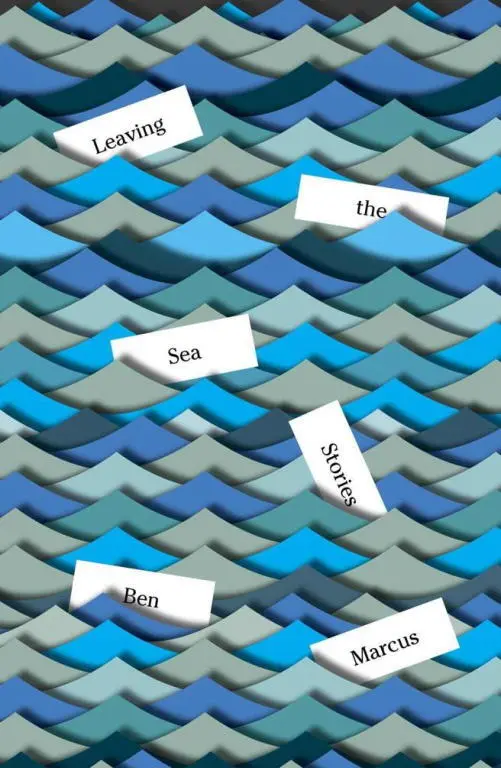
- Название:Leaving the Sea: Stories
- Автор:
- Издательство:Borzoi Books
- Жанр:
- Год:2014
- Город:New York
- ISBN:9780307379382
- Рейтинг книги:4 / 5. Голосов: 1
-
Избранное:Добавить в избранное
- Отзывы:
-
Ваша оценка:
Leaving the Sea: Stories: краткое содержание, описание и аннотация
Предлагаем к чтению аннотацию, описание, краткое содержание или предисловие (зависит от того, что написал сам автор книги «Leaving the Sea: Stories»). Если вы не нашли необходимую информацию о книге — напишите в комментариях, мы постараемся отыскать её.
In the hilarious, lacerating “I Can Say Many Nice Things,” a washed-up writer toying with infidelity leads a creative writing workshop on board a cruise ship. In the dystopian “Rollingwood,” a divorced father struggles to take care of his ill infant, as his ex-wife and colleagues try to render him irrelevant. In “Watching Mysteries with My Mother,” a son meditates on his mother’s mortality, hoping to stave off her death for as long as he sits by her side. And in the title story, told in a single breathtaking sentence, we watch as the narrator’s marriage and his sanity unravel, drawing him to the brink of suicide.
As the collection progresses, we move from more traditional narratives into the experimental work that has made Ben Marcus a groundbreaking master of the short form. In these otherworldly landscapes, characters resort to extreme survival strategies to navigate the terrors of adulthood, one opting to live in a lightless cave and another methodically setting out to recover total childhood innocence; an automaton discovers love and has to reinvent language to accommodate it; filial loyalty is seen as a dangerous weakness that must be drilled away; and the distance from a cubicle to the office coffee cart is refigured as an existential wasteland, requiring heroic effort.
In these piercing, brilliantly observed investigations into human vulnerability and failure, it is often the most absurd and alien predicaments that capture the deepest truths. Surreal and tender, terrifying and life-affirming,
is the work of an utterly unique writer at the height of his powers.
Leaving the Sea: Stories — читать онлайн бесплатно полную книгу (весь текст) целиком
Ниже представлен текст книги, разбитый по страницам. Система сохранения места последней прочитанной страницы, позволяет с удобством читать онлайн бесплатно книгу «Leaving the Sea: Stories», без необходимости каждый раз заново искать на чём Вы остановились. Поставьте закладку, и сможете в любой момент перейти на страницу, на которой закончили чтение.
Интервал:
Закладка:
I am tempted to say that it would serve me right if my mother died today. Because I have chronically abandoned her, each time at the height of an ever-increasing danger, from the moment I could first walk, in some sense it would serve me right if she died. I would get what was coming to me. Her death, today, would be fitting. A comeuppance. However, when I think this through, and realize that I would deserve it if my mother dies today, it occurs to me that her death then becomes contingent on behavior I have or have not produced. Her death is a payment in response to behavior of mine. She cannot die unless I am fully deserving, although since I have been deserving for some time now, from a period beginning right after I was born, my mother has enjoyed a lengthy period in which she could die and I would be found deserving.
I am helpless then to wonder if there is someone in the world who would deserve it if I died. If, for instance, a person’s death occurs as a punitive measure to some other person, as my mother’s death, should it occur today, would certainly seem to me, then whose comeuppance is it when I die? Is there, for each of us, a culprit who will have had it coming when we go?
Well, of course, not every death needs to serve as a punishment of others, even while an attractive ecology is suggested by such a theory. So many things would suddenly be explained. Yet some deaths—my own, for instance—might be independent events, not designed as rebukes or scolds for anyone on earth. Deaths not really meant to trigger guilt in anyone. Deaths perhaps not meant to cause any feelings. Self-contained events without impact. Certainly the ecology of death would need to sustain variety in this regard. Or not certainly. I have no authority on this matter. There is the slight possibility, additionally, that the person for whom my death, when it does occur, is a comeuppance, will never learn of my death, never know that it served him right or that he had it coming. He might be in another part of the world, distant from the news sources that could alert him to my demise, if any news sources report the event. He might live out his days never knowing that I died, thus avoiding, forever, his comeuppance.
The butler, these days, is kindly, having endured long decades being stereotyped as cruel. Always now the butler is bottomlessly kind to everyone concerned.
It is perhaps the phrase, “The butler did it,” that guarantees now, on the PBS mysteries my mother and I watch, that the butler will never have done it. The butler is now too nice to have done it. On the other hand, the current blamelessness of butlers, in mysteries such as these, suggests that the perfect villain must now again, or soon, be the butler. My mother explained once to me that the key to solving these mysteries, at their outset, is to identify the least likely culprit. Often this person ends up being the villain. She said that of the many revelations she’d had in her life, this was among the saddest, since it cruelly ruined any mystery she ever watched. Figuring things out, she said, is such a sadness. You didn’t really know your father, she said, but he wasn’t very hard to know. And that was the problem. What do you do once you know someone?
My father and his colleagues from India, as probablists, must have been considered master odds keepers, the most gifted of the people in the world who keep odds. Had they not passed away, I could turn to one or the other of them now with my questions of odds, but since they have passed away, they no longer keep the odds. Well, have the Indian probablists passed away, along with my father? Even if they have, there are, no doubt, successors. Each field of inquiry creates successors who desecrate and then improve upon the work of their mentors, and the mentors soon pass. No matter how masterful the mentor is, there is a successor waiting in the anteroom. There must be new Indian probablists, probably several new Indian probablists every year, a stream of successors flying in from India. Even my father must have had a successor, after he passed. Someone succeeded my father, the master odds keeper, whose gift I never got to witness. My father must have bequeathed his odds to this successor, who now keeps them. Even if my mother and I do not know this person’s name or his whereabouts, we can safely believe that right now there is, at large in the world, a successor to my father, keeping what my father once kept. When my mother dies, though not today, and then, eventually, when I die, will the successor to my father be considered our survivor, even if we did not know him? The thought offers some comfort.
Physicians who sign autopsy reports, listing a person’s cause of death as unknown, attribute their momentary ignorance to the blind spots of science, which will one day come into view. Eventually every cause of death will be known, in most cases well before the death. It is only that we now live in a curious time when some things cannot be known until after they happen. One imagines that years from now this will be viewed as a touching limitation to our way of life: having to wait for something to happen, like a mother’s death, in order to know about it. People won’t be able to imagine being so docile and patient as we are today, obsessing over the distinction between old-fashioned notions of before and after. They will love us tenderly for waiting around for our mothers to die, for being victims of time, but they will also feel superior to us, and some of them will make a cogent argument that in many ways we were not so different from animals in our ignorance, worthy of tremendous respect, but animals just the same.
If my mother did die today, she would not—I am nearly certain—be discovered until tomorrow. Tomorrow, at the earliest. To be discovered today, someone other than her son would have to think, out of nowhere, late at night, right now, to ring my mother’s doorbell, and then, receiving no response, would need to summon the building superintendent and gain entrance to her apartment. Aside from the unlikelihood, which is considerable, this would take time. Tomorrow would have come before this person had even reached the super. The super’s phone might be off. Perhaps there would be an option to page the super, but it is doubtful the super would respond fast enough, with a key, in order for my mother to be discovered today.
It is bewildering to consider that while these mysteries are being filmed, there are young men and women standing off- camera, wearing contemporary clothing, holding contemporary views of sexuality and ethics, grinning behind their hands at the sad animals strutting in front of the camera.
Even if the super picked up right away. In addition, there would be other explanations for an unanswered doorbell, and the super would have to be mindful.
There is often a young girl in the wealthy family, unbearably beautiful, in league with the servants.
It is late at night and most people are asleep. Old people go to bed early. If my mother has gone to bed, which I hope she has, and fallen asleep, which I hope she has, it is likely she will not hear the doorbell.
The girl is the sole object of sympathy from the wealthy classes, suggesting that not all rich people from the old days were evil.
The super would make this same argument, would be reluctant to use his key to gain entrance to my mother’s apartment. He would want some proof that something had happened. The worry of a neighbor could not count as proof. Blood under the door would be proof. But even if she had died, it is not likely there would be blood under the door. Proof would be very hard to come by.
A constable always comes, but a constable never solves the crime. No body, no crime, my mother sometimes shouts from her chair.
The super would be justified in wondering why a neighbor, in the middle of the night, had decided to ring the doorbell of an old woman, demanding entrance to her apartment. This is not a neighborly action.
Читать дальшеИнтервал:
Закладка:
Похожие книги на «Leaving the Sea: Stories»
Представляем Вашему вниманию похожие книги на «Leaving the Sea: Stories» списком для выбора. Мы отобрали схожую по названию и смыслу литературу в надежде предоставить читателям больше вариантов отыскать новые, интересные, ещё непрочитанные произведения.


Обсуждение, отзывы о книге «Leaving the Sea: Stories» и просто собственные мнения читателей. Оставьте ваши комментарии, напишите, что Вы думаете о произведении, его смысле или главных героях. Укажите что конкретно понравилось, а что нет, и почему Вы так считаете.