Ben Marcus - Leaving the Sea - Stories
Здесь есть возможность читать онлайн «Ben Marcus - Leaving the Sea - Stories» весь текст электронной книги совершенно бесплатно (целиком полную версию без сокращений). В некоторых случаях можно слушать аудио, скачать через торрент в формате fb2 и присутствует краткое содержание. Город: New York, Год выпуска: 2014, ISBN: 2014, Издательство: Borzoi Books, Жанр: Современная проза, на английском языке. Описание произведения, (предисловие) а так же отзывы посетителей доступны на портале библиотеки ЛибКат.
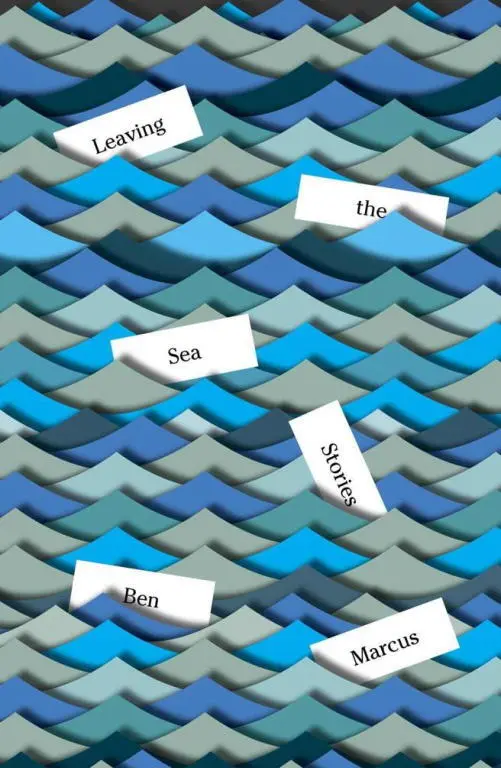
- Название:Leaving the Sea: Stories
- Автор:
- Издательство:Borzoi Books
- Жанр:
- Год:2014
- Город:New York
- ISBN:9780307379382
- Рейтинг книги:4 / 5. Голосов: 1
-
Избранное:Добавить в избранное
- Отзывы:
-
Ваша оценка:
Leaving the Sea: Stories: краткое содержание, описание и аннотация
Предлагаем к чтению аннотацию, описание, краткое содержание или предисловие (зависит от того, что написал сам автор книги «Leaving the Sea: Stories»). Если вы не нашли необходимую информацию о книге — напишите в комментариях, мы постараемся отыскать её.
In the hilarious, lacerating “I Can Say Many Nice Things,” a washed-up writer toying with infidelity leads a creative writing workshop on board a cruise ship. In the dystopian “Rollingwood,” a divorced father struggles to take care of his ill infant, as his ex-wife and colleagues try to render him irrelevant. In “Watching Mysteries with My Mother,” a son meditates on his mother’s mortality, hoping to stave off her death for as long as he sits by her side. And in the title story, told in a single breathtaking sentence, we watch as the narrator’s marriage and his sanity unravel, drawing him to the brink of suicide.
As the collection progresses, we move from more traditional narratives into the experimental work that has made Ben Marcus a groundbreaking master of the short form. In these otherworldly landscapes, characters resort to extreme survival strategies to navigate the terrors of adulthood, one opting to live in a lightless cave and another methodically setting out to recover total childhood innocence; an automaton discovers love and has to reinvent language to accommodate it; filial loyalty is seen as a dangerous weakness that must be drilled away; and the distance from a cubicle to the office coffee cart is refigured as an existential wasteland, requiring heroic effort.
In these piercing, brilliantly observed investigations into human vulnerability and failure, it is often the most absurd and alien predicaments that capture the deepest truths. Surreal and tender, terrifying and life-affirming,
is the work of an utterly unique writer at the height of his powers.
Leaving the Sea: Stories — читать онлайн бесплатно полную книгу (весь текст) целиком
Ниже представлен текст книги, разбитый по страницам. Система сохранения места последней прочитанной страницы, позволяет с удобством читать онлайн бесплатно книгу «Leaving the Sea: Stories», без необходимости каждый раз заново искать на чём Вы остановились. Поставьте закладку, и сможете в любой момент перейти на страницу, на которой закончили чтение.
Интервал:
Закладка:
In the late afternoon, the boy won’t breathe through his mask. He covers his mouth with his hands and turns away. Mather tries to listen to his breath, but the boy won’t stay put. Still, Mather hears a whistle in the boy’s lungs, and he pictures them shriveling inside the boy’s small chest, as dry as paper curling up in the heat. He knows that if the boy would inhale the vapors from the mask his lungs would lubricate and he would feel better, but the boy is stubborn and the more Mather tries to press the mask over his face, the more he twists out of reach.
Mather reminds himself that it isn’t serious. The treatments are supposedly optional, meant to increase the boy’s comfort. It is only asthma. But the boy is pale and certainly too little for his age, and he sits listlessly on the rug after his nap, uninterested in the toy cars that Mather has arranged around him.
Mather schedules a sitter, and the next morning he shows her around the apartment while the boy clings to him. Mather demonstrates the ventilator to the sitter, but it is clear that she has already decided that it is too complicated for her to operate.
Mather was going to leave early for the bus stop, to be sure that he wasn’t late for work, but then his doorbell rings, and he runs downstairs to the car-pool vehicle, the boy crying behind him in the sitter’s arms. A proper good-bye would only have made it worse, and the boy will recover faster this way. In any case, Mather needs to go to work. This is how it has to be.
In the dark car, no one so much as looks his way. Mather wonders what happens day after day in this car before he is picked up that makes for such grim silence. They stare ahead while he settles in and buckles his seat belt, and for a moment Mather feels the enormous relief of traveling alone, even if there are mute coworkers pressed against him. He has no one to take care of and he can relax.
Mather lowers his window when they pull out of the garage, and the woman beside him huffs. He’ll consider himself scolded. They turn onto the Hills Parkway and the car picks up speed. Outside, it’s a flat, gray morning, but the air is warm, and Mather lets the wind cover his face. There are sweet, smoky streaks in the sky, the kind of clouds that scatter if a bird so much as flies through them. Mather almost feels that he could sleep, and he wishes the ride were longer. He’d love to stay in the car like this all day, driving around town, sleeping a little, looking out the window, doing nothing, while someone else keeps the boy busy at home.
The temps are at his desk when he gets to work.
“Okay, guys, break it up,” he says, wanting to sound jovial.
They’re engrossed in their work and don’t look up. It’s the same two temps from yesterday, and a third one leans over them, staring at the computer screen. They have coffees and food wrappers cluttering the desk, and Mather’s own inbox is nowhere to be seen. There’s hardly room for him to put down his briefcase.
“I’m back,” Mather says, this time more softly.
“We’re pretty hunkered down,” the young man from yesterday says. Mather isn’t sure, but the young man’s hand motion may be waving him away.
Mather says, “I can see that.” It’s important to stay friendly, extend an olive branch. He was a temp once. There’s no reason to lord his rank over them. “Would you guys like to take a minute to find another place to work?”
The young man seems to consider this but mentions their deadline and how settled in they are at Mather’s desk. He says that they’re good where they are, but thanks for the offer.
Of course it’s a misunderstanding, and a small one, but Mather feels that he hasn’t been at his desk in ages and he’d like things to return to normal. How long has it been since he’s had a normal workday? He looks around for some sort of backup, commiseration from the other full-timers, but his colleagues are hopelessly entranced by their computers. Unfortunately, he has to go higher up on this one. He’d have liked to avoid that, but the temps have given him no choice. Ferguson’s assistant tells Mather that his appointment isn’t until eleven.
Mather says, “I didn’t make that appointment. Remember? I need to see him now. The temps are at my desk and I have to get to work. It’s already after nine.”
“So are you canceling the eleven o’clock?” the assistant asks, crossing something out in his book.
“No,” Mather says quietly, “because I never made it.”
“Never made what?” a voice booms behind him.
It’s Ferguson walking in, acting as though he’d missed the beginning of a joke. Mather wonders if Ferguson ever gets tired, smiling like that. The assistant disengages, returns to his work.
“I never made an appointment with you,” Mather explains, realizing that this will only confuse Ferguson, but Ferguson has the ability not to show confusion, perhaps not to even experience it. A man like Ferguson can remain impervious to all messages beyond his own internal script, which drives him with purpose from room to room.
Ferguson pats Mather on the back.
“So you got rid of him, huh?” he asks.
“Who?” Mather says.
“Who!” Ferguson laughs. “The kid! You finally fobbed him off! Good work!”
“Oh,” Mather says. “I did. Yeah.”
“Just a quick thing,” he says to Ferguson, using a serious, professional tone.
He would like Ferguson, if possible, to resolve this situation with the temps, he says, because he needs to get back to work, and why does he always have to vacate people from his desk every morning? It’s stressful, if Ferguson wants to know the truth, and Ferguson nods with sympathy. The temps should have marching orders and time frames before they even sit down at someone else’s desk. Mather explains that it creates tension and it’s maybe not a great idea for office morale.
“The temps left at eight today,” Ferguson says, “as usual. But let me introduce you to our new team. We’ve made some pretty killer hires. Morale couldn’t be better.”
At Mather’s desk, Ferguson presents the three new hotshot employees, but Mather doesn’t listen to their names. Ferguson is boasting about the marketing initiative they took as temps and how they’re the first temps in a year to move up the ladder like this. Straight up the ladder. Fire at their heels.
The three of them, still caught up in the seriousness flowing from Mather’s computer, are flushed with Ferguson’s praise, as if they believe that soon they’ll be running the company. And somehow Mather is supposed to feel happy for them, which he tells Ferguson he is, but of course, this is his desk, where his unfinished projects remain and can’t the new team work somewhere else?
Ferguson says that he and Mather should go talk at the elevator. His voice is soft, and he tries to shepherd Mather away, placing an arm around him.
Mather imagines Ferguson obeying his internal voice: Walk employee to a quiet place. Present bad news in positive terms.
About the only way that Mather can have an edge on Ferguson is to hold his ground and force this conversation to happen right here. He can feel his coworkers pretending not to look at him.
Ferguson says, “I think the next step is a good strategy talk down in H.R. They’ll have a really tactical perspective on what might be next for you. It’s never a bad time to talk strategy. You think you’ve considered all your options, but you never have. There’s always something you haven’t thought of.”
Mather’s cell phone rings and he doesn’t recognize the number, but he feels he must pick up, even though the timing is bad. It could be Maureen calling from someone else’s phone. Maybe she lost her phone, which is why she hasn’t picked up for so long. Maybe she’s calling to say she’s sorry, and how is baby Alan, and can she see him soon?
Читать дальшеИнтервал:
Закладка:
Похожие книги на «Leaving the Sea: Stories»
Представляем Вашему вниманию похожие книги на «Leaving the Sea: Stories» списком для выбора. Мы отобрали схожую по названию и смыслу литературу в надежде предоставить читателям больше вариантов отыскать новые, интересные, ещё непрочитанные произведения.












Обсуждение, отзывы о книге «Leaving the Sea: Stories» и просто собственные мнения читателей. Оставьте ваши комментарии, напишите, что Вы думаете о произведении, его смысле или главных героях. Укажите что конкретно понравилось, а что нет, и почему Вы так считаете.