Ben Marcus - Leaving the Sea - Stories
Здесь есть возможность читать онлайн «Ben Marcus - Leaving the Sea - Stories» весь текст электронной книги совершенно бесплатно (целиком полную версию без сокращений). В некоторых случаях можно слушать аудио, скачать через торрент в формате fb2 и присутствует краткое содержание. Город: New York, Год выпуска: 2014, ISBN: 2014, Издательство: Borzoi Books, Жанр: Современная проза, на английском языке. Описание произведения, (предисловие) а так же отзывы посетителей доступны на портале библиотеки ЛибКат.
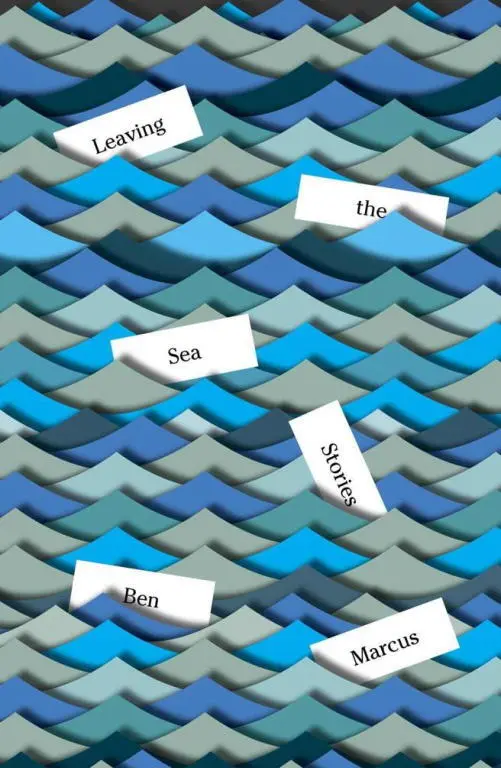
- Название:Leaving the Sea: Stories
- Автор:
- Издательство:Borzoi Books
- Жанр:
- Год:2014
- Город:New York
- ISBN:9780307379382
- Рейтинг книги:4 / 5. Голосов: 1
-
Избранное:Добавить в избранное
- Отзывы:
-
Ваша оценка:
Leaving the Sea: Stories: краткое содержание, описание и аннотация
Предлагаем к чтению аннотацию, описание, краткое содержание или предисловие (зависит от того, что написал сам автор книги «Leaving the Sea: Stories»). Если вы не нашли необходимую информацию о книге — напишите в комментариях, мы постараемся отыскать её.
In the hilarious, lacerating “I Can Say Many Nice Things,” a washed-up writer toying with infidelity leads a creative writing workshop on board a cruise ship. In the dystopian “Rollingwood,” a divorced father struggles to take care of his ill infant, as his ex-wife and colleagues try to render him irrelevant. In “Watching Mysteries with My Mother,” a son meditates on his mother’s mortality, hoping to stave off her death for as long as he sits by her side. And in the title story, told in a single breathtaking sentence, we watch as the narrator’s marriage and his sanity unravel, drawing him to the brink of suicide.
As the collection progresses, we move from more traditional narratives into the experimental work that has made Ben Marcus a groundbreaking master of the short form. In these otherworldly landscapes, characters resort to extreme survival strategies to navigate the terrors of adulthood, one opting to live in a lightless cave and another methodically setting out to recover total childhood innocence; an automaton discovers love and has to reinvent language to accommodate it; filial loyalty is seen as a dangerous weakness that must be drilled away; and the distance from a cubicle to the office coffee cart is refigured as an existential wasteland, requiring heroic effort.
In these piercing, brilliantly observed investigations into human vulnerability and failure, it is often the most absurd and alien predicaments that capture the deepest truths. Surreal and tender, terrifying and life-affirming,
is the work of an utterly unique writer at the height of his powers.
Leaving the Sea: Stories — читать онлайн бесплатно полную книгу (весь текст) целиком
Ниже представлен текст книги, разбитый по страницам. Система сохранения места последней прочитанной страницы, позволяет с удобством читать онлайн бесплатно книгу «Leaving the Sea: Stories», без необходимости каждый раз заново искать на чём Вы остановились. Поставьте закладку, и сможете в любой момент перейти на страницу, на которой закончили чтение.
Интервал:
Закладка:
“Really soon. I’ll call you. I’ll make up the days.”
“So you’re just going off in the middle of the workweek?”
Maureen looks at him sharply, and it’s clear that she doesn’t think she needs to explain herself. She picks up the boy and starts whispering to him, her voice losing its scolding tone, dissolving into singsong. She bounces and hushes him, even though he’s not crying.
The boy clings to his mother. When she bends over the couch to change him, he clutches her as if he were a baby animal, and she has to peel him away. She tells the boy that he will be staying with his daddy for a little while longer, and that she will miss him so much. She will see him soon, and they will do fun things and she will give him lots of kisses because he’s her little boy, isn’t he, and she wants to kiss him all the time. Should they go on a boat ride when she comes home? Does he remember the boat ride they once took? Would he like to do that again? That’s what they’ll do. She’ll come home and they’ll go down to the river and take a nice boat ride.
Mather stands there in the dark living room. There won’t be a boat ride. He knows that. She’s showering so much love on the boy that he will become dazed by it, then Mather will have to take over and the boy will be bitterly disappointed again. To Mather, these intense displays of love are what he must help the boy recover from. Fatherhood has somehow become about helping the boy not love his mother too painfully.
Maureen hands the boy off to Mather, and the boy registers the change for one perfectly quiet second, then screams. He’s never liked parting from his mother, and now they’ve woken him up late at night only to make him suffer the sudden separation. Mather closes his eyes and takes a deep breath. There’s nothing he can do. He’d like Maureen to seem more obviously guilty, but she shows no sign of having done anything wrong. It is, apparently, Mather’s fault that the boy does not love him with the same terrible desperation.
There’s no one else at the bus stop, and from what Mather can tell, after reading the posted schedule, the next bus will come in one minute, which is lucky for him, because the boy is not pleased, outside in the winter at night. Except when one minute passes, then two, then five, it becomes clear that the bus must have come already and now the next one isn’t due for half an hour.
Alone, which is what he was supposed to be tonight, Mather wouldn’t care. He’d sit on the bench and read, enjoying the cold night. But he has the boy with him, and the boy is fully awake after all his screaming and will be cold soon. This isn’t the sort of area where empty taxicabs drive around looking for fares. Mather calls information and gets the number for a car service, then speaks to a dispatcher. They can send a driver in forty-five minutes. Mather tells the man that it’s late and his baby is tired and hungry, and the man repeats that he can send a car in forty-five minutes. More like an hour, actually, to be honest—as if he were doing Mather a favor by lengthening the estimate.
Mather starts to walk home, carrying the boy, along the bus route, even though it’s less direct. He figures that the bus, when it comes, won’t cruelly pass him by if he stands in the road and waves. The roads are so empty that Mather wonders for a moment if something terrible has happened, and everyone is at home watching the news, knowing better than to go outside. He stops walking and listens. It’s the quietest he’s ever heard his city. The boy, too, seems transfixed, staring into the darkness. But then a bus rolls into sight and Mather stands right over the white line, waving. He doesn’t want to take any chances.
Maureen doesn’t call the next day, or the day after that, and then it’s the weekend. On Sunday, Mather’s parents visit, but they’re so tired they don’t leave their chairs. Mather’s parents have been to Lisbon, and they tell him of eating fish seared on the rocks at the harbor. The flat rocks are heated by torches overnight, and when the morning’s catch comes in a man cleans whole fish to order and lays them out, butterflied, on the hot stone, which is black and oily from the cooking. When you salt this fish, it’s the best thing you’ve ever eaten. You eat it with your fingers. Even the locals eat it, which, of course, is the best endorsement.
Mather’s father studies him for signs of enthusiasm.
Mather nods his approval and says that he’d love to try it sometime.
The boy goes to the front hallway and grabs his little white shoes, then brings them over to Mather. Then he carries first one, then the other, of Mather’s old maroon work shoes, dumping them loudly at Mather’s feet.
“He wants to go out,” Mather mumbles.
Mather’s parents smile with abstract pleasure but do not move.
When he doesn’t hear from Maureen by Monday afternoon, Mather calls and gets her voice mail. He would like to know her plans. The boy is doing fine, he tells her. He’s actually eating, and he gets up twice at night, but Mather downgrades this to once in his message, because somehow the extra night wakings might seem like his failure. He asks Maureen to get back to him so that he knows when to drop Alan off.
He gets no call the next day. The day after that, at work, the nursery is closed. The lights are off and the door is locked when Mather carries the boy over in the morning. Mather waits outside while his colleagues head upstairs. He calls the nursery number and gets no answer. He bangs on the dark glass. Finally, when he is going to be late for work, he takes the boy up the ramp to the elevators and brings him into the suite of offices.
Mather asks someone named Drew what’s going on with the nursery today. Drew has pictures of kids on his desk. He must have used the nursery at some point. But Drew shrugs and looks at Alan in Mather’s arms as if Mather has smuggled contraband into work.
“I’ll go see Ferguson, I guess,” Mather says.
Ferguson is the supervisor and maybe he’ll understand.
“He’s not coming in this morning,” Drew says, his face arranged in an unconvincing look of concern.
Mather heads to Ferguson’s office, anyway, and asks his assistant if he can see him.
“And you are?” the assistant asks.
“It’s just for a moment,” Mather says. “It’s an emergency.” He holds up the boy as proof. See my emergency.
The assistant doesn’t look. “Your name?” he asks.
“Mather,” Mather says. “I work over there.” He gestures at the cubicle with his head. There’s a young woman working at his desk. Sometimes temps from the night shift set up at empty desks for their red-eye projects and have to move when the full-timers come in. He’s going to have to ask her to leave and she’s going to be annoyed, even though it’s his desk.
“How’s Friday at eleven?” the assistant asks.
“The day after tomorrow?”
The assistant is irritated. “That would be Friday, yes.”
“Could you please let him know I’ve had an emergency and need a personal day?”
The assistant eyes him carefully. “You’d better write that out yourself to be sure the message is how you want it.”
But Mather says that he trusts the assistant to get it right. It’s not very complicated.
At home, he phones Maureen’s office and the call is routed to a receptionist. Maureen is not available. But he’d like to know if she’s there, if she’s actually at work today. The receptionist repeats that she’s not available to come to the phone and would Mather like to leave a message?
He says that it’s about her son and would she please call him.
The boy won’t nap, but he doesn’t cry. He sits in his crib quietly, and Mather notices that his breath is coming heavily, with a faint whistling sound. Under the boy’s dark hair, Mather thinks, the scalp looks unusually red, and when he touches it the boy flinches. He gives him the humidifier mask and the boy takes hungry gulps of the wet air. When Mather tries to remove him from the crib, the boy protests, points back to his mattress, so Mather leaves him there, and the boy crawls under the tank of the humidifier.
Читать дальшеИнтервал:
Закладка:
Похожие книги на «Leaving the Sea: Stories»
Представляем Вашему вниманию похожие книги на «Leaving the Sea: Stories» списком для выбора. Мы отобрали схожую по названию и смыслу литературу в надежде предоставить читателям больше вариантов отыскать новые, интересные, ещё непрочитанные произведения.












Обсуждение, отзывы о книге «Leaving the Sea: Stories» и просто собственные мнения читателей. Оставьте ваши комментарии, напишите, что Вы думаете о произведении, его смысле или главных героях. Укажите что конкретно понравилось, а что нет, и почему Вы так считаете.