Ben Marcus - Leaving the Sea - Stories
Здесь есть возможность читать онлайн «Ben Marcus - Leaving the Sea - Stories» весь текст электронной книги совершенно бесплатно (целиком полную версию без сокращений). В некоторых случаях можно слушать аудио, скачать через торрент в формате fb2 и присутствует краткое содержание. Город: New York, Год выпуска: 2014, ISBN: 2014, Издательство: Borzoi Books, Жанр: Современная проза, на английском языке. Описание произведения, (предисловие) а так же отзывы посетителей доступны на портале библиотеки ЛибКат.
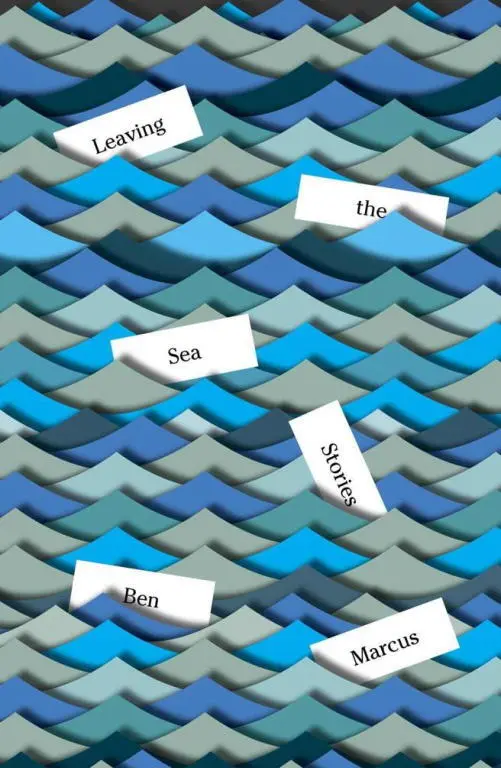
- Название:Leaving the Sea: Stories
- Автор:
- Издательство:Borzoi Books
- Жанр:
- Год:2014
- Город:New York
- ISBN:9780307379382
- Рейтинг книги:4 / 5. Голосов: 1
-
Избранное:Добавить в избранное
- Отзывы:
-
Ваша оценка:
Leaving the Sea: Stories: краткое содержание, описание и аннотация
Предлагаем к чтению аннотацию, описание, краткое содержание или предисловие (зависит от того, что написал сам автор книги «Leaving the Sea: Stories»). Если вы не нашли необходимую информацию о книге — напишите в комментариях, мы постараемся отыскать её.
In the hilarious, lacerating “I Can Say Many Nice Things,” a washed-up writer toying with infidelity leads a creative writing workshop on board a cruise ship. In the dystopian “Rollingwood,” a divorced father struggles to take care of his ill infant, as his ex-wife and colleagues try to render him irrelevant. In “Watching Mysteries with My Mother,” a son meditates on his mother’s mortality, hoping to stave off her death for as long as he sits by her side. And in the title story, told in a single breathtaking sentence, we watch as the narrator’s marriage and his sanity unravel, drawing him to the brink of suicide.
As the collection progresses, we move from more traditional narratives into the experimental work that has made Ben Marcus a groundbreaking master of the short form. In these otherworldly landscapes, characters resort to extreme survival strategies to navigate the terrors of adulthood, one opting to live in a lightless cave and another methodically setting out to recover total childhood innocence; an automaton discovers love and has to reinvent language to accommodate it; filial loyalty is seen as a dangerous weakness that must be drilled away; and the distance from a cubicle to the office coffee cart is refigured as an existential wasteland, requiring heroic effort.
In these piercing, brilliantly observed investigations into human vulnerability and failure, it is often the most absurd and alien predicaments that capture the deepest truths. Surreal and tender, terrifying and life-affirming,
is the work of an utterly unique writer at the height of his powers.
Leaving the Sea: Stories — читать онлайн бесплатно полную книгу (весь текст) целиком
Ниже представлен текст книги, разбитый по страницам. Система сохранения места последней прочитанной страницы, позволяет с удобством читать онлайн бесплатно книгу «Leaving the Sea: Stories», без необходимости каждый раз заново искать на чём Вы остановились. Поставьте закладку, и сможете в любой момент перейти на страницу, на которой закончили чтение.
Интервал:
Закладка:
Mather checks on him later and he is still awake, but he cries when Mather tries to pick him up. The tank is empty, so Mather rinses it out and fills it with more distilled water. The boy returns the mask to his face and Mather can hear a whinny in his breath now. Is he getting worse? The redness on the boy’s scalp has spread beyond his hairline, down his face.
Mather’s mother, before she retired, was a nurse, so he calls her.
“You worry too much,” she says. “Leave him alone. Children are remarkably strong. They’re much stronger than us. You never got sick, never once. You never caused us any problems.”
The next morning the car-pool vehicle does not come. Mather has been up for hours and is packed and ready to go. He’s lost track of whose turn it is to drive today, so he can’t even make a phone call. He’s been so grateful to be part of the car pool, since he has no car of his own, that he’s paid more than his share of the gas, to be sure that nothing goes wrong. He tries not to make trouble, particularly on days when he has the boy. But there’s no car today, and if he doesn’t leave right away he will be late for work.
On the bus there are no empty seats, so Mather stakes out a position for himself against a pole. The boy is pale inside his snowsuit. His face is dry and peeling. His skin seems nearly translucent. His cough is small and weak, and it could be that he’s dehydrated.
The bus lets him off downhill from the Faraday gate. With the boy in his arms, Mather hikes up the side of the road as a stream of cars pass them on the way to work. He sees some people he knows, but no one stops. He’s never hiked this road, and it’s much steeper than he would have thought. He’s drenched inside his winter coat, and the boy’s face is flushed, even though he’s not exerting himself. At the gate, Mather has to show his credentials and they ask to pat down the boy, who goes with one of the guards without complaint. He doesn’t even seem to notice that someone else is carrying him.
The nursery is closed again this morning. Someone has taped a notice to the door, but it’s since been ripped down, leaving the tape fastened over a shred of blank paper. Mather brings the boy up to his office and there are two temps sharing his desk. He stands there holding the boy, needing to put him down so that he can figure out what to do.
“All right,” he says to the temps, trying to sound cheerful. “I guess I have to get in here.”
He has no idea what he’s going to do with Alan today, but at least if he gets his desk back he can settle in and maybe make a play area for him on the floor.
The temps look up at him and blink. “We’re here until noon,” the young man says. Probably he’s in his early twenties, but he looks like a boy.
“Well,” Mather says, “you need to move to the conference room or somewhere else, because this is my desk.”
He shouldn’t have to say this.
“Mr. Ferguson told us to work here,” the other temp says impatiently, a young woman who is so striking he’s afraid to look at her.
The boy wriggles out of Mather’s grasp and sets off away from him, not even looking back, so Mather excuses himself to follow him, until they bump into Ferguson, who is speaking with some executives outside the conference room.
“Well, who do we have here?” Ferguson says, addressing the boy.
Mather leans over the boy, as if he needs to formally present him to his supervisor. “This is Alan,” he says.
“Alan. Is that right? Are you helping your father get his stuff, Alan?”
“My stuff?” Mather asks. “What do you mean?”
“I had a note that you were leaving.”
The executives standing with Ferguson smile at Mather. Ferguson smiles, too.
“No, no, no,” Mather protests. “I had to take a personal day yesterday. His mother is supposed to have him and the nursery was closed. I’m sorry for the misunderstanding. I’m not leaving.”
“Well, that is a misunderstanding,” Ferguson says. “That contradicts the note I received.”
His face has clouded over. When someone like Ferguson exceeds the allotted time for encounters with employees in the hallway, he does not try to hide it.
“No,” Mather says. “I’m here, I’m here. I’m not going anywhere.”
“Okay,” Ferguson says, and he looks down at the boy, who’s still in his snowsuit, pressed against the glass of the conference room. “But what about today?” Ferguson wants to know. “What’s your plan?”
What he’s going to do is check the nursery again, Mather tells Ferguson, because maybe they’ve opened it by now, and then he’ll be right back. But of course the nursery is still closed when he gets there, locked and dark, with no note on the window. He asks the security guards if they know anything, but they don’t. From the guard booth, they look over at the unlit nursery room as if they’ve never seen it before. So Mather has no choice but to go home with the boy in his arms, who is so light it feels to Mather that he is carrying an empty snowsuit.
At home he calls Maureen again, but her voice mail is full and she’s not picking up. Mather would try Robert, to reach Maureen, but if he was ever told Robert’s last name he can’t remember it now. Mather knows nothing about him, let alone where his hometown is.
There are a few of Maureen’s friends to try, but Alma is the obvious one, the loyalist, whose negative forecasts about Mather were always, according to Maureen, 100 percent accurate.
“If Alma is so smart,” Mather once asked, “then why is she fat and alone?” He wanted to think that this was an innocent question, prompted by irreconcilable pieces of information.
“Of course you’d ask that,” Maureen said, smiling. “Of course.” She always seemed genuinely happy when Mather was at his worst.
And of course you’d have no answer, Mather thought, back at her, in the unspoken way he often fought with her, but then Maureen did have an answer, at least about Alma’s weight. A gland or a duct or perhaps an entire organ had begun to work overtime, could not stop laboring inside Alma, as if there were always unfinished work to do. Or was it the reverse? The result was that incredibly pale skin Alma had and, yes, it was true, some extra weight. A depressed metabolism, because Alma actually ate less than the rest of us. But Mather didn’t even deserve to know that, Maureen assured him. He wasn’t even worthy of knowing that about Alma.
She picks up on the first ring, stating her full name, Alma Ryan, which everyone does at her office, a publishing house specializing in children’s books. Mather quickly says that it is him, and that she shouldn’t hang up, because this is about Alan, and does Alma know where Maureen is?
“What happened to Alan?” Alma asks in a careful voice.
Mather explains that nothing has, but Maureen is still not back and this isn’t like her and it’s causing problems for him. He’s home with the boy now when he needs to be at work. He might even lose his job because of this.
“I’m sorry to hear that your child is an inconvenience to you,” Alma says.
Mather curses at her, freely and at length, and Alma hangs up. Then he calls her right back.
“Alma Ryan.”
Mather explains that he is sorry and he needs her help. Alan is no inconvenience to him. Alan is his son and he loves him. Alma has to believe that, no matter what she thinks of him. But the boy needs his mother, too. Mather explains that Alan is too little to be away from his mother for this long, with Mather not even knowing where she is or when she’s coming back. Maybe Alma does not know the details, but Alan is not well. His asthma. This is not fair to Alan.
He explains this to Alma, but when he waits for her to respond she isn’t there. The line is dead. It is possible that Alma hung up as soon as she heard Mather’s voice. She doesn’t pick up again.
Читать дальшеИнтервал:
Закладка:
Похожие книги на «Leaving the Sea: Stories»
Представляем Вашему вниманию похожие книги на «Leaving the Sea: Stories» списком для выбора. Мы отобрали схожую по названию и смыслу литературу в надежде предоставить читателям больше вариантов отыскать новые, интересные, ещё непрочитанные произведения.












Обсуждение, отзывы о книге «Leaving the Sea: Stories» и просто собственные мнения читателей. Оставьте ваши комментарии, напишите, что Вы думаете о произведении, его смысле или главных героях. Укажите что конкретно понравилось, а что нет, и почему Вы так считаете.