Rivka Galchen - American Innovations - Stories
Здесь есть возможность читать онлайн «Rivka Galchen - American Innovations - Stories» — ознакомительный отрывок электронной книги совершенно бесплатно, а после прочтения отрывка купить полную версию. В некоторых случаях можно слушать аудио, скачать через торрент в формате fb2 и присутствует краткое содержание. Год выпуска: 2014, Издательство: Farrar, Straus and Giroux, Жанр: Современная проза, на английском языке. Описание произведения, (предисловие) а так же отзывы посетителей доступны на портале библиотеки ЛибКат.
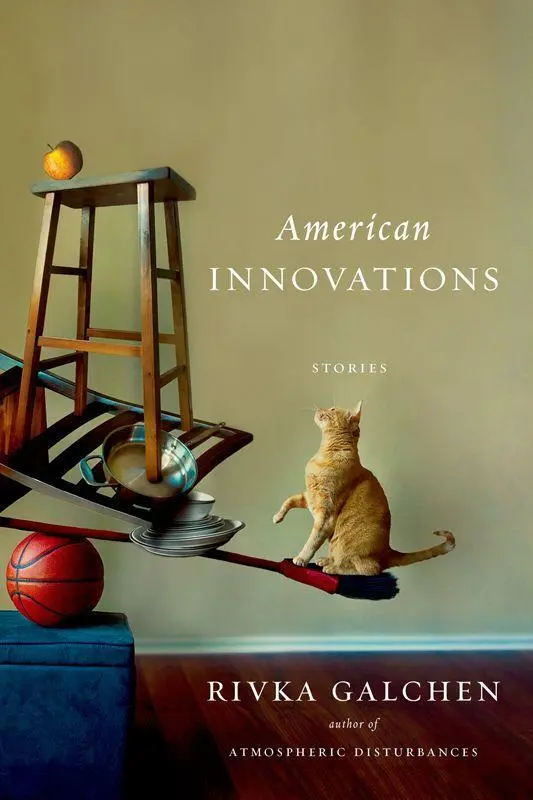
- Название:American Innovations: Stories
- Автор:
- Издательство:Farrar, Straus and Giroux
- Жанр:
- Год:2014
- ISBN:нет данных
- Рейтинг книги:4 / 5. Голосов: 1
-
Избранное:Добавить в избранное
- Отзывы:
-
Ваша оценка:
American Innovations: Stories: краткое содержание, описание и аннотация
Предлагаем к чтению аннотацию, описание, краткое содержание или предисловие (зависит от того, что написал сам автор книги «American Innovations: Stories»). Если вы не нашли необходимую информацию о книге — напишите в комментариях, мы постараемся отыскать её.
, a young woman’s furniture walks out on her. In another, the narrator feels compelled to promise to deliver a takeout order that has incorrectly been phoned in to her. In a third, the petty details of a property transaction illuminate the complicated pains and loves of a family.
The tales in this groundbreaking collection are secretly in conversation with canonical stories, reimagined from the perspective of female characters. Just as Wallace Stevens’s “Anecdote of the Jar” responds to John Keats’s “Ode on a Grecian Urn,” Galchen’s “The Lost Order” covertly recapitulates James Thurber’s “The Secret Life of Walter Mitty,” while “The Region of Unlikeness” is a smoky and playful mirror to Jorge Luis Borges’s “The Aleph.” The title story, “American Innovations,” revisits Nikolai Gogol’s “The Nose.”
By turns realistic, fantastical, witty, and lyrical, these marvelously uneasy stories are deeply emotional and written in exuberant, pitch-perfect prose. Whether exploring the tensions in a mother-daughter relationship or the finer points of time travel, Galchen is a writer like none other today.
American Innovations: Stories — читать онлайн ознакомительный отрывок
Ниже представлен текст книги, разбитый по страницам. Система сохранения места последней прочитанной страницы, позволяет с удобством читать онлайн бесплатно книгу «American Innovations: Stories», без необходимости каждый раз заново искать на чём Вы остановились. Поставьте закладку, и сможете в любой момент перейти на страницу, на которой закончили чтение.
Интервал:
Закладка:
“To see him alive is always like a miracle,” Annalise whispered into my ear. Macheko was standing and shouting at the little television with a raised fist. The coach of the Mexican team is a Communist! He only plays the old broken-down players! He’s punishing the young stars for their big contracts in Europe! Mexico would never go far with this asshole making decisions! Then, fatigued, Macheko sat down. I couldn’t tell if he was familiar with the result of the game or not. The musicians came by. He tipped them well and requested what proved to be a very short song. A candy vendor came by; Macheko bought a pack of mint gum from him, offered it around the table, then put it in his pocket, having taken none. In a more rapid Spanish than usual, which I couldn’t follow so well, Annalise introduced Macheko to me. She called me a brilliant journalist, I think. Macheko kissed my face several times.
I wanted to ask him if he had ever taught at the University of Oklahoma or if he had a son who played trumpet. Alice, however, did not want to ask. And I was Alice.
Macheko ordered a round of beers for the table, each one of which again came with a shot of tequila. He was reilluminated as he spoke to me. There was some notion in the air that I could be of tremendous help, though again I couldn’t really follow; the cantina had only become noisier and more crowded. Macheko had written an account about a headless something? Why it hadn’t yet been translated into English was just for some fucking reason and because people were cowards?
I said: Didn’t you write some sort of set of letters? Letters in English?
He simultaneously ignored me and kept speaking to me. He could do the English translation himself! They wouldn’t even have to pay a translator! Fuck his other projects, this was his most important work! Macheko’s Spanish sounded less Mexican, more something else that I couldn’t place, but I’m not in truth so very good at placing accents. I once asked Germans if they were Canadians. We were interrupted by a man wearing what looked like an accordion connected to what looked like two ends of jump rope with metal handles. Macheko talked the man down from thirty to twenty pesos. Then he stood up, took hold of the handles, and flexed his upper body in what appeared to be agony. This went on for what seemed to me like a long time, though probably it was less than ten seconds. The contraption was an electric shock machine. Macheko declared he felt much more awake now, much better.
“Take, take, you’re welcome to it,” Macheko then said, bringing out handfuls of little plastic bags of white powder and throwing them onto the table. “It’s also a good way to wake up.” He left the bags there as he headed to saloon-doored bathrooms in the back.
A man on my right explained to me that Mexico City had very clean, very inexpensive cocaine because everything passed through there, did I know that?
Upon his return, Macheko said to me that it was so wonderful that I was in Mexico, that I was obviously a good woman.
I did feel that he was staring at me with a kind of intimacy that exceeded the situation. Maybe he stared at me with recognition. Or with a desire to be recognized? Could he see my father’s face in mine? Maybe his look was a petition of some sort. A cry for help?
Then he said he had to go, and he was gone.
* * *
I stayed on awhile, past the end of the replay of the soccer game. You have to help him, Annalise said. He has a metal plate in his head. Another table member nodded in agreement. It was communicated to me that Macheko was the guy who had investigated those hundreds of murders of women in Juárez. Who else had the courage to do that? He was the guy who said to Monkey Vice: It’s not a serial killer. Not a serial killer, but part of the sick culture there. It was from him that Bolaño took the famous line in his novel, the one where the woman says, “¡No somos putas, somos obreras!” We’re not whores, we’re workers! Someone said there were narco kids who thought it was a laugh, or maybe it was an initiation, to shoot a woman in the head while fucking her in the ass, for a special sensation. It needed to be widely known. The metal plate was mentioned again. It was something to do with some time when Macheko was beaten to the edge of his life, left for dead.
I knew it was wrong that I judged these people, mostly negatively, for being both fashionable and emanating flashily unflashy wealth and being interested in “real” life — but it was also real! — in this way; Macheko, the trumpeter and debater, was telling me across the years that there was no place for judgment, not of any kind. Is Macheko from around here? I asked. Oh, he had lived everywhere. He had even lived in Texas, someone said, but something had gone wrong with his green card. Macheko had a secret hideout in his home; the hideout was wall-to-wall books; it could be the home of Edward Said, that was the quality of the books; you could live there for a hundred years. He does so much work! He won’t survive if he stays here. Eventually they’ll decide to get him. You can help him, I was being told. You’re the one who can. You’ll bring attention to him. Then he’ll get his work published in English. They’ll celebrate him as a hero; they’ll give him a job and a green card and everything. That was the power of those American magazines. They already love Bolaño in America. They respect Monkey Vice. You should go north with him. You can report on his reporting. It can definitely work. Alice, you can make this happen.
Alice said, Yes, you’re right. It’s important, I’ll do whatever I can.
* * *
Back in my plain-walled Mexican room, I tried to search for the person I had encountered. My initial Internet searching yielded no Machekos teaching in a chemical engineering department, which was the department from which the corresponder had been fired. I did find a soccer player with the name. Also an empty LinkedIn profile. Not only am I an ineffective Internet searcher, but clicking through a few pages on the Internet makes me feel as if I haven’t slept for days. My husband is immeasurably better at such things.
It was three o’clock in the morning. I called him.
To my joy and surprise, he answered.
I explained about the original Macheko book. Then I described, in a limited way, this other Macheko — some Mexican journalist, I said.
“I’m looking,” he said. My husband couldn’t find Macheko books of any kind. But then, no, he found a copy of the self-published correspondence book on a used books site. It was listed for ninety-one dollars.
I asked if there weren’t any other books by the same writer? Or a writer with a similarly spelled name? Had he looked, specifically, for books written in Spanish as well?
“Don’t you think,” my husband said, “that this being what makes you pick up the phone is a little bizarre? You basically vanish, you don’t explain yourself, we don’t know when you’re coming back, and then, when you do call—”
I thought for a moment to ask after our daughter at that point, but I knew that would just seem defensive, probably even be defensive, seeing as I felt pretty sure about how she was doing; children, I remember this from my own experience, are, I think, very resilient and flexible, and one shouldn’t let people tell one otherwise.
“I’m sorry,” I said. “I guess I panicked.”
“It’s not just me you should talk to,” he said.
“I get it,” I said.
“You must get it and then forget it.”
“I can only panic so many times. It’s not fair to you.”
“It’s not really about fair or not fair. I need you. I really do. But eventually my body will figure it out, that it’s no good to need you, and then I won’t need you anymore. It’ll be like a terrible cure.”
Читать дальшеИнтервал:
Закладка:
Похожие книги на «American Innovations: Stories»
Представляем Вашему вниманию похожие книги на «American Innovations: Stories» списком для выбора. Мы отобрали схожую по названию и смыслу литературу в надежде предоставить читателям больше вариантов отыскать новые, интересные, ещё непрочитанные произведения.











Обсуждение, отзывы о книге «American Innovations: Stories» и просто собственные мнения читателей. Оставьте ваши комментарии, напишите, что Вы думаете о произведении, его смысле или главных героях. Укажите что конкретно понравилось, а что нет, и почему Вы так считаете.