Rivka Galchen - American Innovations - Stories
Здесь есть возможность читать онлайн «Rivka Galchen - American Innovations - Stories» — ознакомительный отрывок электронной книги совершенно бесплатно, а после прочтения отрывка купить полную версию. В некоторых случаях можно слушать аудио, скачать через торрент в формате fb2 и присутствует краткое содержание. Год выпуска: 2014, Издательство: Farrar, Straus and Giroux, Жанр: Современная проза, на английском языке. Описание произведения, (предисловие) а так же отзывы посетителей доступны на портале библиотеки ЛибКат.
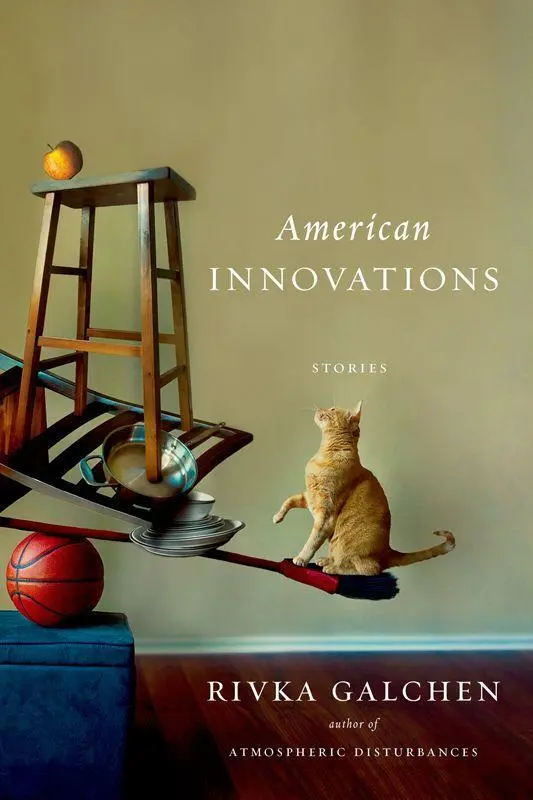
- Название:American Innovations: Stories
- Автор:
- Издательство:Farrar, Straus and Giroux
- Жанр:
- Год:2014
- ISBN:нет данных
- Рейтинг книги:4 / 5. Голосов: 1
-
Избранное:Добавить в избранное
- Отзывы:
-
Ваша оценка:
American Innovations: Stories: краткое содержание, описание и аннотация
Предлагаем к чтению аннотацию, описание, краткое содержание или предисловие (зависит от того, что написал сам автор книги «American Innovations: Stories»). Если вы не нашли необходимую информацию о книге — напишите в комментариях, мы постараемся отыскать её.
, a young woman’s furniture walks out on her. In another, the narrator feels compelled to promise to deliver a takeout order that has incorrectly been phoned in to her. In a third, the petty details of a property transaction illuminate the complicated pains and loves of a family.
The tales in this groundbreaking collection are secretly in conversation with canonical stories, reimagined from the perspective of female characters. Just as Wallace Stevens’s “Anecdote of the Jar” responds to John Keats’s “Ode on a Grecian Urn,” Galchen’s “The Lost Order” covertly recapitulates James Thurber’s “The Secret Life of Walter Mitty,” while “The Region of Unlikeness” is a smoky and playful mirror to Jorge Luis Borges’s “The Aleph.” The title story, “American Innovations,” revisits Nikolai Gogol’s “The Nose.”
By turns realistic, fantastical, witty, and lyrical, these marvelously uneasy stories are deeply emotional and written in exuberant, pitch-perfect prose. Whether exploring the tensions in a mother-daughter relationship or the finer points of time travel, Galchen is a writer like none other today.
American Innovations: Stories — читать онлайн ознакомительный отрывок
Ниже представлен текст книги, разбитый по страницам. Система сохранения места последней прочитанной страницы, позволяет с удобством читать онлайн бесплатно книгу «American Innovations: Stories», без необходимости каждый раз заново искать на чём Вы остановились. Поставьте закладку, и сможете в любой момент перейти на страницу, на которой закончили чтение.
Интервал:
Закладка:
* * *
“Your sister tells me Q has been staying at Morris’s place,” J’s husband said. This was on the phone, around five o’clock, when J had stepped out to look for a lemonade she never found. Key West was humid and sleepy and closed. “Staying there while Morris is in the ICU with some sort of bad pneumonia.” Morris was a retired accountant who had been in the same community choir as Q.
“She’s probably just keeping the place cheerful and clean. Collecting the newspaper.”
“Maybe. Or maybe she doesn’t have her own place anymore.”
“Illusion of trouble,” J said, cheered that the conversation was moving her to the square of reason, since J’s husband had made a knight’s move to the square of paranoia.
As they talked, J found herself picturing their steep driveway, the cleavages of snow, a pile of the neighbor’s discarded shingles waiting for pickup. And then it was “I love you, angel, I love you so much, OK?”
J felt scared. They were getting off the phone. One was supposed to be content and complete on one’s own, to need nothing, and from that position one could truly give love — something like that.
* * *
When J returned to the room, Q said, “I think I won’t come to the dinner.”
“Why not?” J asked, alarmed.
“Maybe you don’t want me there,” Q said.
“But I do. It’s a bunch of people I’m supposed to be collegial with, which is stressful. I don’t want to go alone,” J said, mostly truthfully.
“But I should lose weight,” Q said. “I shouldn’t go until I lose weight.”
“You look nice. Plus, you don’t even know these people.”
“Even more so.”
“The people who are thinner than you will be happy to feel relatively thin; the people who are larger, well, they’ll be thinking about themselves. Actually, almost everyone will be thinking about themselves. You taught me that. Now I finally believe you. Just come. I suspect the food will be good.”
The dinner was held in a large art deco home that J couldn’t help but estimate as being worth around $2.2 million. Greeters — professionals wearing tidy black-and-white outfits — were in place at the entrance to an inner courtyard, and in addition to greeting they were warning guests that the house had many “tripping hazards.” “Please be careful. There are a lot of steps that you might not notice,” one of the greeters clarified. “We’ve marked them with red tape.” It was true: there was a step down to a living room. A step up to a dining room. A couple of steps down to the porch. Steps back up to other rooms. Everything had its level. The backyard, which featured an artificial stream, crossable by a small footbridge, had tables set up for about a hundred guests, maybe more. The party was already crowded when J and Q arrived. Is Twitter like the ancient arcades or is it the end of literature? someone was asking. Someone else was explaining that his younger brother, after their bohemian upbringing in the Oregon woods and then having lived for years on boats, had run off with an evangelical musical theater project called Up with People. Reverse rebellion. What could you do?
J didn’t manage to start up a conversation with anyone. She saw Q speaking with the hostess, with some intensity; M was also there, listening. Q was holding a drink. She looked as if she was enjoying herself. The hostess was wearing an aquamarine leather jacket that had slashes in the back, exposing an underlying black leather in a way that made J think of deboning a fish. The meal was grilled salmon on a quinoa salad, and also greens.
At the table: “It’s so good to have a break,” Q said to a prominent science fiction writer sitting near her and J. “Too many of my friends are sick or in the hospital.”
“In the hospital for what?” a well-regarded older feminist who knew a lot about birds asked.
“Who’s in the hospital?” M asked.
Q seemed to have the attention of the whole table.
“My friend was driving to the airport,” Q said. “He was going to fly to the Philippines and then he couldn’t turn his head, so he drove straight to the emergency room of the nearest hospital. Of course they just left him on a stretcher in the hallway for two days. They wouldn’t have cared if he died — they did nothing for him. That’s America for you. But then his friend arranged a transfer to another hospital. And at the second hospital they scanned him, and they found he had a big tumor in his neck. Also, he was missing one of his, I can’t think of the word—”
“You write about medicine?”
“No, no, I just write e-mails,” Q said. “I’m not a writer. But I was married to J’s father — that’s how I’m connected to J. J says I write very good e-mails.”
“I woke up with my neck sore like that once,” another science fiction writer said. In addition to writing, he was in a band that had a hit song based on Beowulf . “I didn’t go to the hospital, though. I just took ibuprofen.”
“But you could have gone to the hospital,” Q said. “Because you all have insurance in England. The whole country is insured.”
Now J was worried that Q didn’t have health insurance; that was how her secrets usually manifested, like a tuba sound straying into a pop song. J intervened. “It wasn’t just painful to move his neck. I think he really couldn’t move it,” she argued, as if Q were beleaguered, when in fact she seemed aglow. Also, J was just guessing at these details; she didn’t know who or what Q was talking about.
“They have names like C2, C3,” Q was explaining. “One of those Cs — he was missing it entirely.”
“It had eroded away?” M asked.
“No, they just didn’t know where it had gone,” Q said. “I think maybe it was never there. I visited him after he had the surgery,” Q went on. “They didn’t remove the tumor because it was in a bad place for removing it, but they did give him an extra C made out of concrete—”
“I doubt it was concrete—”
“When I left to come down here, he was still in the hospital because he was afraid to go home until he had the results back from the biopsy. But I think he’ll be fine. They scanned the rest of his body and found there were tumors in other places, too, which is a good sign—”
“That sounds like a bad sign,” the woman knowledgeable about birds said.
“It’s not a bad sign,” Q said definitively. “I have a friend who’s a doctor.” Now Q seemed not aglow; she began to speak more slowly. “She says that after a certain age, if we look at anyone’s body, there’s all sorts of things there. When there’s many things like that, it’s not a problem.”
“Incidentalomas,” M said. “That’s what you’re trying to say. That lots of things are just incidentalomas. I agree completely.”
“Has anyone seen that George Clooney movie that’s playing?” J said. She ate quickly. J and Q weren’t the very first to leave, but they were nearly the first, though they were detained near one of the tripping hazards as a very elderly and apparently blind man, dressed in an all-white suit and holding a cane, was being guided out by the greeters.
As he was passing, J asked, “Q, is there something medical going on with you?”
“I’m livelier than you are,” Q said. “I could stay another hour, easy.”
“I mean, do you have medical news?”
“You should be more cheerful,” Q said. “It would be good for your health. You know — that would be something good to write about. About how you take on a good mood in order to have good health. You do that for thirty days and track what happens. That’s something that would really sell. I mean, I admire that you tell stories of make-believe people in worlds that don’t exist and that have no relevance to how we live. That can be nice, but people also like things that are uplifting and practical.”
Читать дальшеИнтервал:
Закладка:
Похожие книги на «American Innovations: Stories»
Представляем Вашему вниманию похожие книги на «American Innovations: Stories» списком для выбора. Мы отобрали схожую по названию и смыслу литературу в надежде предоставить читателям больше вариантов отыскать новые, интересные, ещё непрочитанные произведения.











Обсуждение, отзывы о книге «American Innovations: Stories» и просто собственные мнения читателей. Оставьте ваши комментарии, напишите, что Вы думаете о произведении, его смысле или главных героях. Укажите что конкретно понравилось, а что нет, и почему Вы так считаете.