Rivka Galchen - American Innovations - Stories
Здесь есть возможность читать онлайн «Rivka Galchen - American Innovations - Stories» — ознакомительный отрывок электронной книги совершенно бесплатно, а после прочтения отрывка купить полную версию. В некоторых случаях можно слушать аудио, скачать через торрент в формате fb2 и присутствует краткое содержание. Год выпуска: 2014, Издательство: Farrar, Straus and Giroux, Жанр: Современная проза, на английском языке. Описание произведения, (предисловие) а так же отзывы посетителей доступны на портале библиотеки ЛибКат.
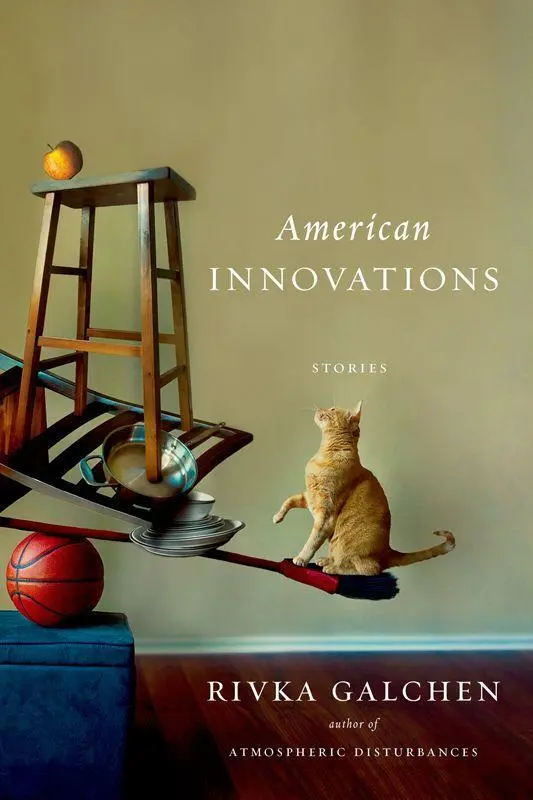
- Название:American Innovations: Stories
- Автор:
- Издательство:Farrar, Straus and Giroux
- Жанр:
- Год:2014
- ISBN:нет данных
- Рейтинг книги:4 / 5. Голосов: 1
-
Избранное:Добавить в избранное
- Отзывы:
-
Ваша оценка:
American Innovations: Stories: краткое содержание, описание и аннотация
Предлагаем к чтению аннотацию, описание, краткое содержание или предисловие (зависит от того, что написал сам автор книги «American Innovations: Stories»). Если вы не нашли необходимую информацию о книге — напишите в комментариях, мы постараемся отыскать её.
, a young woman’s furniture walks out on her. In another, the narrator feels compelled to promise to deliver a takeout order that has incorrectly been phoned in to her. In a third, the petty details of a property transaction illuminate the complicated pains and loves of a family.
The tales in this groundbreaking collection are secretly in conversation with canonical stories, reimagined from the perspective of female characters. Just as Wallace Stevens’s “Anecdote of the Jar” responds to John Keats’s “Ode on a Grecian Urn,” Galchen’s “The Lost Order” covertly recapitulates James Thurber’s “The Secret Life of Walter Mitty,” while “The Region of Unlikeness” is a smoky and playful mirror to Jorge Luis Borges’s “The Aleph.” The title story, “American Innovations,” revisits Nikolai Gogol’s “The Nose.”
By turns realistic, fantastical, witty, and lyrical, these marvelously uneasy stories are deeply emotional and written in exuberant, pitch-perfect prose. Whether exploring the tensions in a mother-daughter relationship or the finer points of time travel, Galchen is a writer like none other today.
American Innovations: Stories — читать онлайн ознакомительный отрывок
Ниже представлен текст книги, разбитый по страницам. Система сохранения места последней прочитанной страницы, позволяет с удобством читать онлайн бесплатно книгу «American Innovations: Stories», без необходимости каждый раз заново искать на чём Вы остановились. Поставьте закладку, и сможете в любой момент перейти на страницу, на которой закончили чтение.
Интервал:
Закладка:
I went to eat lunch at a nearby Italian place.
Maggie, one of the waitresses there, knows me as a regular. “You look like you’ve seen a ghost,” she said.
I’d intended to order spaghetti with meatballs. Maybe my eyes watered because Maggie unprofessionally took the seat across from me and patted my hand.
I told her that my apartment was empty.
“You mean you lost somebody?”
I explained that all my stuff was gone. Not just my TV and stereo and cash, but everything. “Lamps, sweaters, my toothbrush, my backup toothbrush, my ironing board. My favorite fork.”
“What kind of thief takes everything? That’s so weird.”
I shrugged. “Or normal. I don’t know. Who knows about crime, really?”
“Do you have insurance?”
I said yes, though I didn’t know if I did or not.
She gave a little laugh and then pursed her lips, like thinking cartoon style. “Who really loves you?” Maggie asked. “Loves you like crazy. Or like really, really hates you—”
“Besides myself?” I said. “Yeah, no, it’s not like that.” I sipped some water.
“Have you ever broken dishes?” she asked.
“Sure.”
“I mean, out of anger,” she said. “I always wanted to do that.”
“What’s weird,” I ventured, “is my stuff just went and walked out on its own.”
Maggie was lost in thought, in dish-breaking fantasies maybe.
“Just left,” I continued, “like kids running away from home—”
“I’m sorry,” she said to me. “But I have to get back to work. You’ll be OK. I promise.”
I couldn’t refurnish my apartment; I just couldn’t. I decided to rent it out. The first prospective tenant said he was a painter, that he liked the light of my apartment, and then he offered me two hundred dollars less than I was asking. “I can see you’re a person with a rich interior life,” he told me. I suppose he was trying to flatter me as some kind of sponsor of the arts. I’m fine with the arts. But that was not why I agreed to his lower price. I just wanted to cover my property taxes and maintenance fees and have things over and done with.
Myself, I rented a furnished room in a dormitory eleven blocks away. The lessee was a Brooklyn Law School student who was doing something or other in a cold and northern country for a term or two. I could see the Watchtower from the rental room, though I had to lean out the window in order to do so. I went for walks, made smoothies, tried acupuncture, read magazines. I did those things that people do. But the oddness of the furniture crime pressed upon me. Had it changed me? Not that I was so great before, but I had been comfortable with myself, and I had finally escaped an old feeling that I was a failed version of someone — it doesn’t really matter who — else. I knew I was still fundamentally my old reliably me-like version of me. And yet I felt as if the real me were out there somewhere, waiting for my return. I felt wanted by that real me.
Time passed. Not an item of mine — not a lamp a watch a fork a chair an antique ironing board, not a thing — was found at any of the usual fronts where the police, so they said, were accustomed to finding things. I walked back down to the precinct to ask if they had dredged the river. This was misunderstood as a joke. I think this misunderstanding happened because I’m a woman. If I were a man, maybe they would have dredged. Or thought there was something wrong with me for asking.
Though I no longer went to the movies on Tuesdays, some new habits settled in. I, like hundreds or maybe thousands of other people, found myself regularly attending an indoor crafts and antiques market. Some of the merchants there were steady, and some switched in and out. One vendor made exquisite benches out of salvaged wood. Another used old books to make bookshelves. A third sold knit gloves, with the letters for ANGEL stitched onto the fingers of one hand and for DEVIL stitched onto the fingers of the other. Naturally there was also well-packaged jam. Often it was hard to tell who was running any particular stand, as there were no assigned places where vendors stood, and vendors wandered away from their posts, to visit other vendors, I guess, so one (or I at least) was left with the impression that these things had brought themselves out to the market of their own free will.
Of course I hoped my things would turn up. Set themselves out for sale, just like people do, kind of. A normal fantasy, really, given the circumstances. It didn’t happen. Nevertheless, I was often happy there at the market, for spans of time as long as fifteen minutes. I felt like I was thumbing through all the lives I wasn’t leading but might have led. One where I wore dresses that looked like they were made out of doilies and old satin; another where I had a special wood holder for my milk bottles; and a third where I was a typesetter or just collected typesettings. I imagined all the people these objects had owned: short people, and fat people, and people who thought periwinkle was purple, and those who thought of it as blue, and people who blamed their mothers for everything that went wrong in their lives, and people who genuinely liked wearing pearls. Such a crowd.
Each weekend, on my way back from the market to my rented room, I’d pass by an empty lot with three dumpsters on it. The term “dipsy dumpster” then always popped into my head. So I’d think about that term, and then I’d think about how it was a strange term, and I’d wonder where we neighborhood kids had gotten it. Then I’d think about the girl who’d lived across the street from me when I was young, and who had brain damage from being thrown around by an alcoholic dad when she was a baby, and who was beautiful and whose adoptive parents had changed her first name when they got her at age four, and that girl, in addition to saying “dipsy dumpster,” used to say “nekkid” instead of “naked,” which really bothered me, even though we mostly had a great time together. That same little sequence of thoughts ran through my mind each Saturday as I passed those dumpsters. Like a gentle bull within me helplessly charging at the sight of red.
One Saturday — the face of the Watchtower was obscured by fog — as I walked past the dipsy dumpsters, steeled for the predictable memory assault, an unexpected rush of happiness came over me. The happiness arrived earlier than did any perception that might claim responsibility for it. Then, preemptively overjoyed, I noticed my miniature two-tined fork. The pink-handled one. With its slightly melted plastic, and the gold filament mostly missing from the RAD part of COLORADO ROCKIES. It was just there, on a little side table near the first dumpster. My mom had bought that fork for me when we were on a road trip, I was remembering. The fork hadn’t originally been alone; it had been part of a souvenir set that also included a spoon, a spoon that maybe still persisted somewhere. My mother had bought me that tiny silverware the day after we’d seen enormous sequoia trees. She’d liked my hair that day; she’d set it back in two braids so tight that they gave me a kind of languorous headache. It hadn’t been a particularly important day, that fork-buying day. I don’t know why I’d forgotten it or why I was suddenly remembering it. It was just a pretty nice day. We had been pleased with each other. I really loved that fork.
I stepped toward it. I was debating internally whether or not to touch the little fork, to test her reality in that way. Then I saw, near the middle dumpster, among other things, a blue kitchen stool that had a spackle of yellow paint, a spackle that I recognized with horror. Folded neatly over that stool was a pale blue gingham quilt of mine, the one that had nearly smothered me. Turning just a few degrees, I found myself faced down by my old ironing board. My armchair, my striped cardigan, my old yellow toaster …
Читать дальшеИнтервал:
Закладка:
Похожие книги на «American Innovations: Stories»
Представляем Вашему вниманию похожие книги на «American Innovations: Stories» списком для выбора. Мы отобрали схожую по названию и смыслу литературу в надежде предоставить читателям больше вариантов отыскать новые, интересные, ещё непрочитанные произведения.











Обсуждение, отзывы о книге «American Innovations: Stories» и просто собственные мнения читателей. Оставьте ваши комментарии, напишите, что Вы думаете о произведении, его смысле или главных героях. Укажите что конкретно понравилось, а что нет, и почему Вы так считаете.