Rivka Galchen - American Innovations - Stories
Здесь есть возможность читать онлайн «Rivka Galchen - American Innovations - Stories» — ознакомительный отрывок электронной книги совершенно бесплатно, а после прочтения отрывка купить полную версию. В некоторых случаях можно слушать аудио, скачать через торрент в формате fb2 и присутствует краткое содержание. Год выпуска: 2014, Издательство: Farrar, Straus and Giroux, Жанр: Современная проза, на английском языке. Описание произведения, (предисловие) а так же отзывы посетителей доступны на портале библиотеки ЛибКат.
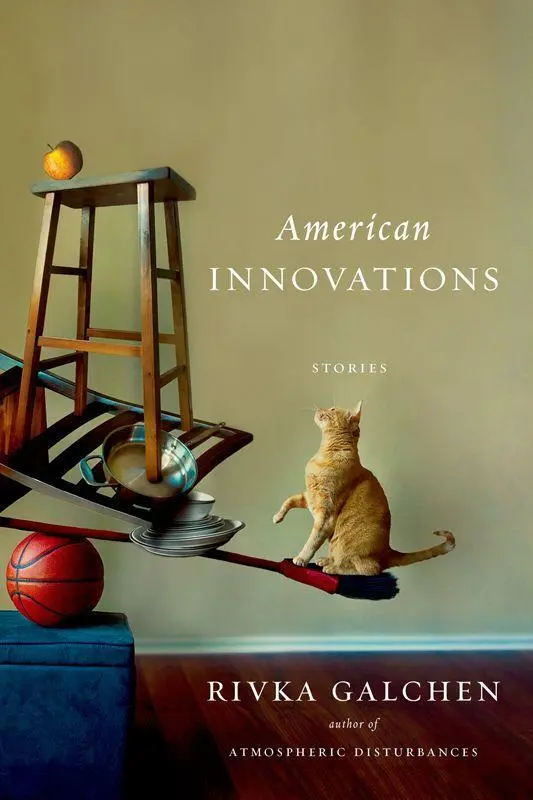
- Название:American Innovations: Stories
- Автор:
- Издательство:Farrar, Straus and Giroux
- Жанр:
- Год:2014
- ISBN:нет данных
- Рейтинг книги:4 / 5. Голосов: 1
-
Избранное:Добавить в избранное
- Отзывы:
-
Ваша оценка:
American Innovations: Stories: краткое содержание, описание и аннотация
Предлагаем к чтению аннотацию, описание, краткое содержание или предисловие (зависит от того, что написал сам автор книги «American Innovations: Stories»). Если вы не нашли необходимую информацию о книге — напишите в комментариях, мы постараемся отыскать её.
, a young woman’s furniture walks out on her. In another, the narrator feels compelled to promise to deliver a takeout order that has incorrectly been phoned in to her. In a third, the petty details of a property transaction illuminate the complicated pains and loves of a family.
The tales in this groundbreaking collection are secretly in conversation with canonical stories, reimagined from the perspective of female characters. Just as Wallace Stevens’s “Anecdote of the Jar” responds to John Keats’s “Ode on a Grecian Urn,” Galchen’s “The Lost Order” covertly recapitulates James Thurber’s “The Secret Life of Walter Mitty,” while “The Region of Unlikeness” is a smoky and playful mirror to Jorge Luis Borges’s “The Aleph.” The title story, “American Innovations,” revisits Nikolai Gogol’s “The Nose.”
By turns realistic, fantastical, witty, and lyrical, these marvelously uneasy stories are deeply emotional and written in exuberant, pitch-perfect prose. Whether exploring the tensions in a mother-daughter relationship or the finer points of time travel, Galchen is a writer like none other today.
American Innovations: Stories — читать онлайн ознакомительный отрывок
Ниже представлен текст книги, разбитый по страницам. Система сохранения места последней прочитанной страницы, позволяет с удобством читать онлайн бесплатно книгу «American Innovations: Stories», без необходимости каждый раз заново искать на чём Вы остановились. Поставьте закладку, и сможете в любой момент перейти на страницу, на которой закончили чтение.
Интервал:
Закладка:
I turned the corner, past the plywood barrier, on around to the front of the abandoned police station. From there I saw the six stories of my own building. I saw my window. My lights weren’t on. Which was wrong. I always leave the lights on in my apartment, day or night. I’ve never shaken that childhood fear that in the dark things cease to exist. Maybe that is what really happens, if briefly; science these days keeps confirming the strangest things.
My window dark: probably just the coordinated demise of several bulbs, I told myself. Or something. Something pretty normal.
I looked down at my feet, as if to remind myself of them. A breeze blew, carrying an ever so slight scent of burning leaves and an industrial shoreline kind of mildew. I felt myself growing dim through inexposure. Maybe a fuse had blown. A very important fuse.
Some sort of sound. I looked back up, toward my unlit window. Some … thing was emerging from the darkness there. At first, it looked like a nothingness that had acquired an outline on the cheap. But as it descended — it was descending — it became more fully ontologically realized. It was my ironing board.
I’d forgotten that I even had an ironing board. It was an old family thing, all wooden. It used to collapse unannounced, and often. I and a series of dogs had been afraid of it when I was a kid. I’d forgotten it to a closet. I would never have said I cared for it. But when I saw it there on the fire escape, out of its context, a great tenderness unearthed itself, flowing from me to it.
The ironing board’s gangly back legs hooked over the fire escape’s final edge; its front legs made gentle, almost elastic contact with the sidewalk below. Having landed confident as a cat burglar, the board then continued east. Its progress wasn’t awkward or zombielike. It moved supplely, playfully. Kind of like a manatee.
Next, with surprising nimbleness, my brown velveteen recliner climbed down, then passed by me in a stump-legged gallop. My wood-armed Dutch sofa shuffled graceful as a geisha. My desk chair seemed to think it had wheels, which it doesn’t. A green-globed desk lamp went by. An ordinary plastic dustpan. A heavy skillet, scorched. My things. They were all heading east. With an enviable sense of purpose. An old set of Russian nesting dolls from my father, the ladder I used to reach my storage loft, a forgotten feather duster (blue), a pine cabinet with round hinges, two high kitchen stools I had painted, one of which had a yellow splatter from another project, which splatter I liked to run my finger across. My dresser whose drawers squeaked just so, a faux-colonial laundry basket, a blur of white dishes; a checkered ceramic vase, downy throw pillows, three folding chairs, a harem of kitchen utensils; a video projector, a yarny bath mat, a striped shower curtain, perky Tupperware labels, a corkboard with its map pins, chewed-on chopsticks, a crystal-like vase that makes a finger look cut in half if held in just the right way. “Stuff” is such a childish word. Sheets passed as if floral ghosts. My books rustled by like a military of ducks. My mother had never liked my books. She’d said they kept me from real life, by which I think she meant men, or money, or both. Always accusing things of precisely the crimes they haven’t committed.
The parade of my things, I was almost enjoying it. I didn’t hate my life, as it left me.
Then my miniature pink plastic-handled two-tined fork, which has COLORADO ROCKIES engraved on its handle in golden letters and is the surviving half of a souvenir set from a truck stop, and which I’ve had forever and ever: then she went by. Not even among other silverware. On her own. Amid that witching hour crowd of my life, it was she — she who had shared so many bowls of noodles with me, so many scrapings of extra sugar onto plain yogurt, so many steaks cut by another into tiniest bites, she for whom I would refuse as a child to eat my dinner until she was found — it was for her, my fork, that my heart beat wildest. Until the moment of her exodus, I had been too mesmerized even to think of moving. What I watched felt no more personal than that cartoon movie with the brooms, a movie I’d never much liked because it had no words. But my little fork. I wanted to follow her. To beg her to stay or to ask her why she was leaving. Why didn’t I run after her or shout out to her? Why did I feel so limbless? Maybe it was terror; I could barely move. And she — she receded beyond my field of vision, as my old ally the Watchtower did not stutter in telling the time, the temperature, the time again, and the temperature again.
Oh, fork. How does it feel to be a bat? I don’t know. Sleepy, maybe? Hungry? Yearning? Content? I don’t know how I felt that Tuesday night. Or hump day morning. Whatever it was. I barely even know how I didn’t feel. I didn’t feel like reading a newspaper, or having a coffee, or going for a jog, or watching television. Nor did I feel like crying behind the boiler in the basement. Or like trying out for something. I didn’t even feel like I had lost someone I deeply loved; this was different from that. I didn’t feel like going to another movie and asking for extra butter on my popcorn. I didn’t feel like talking to someone who would understand.
I managed the short crawl to the stoop of the familiarly abandoned police station and then rested there. Above me: one flagpoled balustrade where surely, at one time or another, a flag had hung. Had that been twenty-one years ago? One hundred and one? I didn’t know. Maybe no one knew. An old police station. Hadn’t I seen a crime? I smiled, a little. A dew was breaking.
Time had blinked or I had fallen asleep. I saw a few skid marks on the sidewalk, as if from a bicycle. I don’t have a bicycle, I thought. I don’t think I do. Though I have a toolbox with rubber feet. Or had one. The sun washed out the face of the Watchtower’s lightbulb billboard in brightness. Where my window was I could see only reflected light.
Britain, once an empire, now a small island off Europe — that was my thought.
A sound then like the Apocalypse. The superintendent, vacuuming the lobby of my building, with one of the front doors propped open. The super’s name sounds like that of a Roman emperor. Advertus, I think it might be. Or Nero. He knocked on the glass of the unopened front door of the building — but you’re inside, I thought briefly — and waved at me, half friendly-like.
I waved back. Then I beckoned him.
“I’ve forgotten my keys,” I found myself calling out in a childish tone as he crossed the street toward me.
Claudius offered me his enormous paternal hand. After a brief moment of hesitation I realized the hand was to help me stand up, not just to wonder at. “Was there,” I asked as casually as I could, dusting off the back of my skirt, “some kind of electrical blip last night?”
“Something happen?” he asked, laughing, showing teeth.
It is in the nature of a dream that we can’t stub our toe against it. I was told that more than once, by my mother, or maybe by my father. Inside my apartment, which the emperor kindly opened for me, was only my ancient stuffed animal dog, Jasper. Him, and a stray leaf, and a to-do list magneted onto the refrigerator.
“Did you move? Are you moving?”
I shook my head. “This is a surprise,” I said. “I mean, this is terrible.”
“Yes,” he said, and his lonely word echoed against the high ceiling.
I couldn’t tell him what I’d seen the night before. He seemed like a nice guy, but still, I couldn’t tell him.
“I’m sure no harm was meant,” I said, when Nero insisted I file a police report.
“For the other people in the building,” he preached.
He walked me to the station. I knew that if I reported the truth of what I had seen, I’d soon be under the fluorescent light of an intake room at a nearby hospital. Even the most normal person, if placed in a highly abnormal situation, can be mistakenly perceived as the source of the abnormality of the person/circumstance aggregate. I signed a sheet attesting to an inventory of objects. I felt as if I had committed the crime. During the brief interview, I broke into tears, though they may have been fake, I’m not sure. I even said, “I feel so guilty!” A hand went to my back; I was told that people forget to lock their doors all the time, that I shouldn’t feel bad about being trusting. I would be called were anything learned of my objects, or of my objects’ thieves.
Читать дальшеИнтервал:
Закладка:
Похожие книги на «American Innovations: Stories»
Представляем Вашему вниманию похожие книги на «American Innovations: Stories» списком для выбора. Мы отобрали схожую по названию и смыслу литературу в надежде предоставить читателям больше вариантов отыскать новые, интересные, ещё непрочитанные произведения.





Обсуждение, отзывы о книге «American Innovations: Stories» и просто собственные мнения читателей. Оставьте ваши комментарии, напишите, что Вы думаете о произведении, его смысле или главных героях. Укажите что конкретно понравилось, а что нет, и почему Вы так считаете.