Rivka Galchen - American Innovations - Stories
Здесь есть возможность читать онлайн «Rivka Galchen - American Innovations - Stories» — ознакомительный отрывок электронной книги совершенно бесплатно, а после прочтения отрывка купить полную версию. В некоторых случаях можно слушать аудио, скачать через торрент в формате fb2 и присутствует краткое содержание. Год выпуска: 2014, Издательство: Farrar, Straus and Giroux, Жанр: Современная проза, на английском языке. Описание произведения, (предисловие) а так же отзывы посетителей доступны на портале библиотеки ЛибКат.
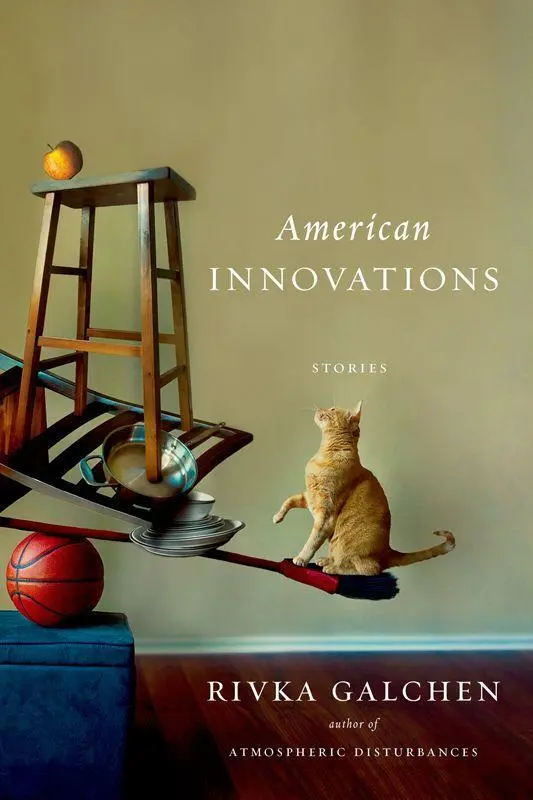
- Название:American Innovations: Stories
- Автор:
- Издательство:Farrar, Straus and Giroux
- Жанр:
- Год:2014
- ISBN:нет данных
- Рейтинг книги:4 / 5. Голосов: 1
-
Избранное:Добавить в избранное
- Отзывы:
-
Ваша оценка:
American Innovations: Stories: краткое содержание, описание и аннотация
Предлагаем к чтению аннотацию, описание, краткое содержание или предисловие (зависит от того, что написал сам автор книги «American Innovations: Stories»). Если вы не нашли необходимую информацию о книге — напишите в комментариях, мы постараемся отыскать её.
, a young woman’s furniture walks out on her. In another, the narrator feels compelled to promise to deliver a takeout order that has incorrectly been phoned in to her. In a third, the petty details of a property transaction illuminate the complicated pains and loves of a family.
The tales in this groundbreaking collection are secretly in conversation with canonical stories, reimagined from the perspective of female characters. Just as Wallace Stevens’s “Anecdote of the Jar” responds to John Keats’s “Ode on a Grecian Urn,” Galchen’s “The Lost Order” covertly recapitulates James Thurber’s “The Secret Life of Walter Mitty,” while “The Region of Unlikeness” is a smoky and playful mirror to Jorge Luis Borges’s “The Aleph.” The title story, “American Innovations,” revisits Nikolai Gogol’s “The Nose.”
By turns realistic, fantastical, witty, and lyrical, these marvelously uneasy stories are deeply emotional and written in exuberant, pitch-perfect prose. Whether exploring the tensions in a mother-daughter relationship or the finer points of time travel, Galchen is a writer like none other today.
American Innovations: Stories — читать онлайн ознакомительный отрывок
Ниже представлен текст книги, разбитый по страницам. Система сохранения места последней прочитанной страницы, позволяет с удобством читать онлайн бесплатно книгу «American Innovations: Stories», без необходимости каждый раз заново искать на чём Вы остановились. Поставьте закладку, и сможете в любой момент перейти на страницу, на которой закончили чтение.
Интервал:
Закладка:
J would definitely pack reading for their week together.
* * *
At the airport in Key West, J and Q were to be picked up by M, who was somewhat old, or old on paper and not old in person, or young, and who was one of the heads of the event. Though J had never met M, she had been informed that M’s wife, who had been quite young, or younger, had not that long ago died. Of something. One of the young-woman cancers was the impression she had. They had only just got married when the diagnosis came. Also, J knew that M wore an eye patch. The eye patch was from an injury years earlier that involved a champagne cork launched haphazardly by a third party, unnamed, and surely still feeling guilty. “Please don’t stare at the eye patch,” J instructed Q. “I’m telling you about it in advance, so that you don’t stare.”
“I would never stare at an eye patch,” Q said.
They exited from the plane directly into the outdoors and then proceeded from sunshine into the small terminal building for baggage claim. Above the airport entrance gate there were full-color, life-size statues of tourists or immigrants or both, a crowd of them, with sculpted suitcases, gathered together, in greeting or suffering; the statues resembled somewhat melted Peeps marshmallow candies. J and Q walked under them and into a tiny airport lobby. There was M! The eye patch made him easy to spot. “Everything good?” he asked. Yes, yes. “And you’re—” He extended his hand to Q, who said that she was Q, which didn’t clear up much, but enough. They headed out to the parking lot, to the surprise of a little green convertible MG.
It was a sunny afternoon, and the wide road went along sandy beaches at the soft water’s edge. Just driving this little car, ideal for two, must be traumatically lonely for him, J found herself thinking. Sorrow’s black wing now shades his brow, she thought, as they proceeded at twenty-five miles an hour on the quiet shoreline road, past occasional seagulls and the foam of gentle waves. J was riding shotgun. Q was in the tiny back, digging between the cushions in search of a seat belt buckle that was not to be found. M was smiling. He was a prominent popular historian. He chatted to J about the upcoming events, where dinner was that evening, what the expected weather was, who had already arrived, the various places people were staying—
“You must feel like a bride,” J said.
“A what?” M said.
“Like a bride,” J repeated.
“Bride? Hmm. Well. No. I don’t feel like a bride. What do you mean?”
J felt obliged to stand by the tenuous comparison. “You know: all this planning, now it’s happening.”
“I see. Well. No,” M repeated. “I don’t feel like a bride. I don’t really do much of the organizing. We have staff that does that. My position is mostly honorary.”
“Of course…”
“I just send a few initial e-mails to get things started. I don’t do the real work. It’s just that I live here. Many of us have lived here, part-time, for decades. It’s very nice, you’ll see.”
“Wait, why is he supposed to feel like a bride?” Q called out from the backseat.
“Not like a bride!” J corrected. “I was wrong about that.”
M dropped J and Q off at their hotel, Secret Paradise, and said that he’d look forward to seeing them at dinner. J avoided saying what for some reason came brightly to mind: God willing.
* * *
The clock read 2:22 p.m. Their accommodation had a spacious bedroom, living room, kitchen, and luxury shower, in addition to a large private deck. Instead of the blank feel of a modern hotel room it had the eccentric collectible-salt-shakers-and-wicker atmosphere of a specific personality. “I could never live in this kind of a place,” Q said. “With so many things on the wall and on the tables. I mean, it’s nice. But it’s very American.”
J didn’t like the decor, either, but she said, “Well, we are in America. Sort of.”
“That man who picked us up didn’t look like a writer,” Q continued. “He was so tall. Like a lawyer, or a nice businessman.”
“He’s more a historian.”
“A writer looks more like — there was that nice dog cleaner, remember? The guy who wrote poetry and did at-home dog cleaning? You remember, he had that van and would come to the house, and he would clean Puffin just there in the driveway. It was an excellent business idea that he had.”
J was unpacking her things. “With animals it’s called grooming, not cleaning. Cleaning is for carpets.”
Q lay on the sofa and turned the television to the Weather Channel. J went out onto the deck. A wooden fence suspended on posts a foot or so off the sand blocked the view of the ocean, which was odd, though it did offer privacy.
J opened to the beginning of her book, which investigated the disappearance, in 1938, of Ettore Majorana, an Italian particle physicist. Majorana’s disappearance might have been an escape, or might have been a suicide, or might have been a murder by Mussolini’s government, or might have been something else. Majorana had for years behaved strangely: he didn’t want to publish his work, or cut his hair, or see people — including his mother — whom he had previously enjoyed seeing. He may have been paranoid, or merely depressed. His work might or might not have been relevant to research into developing an atomic bomb. The historical moment made internal states that would normally be deranged — anxiety, grandiosity — seem quite possibly reasonable. Whatever the case, Majorana withdrew all the money from his bank account, boarded a boat to Palermo, and sent an apologetic goodbye-forever telegram to his employer, another telegram to his family, asking that they not wear black, then a further telegram to his employer, saying that in fact he would be returning — that he hadn’t meant to be dramatic or like an Ibsen heroine, that he would explain it all on his return, a return that never occurred.
The book J was reading had been written in the 1970s by a Sicilian novelist who was famous, apparently, and had most often written about the Mafia. J looked over to the sofa where Q had lain down, but she could see only the sofa’s back. For a moment, J felt certain that Q was gone. J walked over to the sofa; Q was there.
J’s father had married Q two years after J’s mother had died. J couldn’t really remember her mother, though she had one vivid and most likely fabricated-from-a-photo memory of eating a frosted doughnut with sprinkles with her at a Winchell’s when she was three or maybe four. J still loved doughnuts; Q had bought them for her every weekend morning. J and her sister were both blond and blue-eyed, and Q had often been mistaken for the girls’ nanny. “Let people think their thinks” was a Q motto. When J’s father had died, three years earlier, he had left Q a house and a teachers’ union pension fund that must have been worth something, and Q had sold the house — not that she told the girls that she had done this — and moved into a small but tidy apartment. Q still worked part-time as a backup receptionist at a law firm, so there must have been some money left over, but it seemed possible that the money had been lost. Or, maybe, anxiously piled high in a savings account somewhere that she wouldn’t touch. Or maybe loaned out irretrievably to distant Burmese cousins with unfortunate or naive investment strategies. That kind of thing had happened before with Q. When the sisters recently visited Q, she announced on the first evening that she had stopped ordering takeout, saying that it was for spoiled people. Maybe Q had bought the Groupon shares after all? And on margin? One never knew with Q. One day J had idly opened Q’s passport, and it turned out that Q was eleven years older than she had been letting on for all those years.
Читать дальшеИнтервал:
Закладка:
Похожие книги на «American Innovations: Stories»
Представляем Вашему вниманию похожие книги на «American Innovations: Stories» списком для выбора. Мы отобрали схожую по названию и смыслу литературу в надежде предоставить читателям больше вариантов отыскать новые, интересные, ещё непрочитанные произведения.










Обсуждение, отзывы о книге «American Innovations: Stories» и просто собственные мнения читателей. Оставьте ваши комментарии, напишите, что Вы думаете о произведении, его смысле или главных героях. Укажите что конкретно понравилось, а что нет, и почему Вы так считаете.