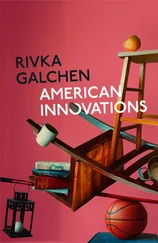
Rivka Galchen - American Innovations - Stories
Здесь есть возможность читать онлайн «Rivka Galchen - American Innovations - Stories» — ознакомительный отрывок электронной книги совершенно бесплатно, а после прочтения отрывка купить полную версию. В некоторых случаях можно слушать аудио, скачать через торрент в формате fb2 и присутствует краткое содержание. Год выпуска: 2014, Издательство: Farrar, Straus and Giroux, Жанр: Современная проза, на английском языке. Описание произведения, (предисловие) а так же отзывы посетителей доступны на портале библиотеки ЛибКат.
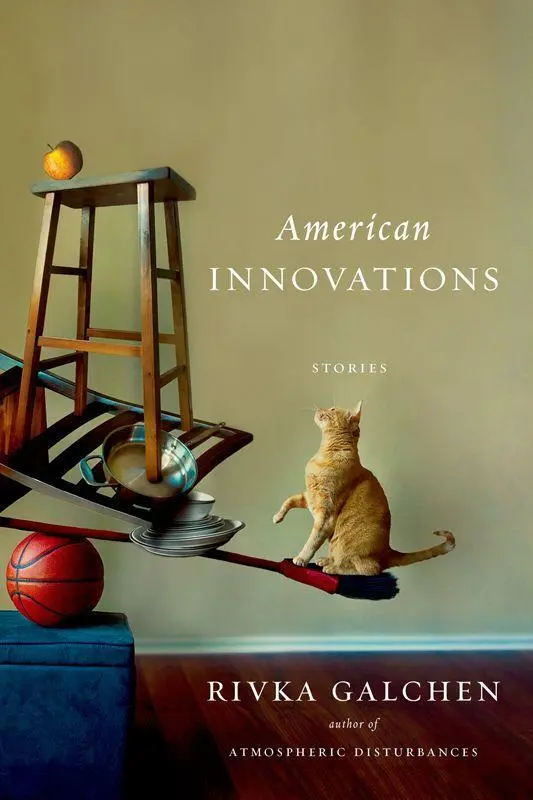
- Название:American Innovations: Stories
- Автор:
- Издательство:Farrar, Straus and Giroux
- Жанр:
- Год:2014
- ISBN:нет данных
- Рейтинг книги:4 / 5. Голосов: 1
-
Избранное:Добавить в избранное
- Отзывы:
-
Ваша оценка:
American Innovations: Stories: краткое содержание, описание и аннотация
Предлагаем к чтению аннотацию, описание, краткое содержание или предисловие (зависит от того, что написал сам автор книги «American Innovations: Stories»). Если вы не нашли необходимую информацию о книге — напишите в комментариях, мы постараемся отыскать её.
, a young woman’s furniture walks out on her. In another, the narrator feels compelled to promise to deliver a takeout order that has incorrectly been phoned in to her. In a third, the petty details of a property transaction illuminate the complicated pains and loves of a family.
The tales in this groundbreaking collection are secretly in conversation with canonical stories, reimagined from the perspective of female characters. Just as Wallace Stevens’s “Anecdote of the Jar” responds to John Keats’s “Ode on a Grecian Urn,” Galchen’s “The Lost Order” covertly recapitulates James Thurber’s “The Secret Life of Walter Mitty,” while “The Region of Unlikeness” is a smoky and playful mirror to Jorge Luis Borges’s “The Aleph.” The title story, “American Innovations,” revisits Nikolai Gogol’s “The Nose.”
By turns realistic, fantastical, witty, and lyrical, these marvelously uneasy stories are deeply emotional and written in exuberant, pitch-perfect prose. Whether exploring the tensions in a mother-daughter relationship or the finer points of time travel, Galchen is a writer like none other today.
American Innovations: Stories — читать онлайн ознакомительный отрывок
Ниже представлен текст книги, разбитый по страницам. Система сохранения места последней прочитанной страницы, позволяет с удобством читать онлайн бесплатно книгу «American Innovations: Stories», без необходимости каждый раз заново искать на чём Вы остановились. Поставьте закладку, и сможете в любой момент перейти на страницу, на которой закончили чтение.
Интервал:
Закладка:
I didn’t have anything to say to that.
After some quiet, maybe with or without shuffling, he said, “You know what I can do for you? I can contact the seller. There’s a way to do that. Who knows, maybe pz21147 can answer all your questions. Do you want me to contact him?”
I said that yes, I would really appreciate that. I said, “They have this thing here, these orange slices that they serve with paprika; it’s really tasty; I’ll prepare it for you when I come back.”
“I’m tired,” he said.
One of the more frustrating traits of my husband was how well he understood me. I had long thought of Macheko as someone seeking contact. But maybe not. Maybe those letters were part of building a hermitage. Maybe Macheko wrote to glittering strangers not with the unreasonable hope that they would see and know him but, rather, with the really quite reasonable hope that he would make contact with people who would almost certainly not know or truly see him, even if they did respond. I understand how that might appeal. I remember when I discovered that my father had kept secret from us years of working at a campus suicide hotline. He was always late coming home on Tuesdays and Thursdays, and one day I saw his car parked and went and investigated. I kept his secret a secret. I accustomed myself to the idea of my dad’s listening to girls at slumber parties prank calling, and to lonelies who had lost jobs and lovers, and to those energetic people who must have abused him as heartless if he suggested that they visit an emergency room or accept an appointment to see a therapist the next day. I later also learned that my dad offered free tax advice for the poor in a booth set up every spring outside the Wal-Mart. He helped get green cards for students from China who really had no relationship to his field. I had known none of this. After he died, I found among his papers all sorts of elaborate thank-you letters he had received. Also a grievance list, by him, of ways he had been misunderstood and underappreciated by us, his family. Most of his complaints seemed valid; we had criticized him for eating more than his share of a bowl of almonds set out as a snack at a neighbor’s dinner, for example. In person, my dad could barely make eye contact, and took his dinner while watching PBS at high volume in the living room. But I remember going to the Denny’s with him once and the waitress there calling him by his first name and putting unasked-for whipped cream and strawberry sauce on my waffle. The approval and gratitude of near-strangers can be a kind of drug; or maybe it’s fair to use the term “medicine.”
Anyhow, there were four more days of Annalise and her crowd. Annalise had a sick mother to support. The architecture student confessed to a fear of being kidnapped a second time. Macheko did not re-surface; no one was sure of his whereabouts. Maybe he had gone back north. Alice eventually flew back home and was not heard from again. I judged her, but I also told myself that I shouldn’t judge; I said to myself that Macheko’s friends could put together a Wikipedia page for him on their own, if attention was what was needed. I continued with my more objective researches. Pz21147 turned out to be a bookseller in Springfield, Missouri, whose books were priced by an algorithm, and who knew nothing about the origins of his copy of The Collected Correspondence .
* * *
About a year after the Mexico episode, I learned something of the fate of the original young Macheko. The wife of a colleague of mine met him. In fact, she worked under him. Young Macheko, it turned out, had gone to graduate school in music at Juilliard. For trumpet. He had married a woman who sang opera; on weekends he rode long distances on his motorcycle; he was the energetic new dean of the arts at the university where this wife of my colleague taught.
These were happy-sounding details; I recognized young Macheko’s metabolism in them even if the particulars surprised me. “He’s a great guy,” I was told. “He’s one of those makes-things-happen people. Maybe a little Teflon-y, sure, like you never feel like you can make genuine contact. But fun. And generous. He says to say hi. I told him maybe we could all get together. He was a little weird about that. He told me an interesting story, though.”
In the eleventh grade the English classes at our high school spent three weeks studying Ralph Ellison’s Invisible Man . Ellison is said to have been aloof toward aspiring black artists and intellectuals, and to have been charming with and beloved among whites. That’s what they say. Ellison was from Oklahoma, from a town not far from where Macheko and I grew up. Ellison’s father worked delivering ice, and died from a work accident — impaled on a cleaved ice shard — when Ellison was just three. His mother then worked a miscellany of jobs, of which little Ellison was ashamed. The “battle royal” scene near the opening of Invisible Man , in which the young black boys are set up to fight one another blindfolded in order to entertain a gathering of white community leaders who are giving them small scholarships, is roughly autobiographical. At eighteen Ellison jumped a freight train to Alabama to attend Tuskegee University, where he was a music major and played trumpet. In later life Ellison became nostalgic for his home state. Turn of the century Oklahoma — Ellison’s Oklahoma — had at least twenty-eight all-black towns, with their own newspapers and schools, and many of those communities were prosperous. Those towns have since vanished; when a book of Oklahoma ghost towns was put out, those towns were absent even from that book. Shortly before Ralph Ellison himself died, young Macheko, having just studied Invisible Man , went to the public library, took out a New York City phone book, and found a listing for “Ellison, R.” He called. A woman answered. The sixteen-year-old asked to speak with Mr. Ellison. She said to hold on a moment. Macheko and Ellison then spoke for more than two hours. About all the things they had in common.
I admired Macheko-son. He had improved upon his father’s methodology. That was a tribute. I was not honoring my line as well.
THE LATE NOVELS OF GENE HACKMAN
Most of the presenters at the conference in Key West were somewhat old, and the audience was very old, which was something J was accustomed to, being among people considerably older than herself, since it is the older people, generally, who have money, and who thus support the younger people, who have youth. Or something. The young have something to offer. J had accepted the invitation to the seminars impulsively, in the middle of a cold February, because it promised a warm idyll for the following January, and because she was promised a “plus one.” When the time came, months later, to choose the plus one, J invited not her gentle husband but her stepmother, Q, to join her. Q’s latest business venture, an online Vitamins Hall of Fame, had failed. Also, Q’s hair, which into her sixties had been a shiny Asian black — Q was Burmese — had begun to gray, and when she had dyed it at home, it hadn’t gone back to black but had instead turned a kind of red. J thought that this sounded like no big deal, but it was apparently very distressing to Q. Same with the slightly below-normal results from a bone-density scan. “Do you think when someone sees me on the street, they think to themselves, There goes an old woman?” Q asked.
“No,” J said. This was on the phone. “I doubt they think anything at all.” Then J felt bad for saying that. That was when she impulsively invited Q to go down to Key West with her the following January. J lived in Pittsburgh and Q lived near Cleveland, so their communication lacked for enlightening facial expressions. J had recently e-mailed Q, jokingly, about its being an ideal time to invest in Greek yogurt. Q wrote back, saying that she’d bought ten thousand shares of Groupon’s IPO. J couldn’t imagine where Q had got the money. After the initial offering, Groupon’s shares sank dramatically. It was rumored that there might have been fraud, insider information — why had Q thought that she could swim with sharks?! But Q hadn’t purchased shares; she had just been joking; Q seemed upset that J had even briefly believed she had purchased Groupon shares. Only a sucker would do such a thing. Did J really think she was such a sucker? Was that what she thought?
Читать дальшеИнтервал:
Закладка:
Похожие книги на «American Innovations: Stories»
Представляем Вашему вниманию похожие книги на «American Innovations: Stories» списком для выбора. Мы отобрали схожую по названию и смыслу литературу в надежде предоставить читателям больше вариантов отыскать новые, интересные, ещё непрочитанные произведения.



Обсуждение, отзывы о книге «American Innovations: Stories» и просто собственные мнения читателей. Оставьте ваши комментарии, напишите, что Вы думаете о произведении, его смысле или главных героях. Укажите что конкретно понравилось, а что нет, и почему Вы так считаете.