Rivka Galchen - American Innovations - Stories
Здесь есть возможность читать онлайн «Rivka Galchen - American Innovations - Stories» — ознакомительный отрывок электронной книги совершенно бесплатно, а после прочтения отрывка купить полную версию. В некоторых случаях можно слушать аудио, скачать через торрент в формате fb2 и присутствует краткое содержание. Год выпуска: 2014, Издательство: Farrar, Straus and Giroux, Жанр: Современная проза, на английском языке. Описание произведения, (предисловие) а так же отзывы посетителей доступны на портале библиотеки ЛибКат.
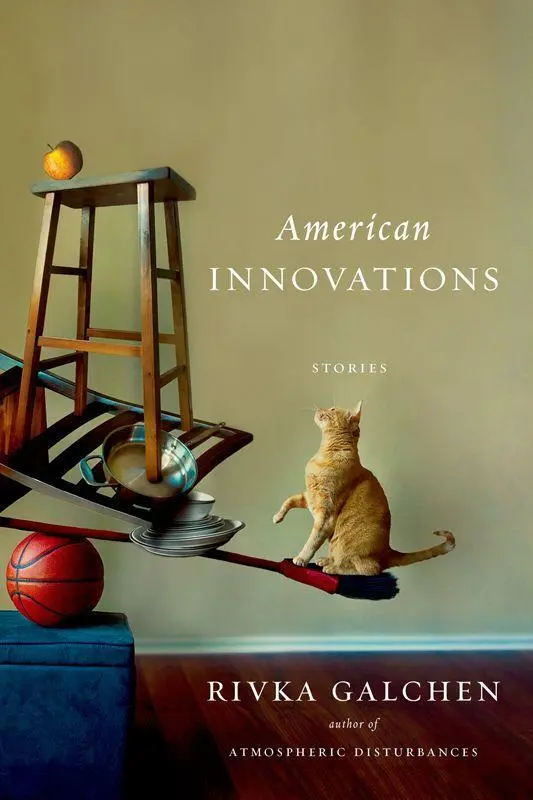
- Название:American Innovations: Stories
- Автор:
- Издательство:Farrar, Straus and Giroux
- Жанр:
- Год:2014
- ISBN:нет данных
- Рейтинг книги:4 / 5. Голосов: 1
-
Избранное:Добавить в избранное
- Отзывы:
-
Ваша оценка:
American Innovations: Stories: краткое содержание, описание и аннотация
Предлагаем к чтению аннотацию, описание, краткое содержание или предисловие (зависит от того, что написал сам автор книги «American Innovations: Stories»). Если вы не нашли необходимую информацию о книге — напишите в комментариях, мы постараемся отыскать её.
, a young woman’s furniture walks out on her. In another, the narrator feels compelled to promise to deliver a takeout order that has incorrectly been phoned in to her. In a third, the petty details of a property transaction illuminate the complicated pains and loves of a family.
The tales in this groundbreaking collection are secretly in conversation with canonical stories, reimagined from the perspective of female characters. Just as Wallace Stevens’s “Anecdote of the Jar” responds to John Keats’s “Ode on a Grecian Urn,” Galchen’s “The Lost Order” covertly recapitulates James Thurber’s “The Secret Life of Walter Mitty,” while “The Region of Unlikeness” is a smoky and playful mirror to Jorge Luis Borges’s “The Aleph.” The title story, “American Innovations,” revisits Nikolai Gogol’s “The Nose.”
By turns realistic, fantastical, witty, and lyrical, these marvelously uneasy stories are deeply emotional and written in exuberant, pitch-perfect prose. Whether exploring the tensions in a mother-daughter relationship or the finer points of time travel, Galchen is a writer like none other today.
American Innovations: Stories — читать онлайн ознакомительный отрывок
Ниже представлен текст книги, разбитый по страницам. Система сохранения места последней прочитанной страницы, позволяет с удобством читать онлайн бесплатно книгу «American Innovations: Stories», без необходимости каждый раз заново искать на чём Вы остановились. Поставьте закладку, и сможете в любой момент перейти на страницу, на которой закончили чтение.
Интервал:
Закладка:
I mention this irritatingness in order to give the benefit of doubt, at least kind of, to the midwesterners I grew up among, who took me — also an odd-looking foreigner — into their homes, and who taught me more about openness and social justice than anyone since, and about whom no one around me these days is, I think, fair. And I presume this — that Macheko was irritating — because his son was one year ahead of me in high school and he played trumpet. He was very, very talkative. He had bad acne, a big nose, glasses, lots of energy, and a cheerfulness whose border none of us had encountered. The social shame heaped unjustly and unsurprisingly on young Macheko for reasons of genetics and origin and whatnot — he took that and steam-engined it into just more gregariousness and academic distinction. Even: our art teacher gave up Friday lessons to “Bible Jeopardy,” and though it was not Macheko’s sacred text — I think he was Zoroastrian — his team almost infallibly won. Lots of kids disliked young Macheko, and even more mocked him. Some went so far as to throw stones at him. Yet his exuberance only intensified. He had good things to say about everyone.
Once, for a weekend debate tournament, he and I were assigned to be partners, to be a team of two set to debate other teams of two. The debate topic was “A person has the right to die how and when he or she chooses.” We had to argue both Affirmative and Negative. For Negative, we focused on what we decided was the overlooked “how” of the proposition; it was a silly argument — as if the issue were people’s right to kill themselves by stepping into the middle of a freeway or by drowning themselves at a city pool — but a technically sound one, and we won all four rounds that day, easily. We knew we had to come up with a new set of rebuttals for what, by the second day of the tournament, would be premeditated counterarguments, and so late into the night, over fried okra and many teas at the local diner, we worked out ideas and arguments, at first about the debate topic and then slipping toward this, that, and the mark of Cain. “Innocent Abel has no descendants,” Macheko-son said, as if someone had inquired. “We forget that we’re all descendants of Cain, not Abel. It’s like each of us wears the mark of Cain, like each of us has killed our brother. And people think God marked Cain to shame him, but that’s not it.” Still no one was inquiring but he was responding. “The mark was to protect him. The mark meant that anyone who punished Cain would be punished by God sevenfold in return. It’s not for us to judge!” Macheko said. “Something like that.” We moved on, to other topics. Talking was easy. In some sense, we had a lot in common. Then, at around one o’clock in the morning, I don’t know how to describe what happened except to say that young Macheko gave me a look. Not a romantic look; it was more awful than that. He gave me a look that seemed to signal an imminent confession of Machekovian isolation and misery. A confession that, if I heard it, would draw me into an obligation I could not come even close to fulfilling. I would be a passing meal for an eternally starving golem, and I would be nothing else. “Whoa, I am so tired,” I said. “Jesus. It’s like somebody just hit me over the head with a club.” I left.
At the tournament the next day we lost the Negative rounds and won the Affirmative ones. For the rest of high school I avoided young Macheko, and I tried not to think of him in the twenty years following. I did hear that he hadn’t had the means to leave town for college, but that eventually the Macheko family had moved away — to somewhere, or to a few somewheres. I myself had also left and not returned.
* * *
Then last year I was down in Mexico City for a couple of weeks. I was going through an intense bout of fearfulness that is too irrational and stupid and elusive to explain, and I had done what my husband termed pulling a geographical. I realize it isn’t common to think of Mexico City as a haven from fear. Anyhow, there I could in conscience afford things I couldn’t normally afford because life was cheaper but not so very much cheaper that one felt awful all the time (though one felt somewhat bad). I found myself getting a manicure and a pedicure, which was weird for me, I don’t even like the look of manicured nails, and having a stranger attending to my cuticles with sharp and blunt objects: it just all feels very wrong. As I was engaged in this incorrectness, I found myself in conversation with a Mexican woman who was, she said, a television news reporter. Or rather, she used to be a television news reporter. Until she had gotten into a bad car accident. Followed by a long recovery period. She had become very depressed in that period and put on a lot of weight. Forty pounds! The television station told her that if she wanted to keep her job, she would need to take the weight off; they said they’d give her four months to do it. I was American, right? Oh, she knew my neighborhood in New York! because she had dated the grandson of Norman Mailer, and Norman Mailer had lived there, hitting on her, yes, even from his deathbed, no, that relationship had not worked out, neither the one with Norman Mailer nor with the grandson of Norman Mailer. She was soon going to be covering the Mexican midterm elections, if all went well with the diet. She might have to go to Sinaloa, or Chihuahua, in any case to a place where the narco wars were very much alive. Her friend was in Juárez; he saw bodies in the streets. Well, that’s the North!
The young woman handling my feet tenderly asked me what color I wanted my toenails painted. The TV reporter asked me what was I doing in Mexico City.
I wasn’t feeling like myself, and the light was lumbering through the extra-thick window, bending into a bright diadem, which maybe explains how I found myself getting lime green toenails and saying I was writing a culture piece about Mexico City for a magazine. For The New York Times Magazine. I hadn’t really figured out what I would focus on; I was a little lost, to be honest.
Except for the bit about being lost, what I’d said was not true. I’m a molecular biologist, for one thing. I study epigenetics, things that alter expression of the genetic code but that aren’t themselves in the genetic code. It’s actually pretty interesting, I think, but it’s difficult to find a way to “chat” about it with strangers, it being difficult to chat about methylation and histones.
I know the perfect thing! the TV reporter said. You should write about me and my friends! She could show me a real circle of artists and writers. When she said circle — she had switched to speaking English; her colloquialisms were good — I thought for a moment she said circus. It sounds narcissistic, she laughed, but American readers would be very interested, and it would be very easy and fun for me, she explained, and it would really be a help to her, too, because she wanted to get a different kind of work, work in the U.S., work that she knew she’d be great at, and it was very difficult to live in Mexico just now; she loved Mexico, of course. There were enough negative stories about Mexico City, this would be a positive one! She just needed to lose a little more weight. And establish herself in the U.S. She was so lucky that she had met me. This was really going to be great.
I said that I, too, thought that sounded great.
I imagine that there are those who, even if it was misdirected, might at least briefly enjoy being an object upon which esteem and hope are projected. There are those who can be lighthearted about a basic deception and/or error and either correct it or just go with it and then even do whatever little thing they can do to give the people around them what they want or need and who can then handle whatever disappointment ensues. Some people might not find that even someone’s minimal excitement about them provokes imaginings of that scene, which may or may not be in Dante but is certainly somewhere in my education, where the narrator is in some boat, crossing some river into the underworld, maybe the Styx, or Lethe, and the dead souls in the river are clamoring to get aboard, though of course they will not be able to get aboard, because they are the damned, whereas the narrator is still alive and not yet judged. When heading out to meet Annalise (that was her name) the next day, I might even have thought briefly of Manuel Macheko. Or at least of that gold-jacketed book, of those letters obliquely asking for help, and setting out on journeys from which news might or might not return.
Читать дальшеИнтервал:
Закладка:
Похожие книги на «American Innovations: Stories»
Представляем Вашему вниманию похожие книги на «American Innovations: Stories» списком для выбора. Мы отобрали схожую по названию и смыслу литературу в надежде предоставить читателям больше вариантов отыскать новые, интересные, ещё непрочитанные произведения.











Обсуждение, отзывы о книге «American Innovations: Stories» и просто собственные мнения читателей. Оставьте ваши комментарии, напишите, что Вы думаете о произведении, его смысле или главных героях. Укажите что конкретно понравилось, а что нет, и почему Вы так считаете.