Rivka Galchen - American Innovations - Stories
Здесь есть возможность читать онлайн «Rivka Galchen - American Innovations - Stories» — ознакомительный отрывок электронной книги совершенно бесплатно, а после прочтения отрывка купить полную версию. В некоторых случаях можно слушать аудио, скачать через торрент в формате fb2 и присутствует краткое содержание. Год выпуска: 2014, Издательство: Farrar, Straus and Giroux, Жанр: Современная проза, на английском языке. Описание произведения, (предисловие) а так же отзывы посетителей доступны на портале библиотеки ЛибКат.
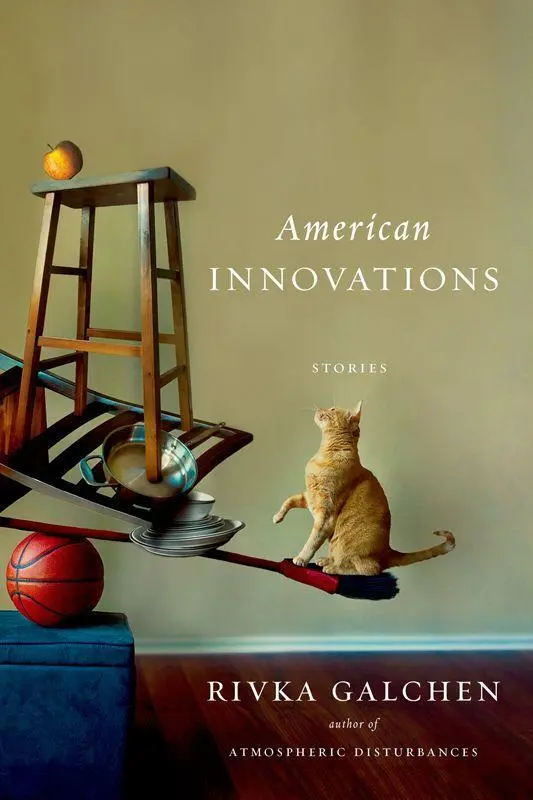
- Название:American Innovations: Stories
- Автор:
- Издательство:Farrar, Straus and Giroux
- Жанр:
- Год:2014
- ISBN:нет данных
- Рейтинг книги:4 / 5. Голосов: 1
-
Избранное:Добавить в избранное
- Отзывы:
-
Ваша оценка:
American Innovations: Stories: краткое содержание, описание и аннотация
Предлагаем к чтению аннотацию, описание, краткое содержание или предисловие (зависит от того, что написал сам автор книги «American Innovations: Stories»). Если вы не нашли необходимую информацию о книге — напишите в комментариях, мы постараемся отыскать её.
, a young woman’s furniture walks out on her. In another, the narrator feels compelled to promise to deliver a takeout order that has incorrectly been phoned in to her. In a third, the petty details of a property transaction illuminate the complicated pains and loves of a family.
The tales in this groundbreaking collection are secretly in conversation with canonical stories, reimagined from the perspective of female characters. Just as Wallace Stevens’s “Anecdote of the Jar” responds to John Keats’s “Ode on a Grecian Urn,” Galchen’s “The Lost Order” covertly recapitulates James Thurber’s “The Secret Life of Walter Mitty,” while “The Region of Unlikeness” is a smoky and playful mirror to Jorge Luis Borges’s “The Aleph.” The title story, “American Innovations,” revisits Nikolai Gogol’s “The Nose.”
By turns realistic, fantastical, witty, and lyrical, these marvelously uneasy stories are deeply emotional and written in exuberant, pitch-perfect prose. Whether exploring the tensions in a mother-daughter relationship or the finer points of time travel, Galchen is a writer like none other today.
American Innovations: Stories — читать онлайн ознакомительный отрывок
Ниже представлен текст книги, разбитый по страницам. Система сохранения места последней прочитанной страницы, позволяет с удобством читать онлайн бесплатно книгу «American Innovations: Stories», без необходимости каждый раз заново искать на чём Вы остановились. Поставьте закладку, и сможете в любой момент перейти на страницу, на которой закончили чтение.
Интервал:
Закладка:
Or maybe I didn’t think of Macheko’s book. Maybe it was only in retrospect that I thought of the Machekos.
* * *
I arrived at a crowded cantina in the Condesa neighborhood. People were gathered to watch Mexico versus France in the World Cup. “This is my great friend Alice!” Annalise said, introducing me around a table crowded with good-looking people, a number of them wearing glasses with “personality.” She then followed up with further biographical details about me, most untrue, some of which I was not even responsible for having related to her. My name is not Alice, but to be fair, I had told Annalise that it was. Someone at the table ran an art gallery; someone was studying architecture at Yale; or maybe his girlfriend was doing that, and he was in a rock band; someone had on a very nice suit jacket over a seafoam-colored shirt. The cantina was noisy with cheer and chatter. A corn and cream snack showed up at the table, looking somehow luxurious in little tumblers, with a sprinkle of hot pepper. A round of mescal was ordered! A goal was scored! The cantina patrons stood up and cheered. Little kazoos were being blown.
“The narcos don’t want Mexico to win,” the rock musician or architecture student explained to me. “It makes the people confident. They start expecting things.” The woman next to him, who looked maybe one-quarter Indian and was tiny, under five feet — this made her otherwise straightforward beauty otherworldly — had recently finished an art project called Canned Laughter , cans that said “laughter” on them.
“This is what Uribe did in Colombia,” a drunk older man said to me. “He killed every single one of them. Not just the narcos, but anyone associated with the narcos. A narco accountant. A narco driver. A narco nephrologist. All of them. You have to kill them all. Then you can let them come back, slowly, because of course there will always be a narco business. But you can’t let them think they own the country.”
“You can’t just put them in jail?” I asked.
“Jail is like Club Med for them,” he said. He had wide-set brown eyes, and upon reflection, he was kind of handsome. There were more drinks. I started not to mind whatever was said, including “It’s so important for people to know what’s what. I wrote a poem about it.”
“It’s so good that you can show how involved the arts are here with the real world,” Annalise said to me. “About the situations in which we produce, our means of production. I’m so, so happy that you’re here.” Even more snacks came to the table. I felt bad for Annalise, trying to lose weight in a drinking and snacking culture.
And not much later that was the end of it. That was the afternoon. Mexico won the game. I was drunk.
I took a long nap. In my dream, I walked into some sort of cantina or bar or pool hall or all of those things, and my father was there, though his face was that of my husband. I had two young boyfriends, or just young male companions, with me. The thing that was weird about my father’s being there was that he is dead, and this was true even in the dream, and so what was he doing there, mobile and breathing? I went ahead and approached him, in the middle of his pool game. He had his own face now. “Why didn’t you at least call to say you were still alive?” I asked. “At least a phone call. A letter. Something.” He didn’t really say much in return. In (dream) fact, he said nothing. Nor did my manifestation or questioning appear to startle or disturb him. His face — now it was my husband’s face again — was pale, and he shrugged his shoulders and went back to his pool game. I wondered if he was mentally well. Then I called my mom and my sister, from a public telephone that was there in the bar, to tell them the news — that the head of our family was alive. They already knew; they had always known. Why hadn’t they told me? “He was dead to us. We were hiding nothing.”
I woke up not sweating, but very thirsty. I saw that my husband had called, but I didn’t return the call.
* * *
Around 10:00 p.m., I arrived at another cantina. A smaller group was gathered. Annalise spotted me at the entrance, got up from her seat, ran over to hug me, and also gave me three cheek kisses. The physical affection made me feel companioned and safe in the world, even as in my heart I was supposedly very skeptical of her affection, or really, of late, anyone’s affection. And even as her affection was directed to a falsely named and attributed me. The crowd was already rowdy. A plate of limes was accidentally knocked over. I ordered just a single beer; it arrived alongside a free shot of tequila. Someone was shouting angrily about peccaries. Or about Gregory Peck movies? Someone patted my knee. Over the bar, a small television was showing a rerun of the soccer match from earlier in the day. The patrons still cheered at the game’s key moments, as if the game were live, its outcome unknown. I cheered, too. Ordering another beer, I wondered about both my own and Annalise’s waistline. Perhaps this was the start of a genuine empathy?
There was a three-man band — two large guitars, a washboard with an attached harmonica — that came by the table, sang a corrido, took their tip, then went back to hanging around closer to the bar itself, watching the tiny television. When a new group of patrons arrived, the band went over to them, not immediately, but soon enough, to play again.
I heard shouting at the entrance.
The entrance doors were saloon doors, though I hadn’t noticed that when I myself had entered.
Annalise ran up to a man there at the entrance. To stop him? Was he angry? Dangerous? They kissed one another’s cheeks, maybe ten or fifteen times, although not like lovers, or like former lovers, or like anything like that.
“You know who that is, right?” someone sitting near me said.
“No,” I said.
“That’s Manuel Macheko,” he said.
Or at least I heard him say Manuel Macheko. I felt sweaty, and afflicted by a ringing sound that no one else seemed to register, and also as if someone I long trusted had revealed his willingness to throw me to the dogs. Was it just the remnants of my dream talking to me? Was I really haunted by Manuel Macheko? “Who did you say that was?”
“You know, he was a great friend of bunuelos. And also of monkey vice.”
Or, again: I heard him say bunuelos and monkey vice. I was pretty sure bunuelos was Spanish for “little doughnuts.” Then I realized, no, he had said Bolaño. I had at least heard of Bolaño. As for Monkey Vice, I made no progress in rehearing that into a more reasonable name. Instead, I just heard monkey vice, monkey vice, monkey vice. I was able to deduce that this Monkey Vice was a relatively recently dead intellectual of considerable stature. Who had loved cats. Someone very beloved. Whom everyone now wished they could say that they had known well. It became obvious to me that I would seem like a loser and perhaps a colonialist if I let on that I had no idea about the venerable Monkey Vice, and only a dim rumored sense of Bolaño — these men who cast, even from their graves, a glow upon the Manuel Macheko with whom Annalise was walking back to our table. Whose life was this? Not mine.
“The name is Manuel Macheko?” I confirmed quietly with the man on my right.
“Yes, yes, Manuel Macheko,” he repeated.
Up close, this Macheko was an unusually short, ugly, and joyous-looking man. I didn’t recognize him. But I had never met the father of the young Macheko. This Mexican Macheko was not as dark as the young Macheko. I couldn’t securely assign any ethnicity to the man there before me, though I can reliably say that I wouldn’t have not believed the man in front of me was native Mexican — probably mestizo — nor would I have not believed that he was Persian. All I had as a compare was a fallible memory of the cover of the Machekan correspondence book, in which the author had appeared as an inked cartoon sketch of a man with a small mustache, sitting at a typewriter with an unfurling paper scroll upon which could be made out the names of well-knowns. Not very pathognomonic. And why had I never before wondered why a Persian man had taken a Hispanic pseudonym?
Читать дальшеИнтервал:
Закладка:
Похожие книги на «American Innovations: Stories»
Представляем Вашему вниманию похожие книги на «American Innovations: Stories» списком для выбора. Мы отобрали схожую по названию и смыслу литературу в надежде предоставить читателям больше вариантов отыскать новые, интересные, ещё непрочитанные произведения.









Обсуждение, отзывы о книге «American Innovations: Stories» и просто собственные мнения читателей. Оставьте ваши комментарии, напишите, что Вы думаете о произведении, его смысле или главных героях. Укажите что конкретно понравилось, а что нет, и почему Вы так считаете.