Rivka Galchen - American Innovations - Stories
Здесь есть возможность читать онлайн «Rivka Galchen - American Innovations - Stories» — ознакомительный отрывок электронной книги совершенно бесплатно, а после прочтения отрывка купить полную версию. В некоторых случаях можно слушать аудио, скачать через торрент в формате fb2 и присутствует краткое содержание. Год выпуска: 2014, Издательство: Farrar, Straus and Giroux, Жанр: Современная проза, на английском языке. Описание произведения, (предисловие) а так же отзывы посетителей доступны на портале библиотеки ЛибКат.
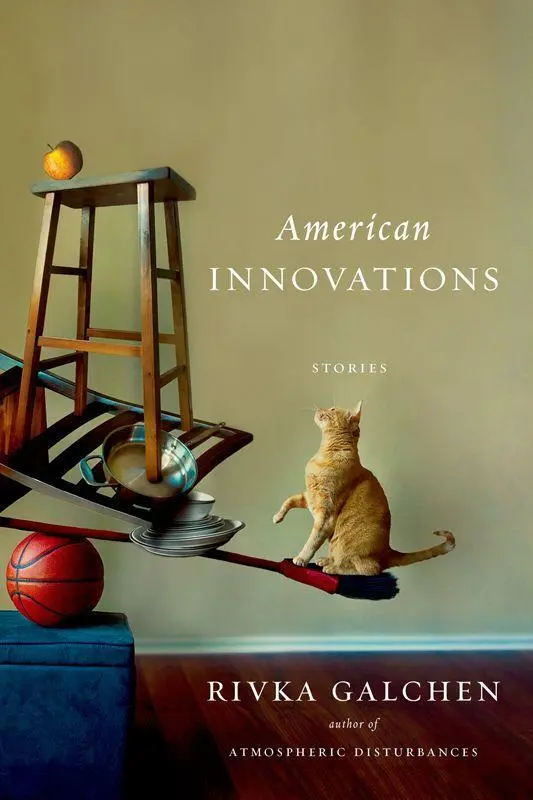
- Название:American Innovations: Stories
- Автор:
- Издательство:Farrar, Straus and Giroux
- Жанр:
- Год:2014
- ISBN:нет данных
- Рейтинг книги:4 / 5. Голосов: 1
-
Избранное:Добавить в избранное
- Отзывы:
-
Ваша оценка:
American Innovations: Stories: краткое содержание, описание и аннотация
Предлагаем к чтению аннотацию, описание, краткое содержание или предисловие (зависит от того, что написал сам автор книги «American Innovations: Stories»). Если вы не нашли необходимую информацию о книге — напишите в комментариях, мы постараемся отыскать её.
, a young woman’s furniture walks out on her. In another, the narrator feels compelled to promise to deliver a takeout order that has incorrectly been phoned in to her. In a third, the petty details of a property transaction illuminate the complicated pains and loves of a family.
The tales in this groundbreaking collection are secretly in conversation with canonical stories, reimagined from the perspective of female characters. Just as Wallace Stevens’s “Anecdote of the Jar” responds to John Keats’s “Ode on a Grecian Urn,” Galchen’s “The Lost Order” covertly recapitulates James Thurber’s “The Secret Life of Walter Mitty,” while “The Region of Unlikeness” is a smoky and playful mirror to Jorge Luis Borges’s “The Aleph.” The title story, “American Innovations,” revisits Nikolai Gogol’s “The Nose.”
By turns realistic, fantastical, witty, and lyrical, these marvelously uneasy stories are deeply emotional and written in exuberant, pitch-perfect prose. Whether exploring the tensions in a mother-daughter relationship or the finer points of time travel, Galchen is a writer like none other today.
American Innovations: Stories — читать онлайн ознакомительный отрывок
Ниже представлен текст книги, разбитый по страницам. Система сохранения места последней прочитанной страницы, позволяет с удобством читать онлайн бесплатно книгу «American Innovations: Stories», без необходимости каждый раз заново искать на чём Вы остановились. Поставьте закладку, и сможете в любой момент перейти на страницу, на которой закончили чтение.
Интервал:
Закладка:
“I’m here with my mom,” J said. “I better go check in with my mom.” J couldn’t recall ever having used that phrase out loud. It sounded almost like science fiction.
She couldn’t find her!
Then she found her.
Q was in conversation with M. And also with the lover of the other Norm, the guesthouse Norm. And also with a man who had lived for a long time on a boat. The man had lived on the boat when real estate in Key West was too expensive, he was explaining, but now he was back on the island again. Which had he liked more? Well, he liked both. Then the other Norm’s lover was explaining that sure, Norm didn’t like to sleep alone when “the chestnut” was in town. Especially since his recent health scare. But one couldn’t be at the sugar teat all the time, the lover was of the opinion. The other Norm was in sight, looking pretty happy, talking to some people near a fountain. The other Norm was a painter and a language poet, known to have been living in relative health and joy, and with numerous lovers, while HIV+, for decades.
J did feel a little spooked by the openness of it all.
It had to be how it had to be, the lover was saying. And it helped keep things really hot — there was that, too. The conversation went back to boats.
Someone startled J with a tap on the shoulder.
“Did you find your mom?” It was the Real Humans woman.
J blushed.
“Look,” the woman said. “I can see you’re disgusted by us.”
“What?” J said.
“I know about young people. They’re very conservative and very judgmental.” She had now opened up her speech to the whole group, but she was still clearly addressing J. “You think we’re all decayed and dying, which we are, of course, but you’re dying every day, too. You’ll just keep dying and dying. I know from my own children.” She took a sip from her little blue drink. “I mean, look at you. Quiet as a superior little mouse.”
“Let me get you some water,” M said to the woman.
“No, no,” she said. “I don’t need water. I’m just saying something about this young woman. She’s had her little bit of success. She’s thinking to herself, I’m not going to make the mistakes these people made. I’m going to keep my head down and work and not hurt anyone’s feelings too much and not get hurt myself. She thinks she’s solved it all with her preemptive gloominess and her inoffensiveness.”
“You should enjoy your party,” the man who had lived on a boat said.
“There’s a subspecies of these young people,” the woman was saying. “They’re very careful. The young women especially; they’re the worst—”
“You’re so right,” Q said. She took hold of Real Humans’s arm. “They are the worst. This one’s probably innocent enough, though.”
“She’s a wily mouse, you don’t know. Do you have children?” she now asked Q. “They’re very judgmental. If you have children, you know.”
“This one’s kind of my daughter.”
She gave Q the once-over. “Yes, they’re all kind of our daughters, aren’t they?”
“I wouldn’t take any of this too seriously,” Norm’s lover said to J. “She’s been starting arguments at parties for thirty years. Haven’t you?”
“For fifty years,” Real Humans said.
“Did you hear about Gene Hackman?” Q asked.
“He doesn’t really live here,” Real Humans said. “He lives one island over. I heard he’s doing just fine.”
“I feel kind of elated,” J said.
“Sure you do,” Real Humans said.
It was as if Q’s secret wasn’t that she’d lost her home, or lost her money, or was secretly ill, but that she actually knew what she was doing. Or maybe she had lost her money, and her home, and maybe she was ill, but she was able to handle it. All these partygoers seemed able to handle their lives.
“He was just scratched up a bit,” Norm’s lover said.
“Who was scratched up?”
“Gene Hackman. He wasn’t really hurt at all.”
“That’s what I thought,” Q said. “I thought he would be fine.”
Everyone admired Gene Hackman.
“Hasn’t he had a sad life?” J asked. “I thought I’d been told that. That his mother had died in a fire started by her own cigarette?”
No, no, his life had worked out. He had a great life. He joined the navy. He was a failure in acting school. When his old teacher saw him working as a doorman in New York, the teacher said that he’d always known he’d amount to nothing. He was retired from movies. He had three kids. He had paired up with an underwater archaeologist to write three adventure novels. Maybe four adventure novels. Or one was a Western, maybe. It was titled Justice for None .
ONCE AN EMPIRE
I’m a pretty normal woman, maybe even an extremely normal one. Especially now as I’m entering my mid-thirties, which are among the most normal of years. I live — I used to live, that is — in a small lofted studio apartment on the top floor of a six-story building on a tree-lined block, across the way from an abandoned police station. I bought that studio with an inheritance from, well, it doesn’t matter from whom. I bought it because it was time. My mother no longer tenderized meat with a hammer, I had failed to become the cabaret singer or CEO she once might have become; the termination of our roommatehood had become essential. This was many years ago. I love my apartment so much. Its window looks out onto the Jehovah’s Witness Watchtower building whose enormous lightbulb billboard broadcasts the temperature in Fahrenheit, the time, then the temperature in Celsius, then the time again, then the updated temperature in Fahrenheit, and so on, unto eternity. Having sight of that billboard: it used to make me feel like neither time nor temperature would ever change without first petitioning my approval.
As a normal, stable adult with an ordinary life on a quiet street in a peaceful neighborhood, I never thought I’d be the victim of an especially unusual crime. Or of any crime, really. If it was a crime. A middle school counselor once told me that she didn’t know if as a child, she was, or wasn’t, beaten with a belt one or many times because, she said, we never really know what happened in the past. Only what we dread or long for in the future. And often not even that, she added. OK, sure.
It was a Tuesday when what happened happened.
Every Tuesday night I go and see whatever is playing at the movie theater nearby. I’m not choosy. I’m happy to see whatever everyone else is going to see. That way I stay in touch without having to talk to people, which is great, because even though I very much like people in general, I find most people, in specific, kind of difficult. I prefer the taciturn company of my things. I love my things. I have a great capacity for love, I think.
Like the movie theater. I love the popcorn there, which makes me feel ever so slightly asthmatic. And I love the heavily patterned carpet that recalls the slot machine section of a gas station out West. And that fateful Tuesday evening I saw a movie that was about love. If also about Japan, and kind of about dinnerware, too. The movie ran late, past midnight, which is when — this is what they said in the movie anyhow — the veil between the living and the dead is at its thinnest.
Its being the witching hour didn’t spook me, I want to be clear about that. One time the Watchtower displayed a static LL: LL, and that spooked me, but little else has ever spooked me. Which is to say, I wasn’t out of sorts that Wednesday morning. (Because now that I think about it, that fateful Tuesday night was actually a Wednesday — as kids we used to call Wednesday hump day — morning.) After that movie I was walking my regular walk home, past the now nineteen months’ static construction site that sits at the corner of my very own block, right next to the abandoned police station.
Читать дальшеИнтервал:
Закладка:
Похожие книги на «American Innovations: Stories»
Представляем Вашему вниманию похожие книги на «American Innovations: Stories» списком для выбора. Мы отобрали схожую по названию и смыслу литературу в надежде предоставить читателям больше вариантов отыскать новые, интересные, ещё непрочитанные произведения.







Обсуждение, отзывы о книге «American Innovations: Stories» и просто собственные мнения читателей. Оставьте ваши комментарии, напишите, что Вы думаете о произведении, его смысле или главных героях. Укажите что конкретно понравилось, а что нет, и почему Вы так считаете.