Joseph O'Neill - Blood-Dark Track
Здесь есть возможность читать онлайн «Joseph O'Neill - Blood-Dark Track» — ознакомительный отрывок электронной книги совершенно бесплатно, а после прочтения отрывка купить полную версию. В некоторых случаях можно слушать аудио, скачать через торрент в формате fb2 и присутствует краткое содержание. Год выпуска: 2010, ISBN: 2010, Издательство: Knopf Doubleday Publishing Group, Жанр: Современная проза, на английском языке. Описание произведения, (предисловие) а так же отзывы посетителей доступны на портале библиотеки ЛибКат.
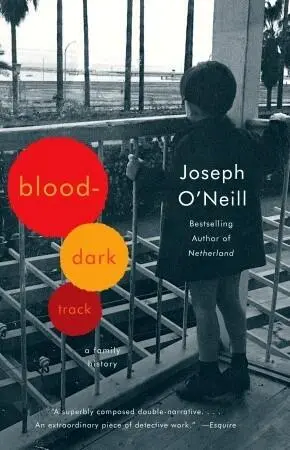
- Название:Blood-Dark Track
- Автор:
- Издательство:Knopf Doubleday Publishing Group
- Жанр:
- Год:2010
- ISBN:978-0-307-74265-0
- Рейтинг книги:4 / 5. Голосов: 1
-
Избранное:Добавить в избранное
- Отзывы:
-
Ваша оценка:
Blood-Dark Track: краткое содержание, описание и аннотация
Предлагаем к чтению аннотацию, описание, краткое содержание или предисловие (зависит от того, что написал сам автор книги «Blood-Dark Track»). Если вы не нашли необходимую информацию о книге — напишите в комментариях, мы постараемся отыскать её.
, a fascinating, personal, and beautifully crafted family history.
Joseph O'Neill's grandfathers-one Turkish, one Irish-were both imprisoned for suspected subversion during the Second World War. The Irish grandfather, a handsome rogue from a family of small farmers, was an active member of the IRA. O'Neill's other grandfather, a debonair hotelier from the tiny and threatened Turkish Christian minority, was interned by the British in Palestine on suspicion of being an Axis spy.
With intellect, compassion, and grace, O'Neill sets the stories of these individuals against the history of the last century's most inhuman events.
Blood-Dark Track — читать онлайн ознакомительный отрывок
Ниже представлен текст книги, разбитый по страницам. Система сохранения места последней прочитанной страницы, позволяет с удобством читать онлайн бесплатно книгу «Blood-Dark Track», без необходимости каждый раз заново искать на чём Вы остановились. Поставьте закладку, и сможете в любой момент перейти на страницу, на которой закончили чтение.
Интервал:
Закладка:
The next day, I drove out to Latrun for a second time. It was another warm and sunny day and the traffic flowed quickly. There was no indication anywhere that, three days before, on 10 April, Israel had suddenly launched Operation Grapes of Wrath, a ferocious aerial and artillery attack directed at Hezbollah guerrillas in south Lebanon which, by 15 April, would result in the deaths of at least twenty-two people and the displacement of around 400,000. I had personally felt a gust of the political violence stirring in the air. The previous day, 12 April, which was the day after my meeting with Haider Husseini, a bomb exploded directly above the Lawrence Travel Agency in room 27 of the Lawrence Hotel. The explosion shattered every window on the second floor of the hotel, spewing glass on to Salah-a-Din Street, and the doors of all ten rooms on the second floor were ripped from their hinges and scattered. It was first thought that the occupant of room 27, who crawled out of the room covered in blood, was a British citizen called Newman; but investigations would subsequently reveal that the man — who lost his legs, an arm, and the use of his eyes — was a Lebanese Shiite called Hussein Mohammed Hussein Mikdad, and a Hezbollah operative.
I arrived at the junction of Latrun and turned off in the direction of the Trappist monastery. Following a suggestion made by Monsieur Arnaud, I asked the receptionist at the monastery if I might see Brother Guy. ‘The old monk is a simpleton,’ Arnaud had said, ‘but he’s lived in Latrun all his life and might be able to tell you something of interest.’
I had always associated Trappist monks with silence, but Brother Guy — a small, cheerful, bald, physically robust man wearing brown sandals, a stone-coloured ankle-length habit, a black scapula with a hood, and wide brown cincture that tied at the hip — was loquacious and excitable. ‘I saw it all!’ he would exclaim from time to time. ‘ J’ai tout vu! I’m seventy-one, I’ve been here since I was ten, I tell you I saw it all with my own eyes!’
Brother Guy walked me up towards the top of the hill on which the Trappist monastery was built. He was born in Tripoli, in Lebanon, he told me, and had been brought by his cousin to the monastery as a juvéniste . He had only twice left the monastery: to study in Jerusalem, in 1942, and to have a brain operation in France. When a huge bandy-legged lizard scuttled across our path, Brother Guy noticed my interest and asked in astonishment, ‘You don’t have lizards in London?’
After a few minutes Brother Guy stopped and pointed back to the plain of Ayalon, where Fort Latrun had come into view. ‘I saw them locked up there,’ he exclaimed, waving his arms in excitement. ‘Four thousand Italians, one hundred Germans, one hundred Pétainistes — I saw them for myself. There were executions — an Englishman was executed, a German, an Arab, a Druse, and one other. There was barbed wire everywhere, and Poles guarded the prisoners. There were seven thousand Poles here!’
Presently, the remains of a castle appeared on the other side of a chasm formed by old Ottoman barracks. ‘This is a Crusader castle,’ the monk said. ‘Richard Coeur de Lion played checkers with Saladin right here. The castle was built by Flemish knights in the twelfth century, to guard the road from Jaffa to Jerusalem. That’s where the name Latrun comes from, from the name of the castle, La Tour des Chevaliers .’
We walked on and reached the very top of the hill. ‘The moment the British left in 1947,’ Brother Guy said, ‘the Arabs built fortifications around this castle. From here the Jordanian artillery, under the command of a German officer, bombarded the Jewish convoys to Jerusalem. The Jews counter-attacked, but it was a disaster. Six hundred Jewish soldiers died on this hill in three hours, as you can see from this commemorative monument.’ Brother Guy gestured at a menhir-like boulder held aloft by two metal prongs.
‘What about the house over there?’ I asked, pointing to the hill of Emmaus. ‘Do you remember anything about that place during the war?’ ‘Well,’ Brother Guy answered, ‘there used to be barbed wire around that house, too. I’m not really sure who was imprisoned in there — top officers, was the rumour. It was a mysterious place. I never went there. It was at Emmaus,’ the monk said, ‘that Jesus manifested Himself to the two disciples and took supper with them. There used to be an Arab village there,’ he added. ‘They were good people, the people of Amwas. Some of them worked at the monastery. In three days, using nine bulldozers, the village was wiped off the face of the earth. The gardens, the olive trees, the apricot trees, all were churned up and destroyed. The chickens and vegetable plots were buried in rubble. I saw it happen,’ the monk said. ‘I saw it all.’
Brother Guy agreed to accompany me to the house at Emmaus. He turned out to be a knowledgeable guide. As we stood by the ruined basilica just inside the gate of the house, he explained that this was a Byzantine construction from the fifth century, which had been covered seven hundred years later by a Crusader church. ‘Emmaus,’ Guy said, ‘first came to historical prominence in around 165 BC, when Judas Machabeus defeated the Syrians in the famous victory that gave rise to the Jewish feast of Hanukkah. The city was destroyed by Varus, in AD 4, but rose again. The Roman Fifth Legion camped here for two years before attacking Jerusalem in AD 70, and by 223 the Romans had renamed the place Nicopolis. Arab armies established a large military base here in the seventh century, then shortly afterwards a plague broke out and the city emptied. Then it was repopulated and it regained its importance. It was the last station of the Crusaders on their way to Jerusalem in June 1099,’ Brother Guy said.
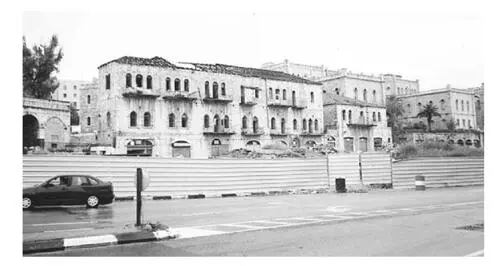
Standing in the basilica, I looked up the hill of Emmaus and saw once more the mock-battlements of the house appearing just above the tops of thick green trees. Leaving Brother Guy down at the basilica, I set off on foot up one of the pair of driveways that approached the house in two separate curves, like pincers.
I walked up the hill reflecting that I was the first in my family to have parted the thick folds of familial pain that had covered this place; and when I thought about the tears that would come to Mamie Dakad’s eyes at the mere mention of my grandfather’s time here, I became light-headed with sadness. I arrived once more at the house. I thought about ringing the bell and having another look around. There seemed little point. I had been inside once already and, if Florent Arnaud was correct, the cellars in which my grandfather had spent the last months of his internment were now hazardous and out of bounds. The house did not look as though it was in danger of falling down. It exuded solidity and beauty and militaristic Christianity, and there was no sign of its past as (Arnaud’s term) a concentration camp. But it was certainly here that my grandfather had lived for nearly three years. He had slept and woken in this building, walked these grounds, and surveyed the valley below and the encampments at Latrun, and hated it here. The competition to tell the story of this patch of the planet was intense: the Jews, the Arabs, the British, the Christian churches, the Romans, the French — all had laid narrative claim to Emmaus or Amwas or Nicopolis, and alongside their insistent sagas my grandfather’s small story seemed as miserable and effaceable as graffiti. But I was glad to have made the journey. I felt I was claiming my grandfather and his pain from this beautiful doomed house, and by my presence scrawling on its pristine stone, Joseph Dakak was here .
Читать дальшеИнтервал:
Закладка:
Похожие книги на «Blood-Dark Track»
Представляем Вашему вниманию похожие книги на «Blood-Dark Track» списком для выбора. Мы отобрали схожую по названию и смыслу литературу в надежде предоставить читателям больше вариантов отыскать новые, интересные, ещё непрочитанные произведения.





Обсуждение, отзывы о книге «Blood-Dark Track» и просто собственные мнения читателей. Оставьте ваши комментарии, напишите, что Вы думаете о произведении, его смысле или главных героях. Укажите что конкретно понравилось, а что нет, и почему Вы так считаете.