Joseph O'Neill - Blood-Dark Track
Здесь есть возможность читать онлайн «Joseph O'Neill - Blood-Dark Track» — ознакомительный отрывок электронной книги совершенно бесплатно, а после прочтения отрывка купить полную версию. В некоторых случаях можно слушать аудио, скачать через торрент в формате fb2 и присутствует краткое содержание. Год выпуска: 2010, ISBN: 2010, Издательство: Knopf Doubleday Publishing Group, Жанр: Современная проза, на английском языке. Описание произведения, (предисловие) а так же отзывы посетителей доступны на портале библиотеки ЛибКат.
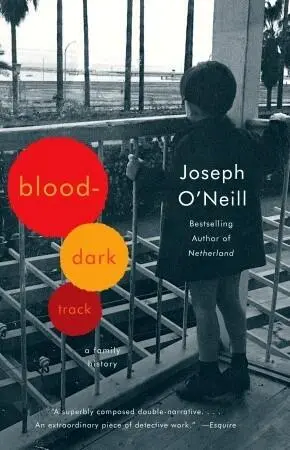
- Название:Blood-Dark Track
- Автор:
- Издательство:Knopf Doubleday Publishing Group
- Жанр:
- Год:2010
- ISBN:978-0-307-74265-0
- Рейтинг книги:4 / 5. Голосов: 1
-
Избранное:Добавить в избранное
- Отзывы:
-
Ваша оценка:
Blood-Dark Track: краткое содержание, описание и аннотация
Предлагаем к чтению аннотацию, описание, краткое содержание или предисловие (зависит от того, что написал сам автор книги «Blood-Dark Track»). Если вы не нашли необходимую информацию о книге — напишите в комментариях, мы постараемся отыскать её.
, a fascinating, personal, and beautifully crafted family history.
Joseph O'Neill's grandfathers-one Turkish, one Irish-were both imprisoned for suspected subversion during the Second World War. The Irish grandfather, a handsome rogue from a family of small farmers, was an active member of the IRA. O'Neill's other grandfather, a debonair hotelier from the tiny and threatened Turkish Christian minority, was interned by the British in Palestine on suspicion of being an Axis spy.
With intellect, compassion, and grace, O'Neill sets the stories of these individuals against the history of the last century's most inhuman events.
Blood-Dark Track — читать онлайн ознакомительный отрывок
Ниже представлен текст книги, разбитый по страницам. Система сохранения места последней прочитанной страницы, позволяет с удобством читать онлайн бесплатно книгу «Blood-Dark Track», без необходимости каждый раз заново искать на чём Вы остановились. Поставьте закладку, и сможете в любой момент перейти на страницу, на которой закончили чтение.
Интервал:
Закладка:
Here one came to Tom Barry’s difficulty: how to leap from this premise to a necessarily remote and terrible spot in the ethical landscape — the shooting of an elderly Irishman in his home. (It is a vital and appealingly pluralistic tenet of republican ideology that Protestants in Ireland like Admiral Somerville, however unionist or ‘West British’, are as Irish as the next man.) The reason given by Barry for the Somerville killing was that the victim had ‘sent’ Irish boys to the Royal Navy as an ‘agent of the British’. But this did not really make sense. Somerville’s sending of Irish boys to the Royal Navy was a mischief that could have been stopped without shooting him dead. The fact that nonetheless the IRA undertook the perilous and dreadful course of homicide suggested that it was not really concerned, in this instance, with stopping recruitment. What if the objective had not been to stop Somerville but to punish him? Again, this did not stand up to scrutiny. Somerville’s actions were, in practical terms, harmless. There had been no systematic IRA engagement with the British since 1921, and the continuing British presence in Ireland was not even slightly dependent on the Royal Navy’s enlistment of young men from West Cork or elsewhere in the country. Somerville was, therefore, a purely ideological offender, at most guilty, as the state solicitor put it, of distasteful conduct unworthy of an Irishman. By the ethical and judicial standards operative in non-repressive societies (standards espoused by the IRA), causing ideological offence was not a capital crime; and it followed that any ‘execution’ of Somerville, particularly in circumstances where he received no warning, would bear no rational relation to the gravity of his offence.
But it seemed unlikely that Tom Barry’s embarrassment would have been caused simply by the problem of irrationality. Although preoccupied by his image in history as a disciplined soldier who played by the rules, Barry was also a hardline republican. Hardline republicans are disinclined to throw doubt on their own or their comrades’ actions. They are convinced of the justness of their cause and of the good faith in which their fellow volunteers act, and they know that misjudgements, even irrational misjudgements, are a regrettable, unavoidable fact of war, and they do not hold themselves peculiarly responsible for that fact. It seemed, then, that Tom Barry must have been defensive about something other than the (irrational) reasons given for the shooting — which meant that the Admiral must have been shot for some other, unmentioned, reason. But what reason was it?
Although the answer to this question was obvious and terrible, it was not until much later that I was able to see it. What I knew, in the first instance, was that the death of Admiral Somerville had historic consequences: together with the fatal shooting, on 26 April 1936, of a suspected informer, John Egan, in County Waterford, it led to the final collapse of the relations between the IRA and Fianna Fáil. On 18 June 1936, the IRA was declared an unlawful association by the government, and has remained unlawful in Ireland ever since.
Uncle Brendan did not elaborate on his pronouncement that the Colt.45 unearthed at Ardkitt was the weapon used to shoot Admiral Somerville. He said that he was going to do a little bit of research into the matter. I didn’t press him. Streams of confidential information run underneath all families, but the very integrity of republican families depends on secrecy. Leaks are avoided by restricting the movement of sensitive information to approved channels and, just as importantly, by the cultivation (conscious or unconscious), by those not in the know, of a measured incuriosity about certain things that others might be up to. This complicity perhaps comes naturally in large, claustrophobic families, where not everybody can or wants to know everybody else’s business, and where mutual, unintrusive loyalty is an essential familial glue. ‘You’ve to stick together for better or worse,’ my grandfather would say to his sons. The reservoir of O’Neill republican confidences was Brendan. He was the son whom my grandfather trusted, and to whom he vouchsafed knowledge of certain matters so that Brendan might bear witness to them and, it could be inferred, keep them in memory until they might safely emerge at the lit surface of history. But when is this kind of disclosure timely? This was a matter for Brendan’s judgement and, in relation to the circumstances surrounding the death of Admiral Somerville, quite a responsibility. Sometimes, I discovered, O’Neill sensitivities are anomalous, so that even though an event might be a matter of public record it remains subject to our internal hush; thus we have secrets that elsewhere have become non-secrets and we treat as out-of-bounds territory trampled by the rest of the world. The discrepancy is understandable: why should the family’s boundaries of discretion, staked out in times of extreme jeopardy, follow the shifting contours of a public discourse that embodied the political values which for so long brought us danger and hardship? But in relation to Admiral Somerville, we had not been overtaken by public knowledge. The public had no idea about the Colt.45 or who had pulled its trigger.
When I asked her about it, my grandmother could not to tell me whether the story about the gun was true or not. ‘We were never told anything,’ she said. She did, however, remember the ‘hullabaloo’ that the Somerville shooting caused; and she also knew — from what source, I didn’t know — that the car used by the assassins had been finally abandoned at Rathduff, a small village north of Cork city, close by the house of her father’s sister.
Not long after the Ardkitt trip, another thing surfaced. Breaking a silence he’d kept for a quarter of a century, my uncle Billy Pollock said that when he became engaged to my aunt Ann O’Neill a fellow remarked to him, ‘Do you know you’re marrying the daughter of the man who shot Admiral Somerville?’
My grandfather’s childhood was a wartime childhood. From around 1918 until the truce in July 1921, he lived through the Anglo-Irish War and — after nearly a year’s imperfect peace — through the Civil War. County Cork, sometimes referred to as the Cork Republic, was a centre of fierce resistance to the Anglo-Irish Treaty of December 1921, which provided for the partition of Ireland into an independent Irish Free State (comprising 26 counties) and a province of the United Kingdom (comprising six Ulster counties) to be called Northern Ireland. But the rebels’ resistance did not last long. Free State troops arrived in Cork in August 1922 and, notwithstanding the death of General Michael Collins and instances of extreme violence, took physical control of the county with relative ease. By May 1923, the fighting was as good as over and the great majority of the IRA was in captivity.
During these conflicts, Cork was by far the most violent county in Ireland. From 1917 to 1923, the IRA in Cork killed 195 and seriously wounded 113 people, and blew up 211 bridges and 301 buildings. The British army killed 93 and wounded 155, the Royal Irish Constabulary killed 108 and wounded 145, and the Free State army killed 70 and wounded 175. The combined forces of the Crown destroyed 237 buildings. The total number of serious casualties came to around 1,600, which is to say around one victim per 240 persons — a much higher rate than that suffered in Northern Ireland since the troubles there began in 1969.
The Anglo-Irish War was much bloodier and more terrifying than the Civil War. The IRA’s guerrilla campaign was ruthless and unpredictable and calculated to cow not only the Crown forces but also their perceived civilian supporters — most notably, Protestant families, whose Big Houses were burned down in reprisals against British actions. Faced with an effective and intangible enemy, the British imposed martial law and terrorized the local population by official and unofficial reprisals, death squads, and the raiding and destruction of homes. A good part of the centre of Cork city was burned down as a reprisal for the Kilmichael ambush. I learned something of the scope and deadliness of the violence by leafing through the newspapers of the time. On 16 February 1921, for example, the Cork Examiner ran the following headlines: CORK TRAIN AMBUSH — SIX PASSENGERS DEAD, TWO ATTACKERS KILLED, MILITARY WOUNDED · MOURNEABBEY CONFLICT — CIVILIANS DEAD AND CAPTURED · SHOT DEAD IN CORK FIELD — ANOTHER LABELLED BODY FOUND · REPORTED SKIRMISH NEAR CORK.
Читать дальшеИнтервал:
Закладка:
Похожие книги на «Blood-Dark Track»
Представляем Вашему вниманию похожие книги на «Blood-Dark Track» списком для выбора. Мы отобрали схожую по названию и смыслу литературу в надежде предоставить читателям больше вариантов отыскать новые, интересные, ещё непрочитанные произведения.



Обсуждение, отзывы о книге «Blood-Dark Track» и просто собственные мнения читателей. Оставьте ваши комментарии, напишите, что Вы думаете о произведении, его смысле или главных героях. Укажите что конкретно понравилось, а что нет, и почему Вы так считаете.