Joseph O'Neill - Blood-Dark Track
Здесь есть возможность читать онлайн «Joseph O'Neill - Blood-Dark Track» — ознакомительный отрывок электронной книги совершенно бесплатно, а после прочтения отрывка купить полную версию. В некоторых случаях можно слушать аудио, скачать через торрент в формате fb2 и присутствует краткое содержание. Год выпуска: 2010, ISBN: 2010, Издательство: Knopf Doubleday Publishing Group, Жанр: Современная проза, на английском языке. Описание произведения, (предисловие) а так же отзывы посетителей доступны на портале библиотеки ЛибКат.
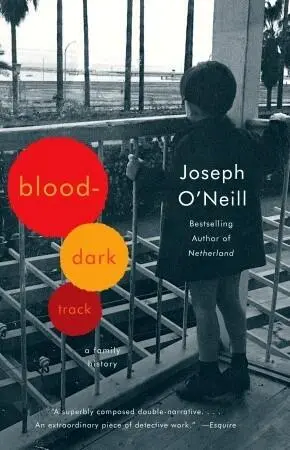
- Название:Blood-Dark Track
- Автор:
- Издательство:Knopf Doubleday Publishing Group
- Жанр:
- Год:2010
- ISBN:978-0-307-74265-0
- Рейтинг книги:4 / 5. Голосов: 1
-
Избранное:Добавить в избранное
- Отзывы:
-
Ваша оценка:
Blood-Dark Track: краткое содержание, описание и аннотация
Предлагаем к чтению аннотацию, описание, краткое содержание или предисловие (зависит от того, что написал сам автор книги «Blood-Dark Track»). Если вы не нашли необходимую информацию о книге — напишите в комментариях, мы постараемся отыскать её.
, a fascinating, personal, and beautifully crafted family history.
Joseph O'Neill's grandfathers-one Turkish, one Irish-were both imprisoned for suspected subversion during the Second World War. The Irish grandfather, a handsome rogue from a family of small farmers, was an active member of the IRA. O'Neill's other grandfather, a debonair hotelier from the tiny and threatened Turkish Christian minority, was interned by the British in Palestine on suspicion of being an Axis spy.
With intellect, compassion, and grace, O'Neill sets the stories of these individuals against the history of the last century's most inhuman events.
Blood-Dark Track — читать онлайн ознакомительный отрывок
Ниже представлен текст книги, разбитый по страницам. Система сохранения места последней прочитанной страницы, позволяет с удобством читать онлайн бесплатно книгу «Blood-Dark Track», без необходимости каждый раз заново искать на чём Вы остановились. Поставьте закладку, и сможете в любой момент перейти на страницу, на которой закончили чтение.
Интервал:
Закладка:
The deceased, Mr Healy continued, was a man who ‘had acted as a kindly gentleman to all, and everybody who came to him for help and aid was assisted by him’. The suggestion that he was a recruiting agent for the British armed forces was, Healy stated, false. ‘Admiral Somerville never asked, sought or induced any person to join that army or navy, but when people came to him and asked him for a recommendation he gave it freely in so far as it lay in his power where he knew people, and when he did not know them he told them the procedure to be adopted. But he used no influence to get any man or boy into the English navy. Now, if every person who had signed a recommendation for boys to join the English navy is to be shot, I am afraid there will be a great number of people in this country who will be shot, because men in all stages and positions, clergy, have signed such recommendations. Surely, the least that might have been given to the deceased was a warning that his action was distasteful, and was regarded as unworthy of the conduct of Irishmen. No notice or warning was given to the deceased, but instead he was hurled to his death. No stain will lie on the memory of the deceased where he was known, and throughout the country the action which has taken place is abhorrent, and I again repeat that every effort will be made to trace the authors of it, though goodness knows, with modern means of communication, the assassin has the advantage on his side.’
The State Solicitor’s gloomy remark was directed at the fact that the killers had fled in a car that two schoolgirls had seen driving away from the house at great speed. It was not until the following day that guards arrived. A minute investigation began. Castings were taken of the tyre-marks left by the car, photographs and measurements were taken of the scene, fingerprints and footprints were thoroughly examined. A week after the homicide, forensic searches were still being carried out at Point House.
While the detectives went about their work, more details began to emerge in the press about the late Admiral. He was born in Castletownshend in 1863, the son of Lieutenant-Colonel Thomas Henry Somerville (who served as High Sheriff of Cork in 1888) and Adelaide, daughter of Admiral Sir Josiah Coghill, Bt. Ships on which the Admiral served included the HMS Shandon , the Agincourt , the Audacious , the Heroine , the Sphinx and the HMS Sealark . He had seen active service in the Chilean — Peruvian war and the first Egyptian war, and as a hydrographic surveyor had sailed in waters by China and Ceylon and in the western and eastern Pacific Ocean. During the Great War he had commanded the Victorian, Argonaut, Amphitrite and King Alfred . He was awarded the CMG and made an officer of the Légion d’Honneur . After his retirement from the navy in 1919, the Admiral was employed by the Hydrographic Department at the British Admiralty. He wrote several books, including dictionaries of languages spoken in New Hebrides and New Georgia, Solomon Islands. Writing ran in the family: Edith Somerville, co-author of the Somerville and Ross books, was his sister. Boyle — the Christian name he went by — Somerville was a Fellow of the Royal Anthropological Society and a Vice-President of the Cork Historical and Archaeological Society. He was a charitable man and frequently contributed to the funds of the Skibbereen Conference of the (Catholic) St Vincent de Paul Society.
And indeed the assassination outraged the Catholic Church. In an address that was read out in every parish in his diocese, the Bishop of Ross stated that in respect of the crime there was ‘no single circumstance to palliate guilt in the slightest. It was not the result of sudden and overwhelming passion, an outbreak of uncontrollable excitement, momentarily taking away the full use of reason. No. It was a well-planned, carefully thought out and deliberately organized crime, with every move coolly forecasted and every precaution taken to ensure the subsequent safety of the perpetrator. It bore every mark of the crime of the coward, who will strike only when assured of impunity.… It is to be hoped,’ the bishop said, ‘that this awful crime will be a warning to our young men, who may be tempted to join Secret Societies, so often and deservedly condemned by the Catholic Church.’
Condemnation also came from the political establishment. In the Dáil, a government spokesman sympathized with the relations of the victim of ‘this cowardly crime’, and Cork County Council also passed a resolution expressing its sympathies. Councillor D. O’Callaghan said that the Admiral, whom he’d known for fifty years, never did anything in his life that either Catholic or Protestant could be ashamed of. He was an idol of the people. He was not a recruiting agent for the British. Mr O’Callaghan himself had recommended persons to British armed forces for the last twenty to thirty years, poor men who came home with a pension of £300 and £400 to support their families. Senator Fitzgerald, speaking on behalf of Fianna Fáil, stated that even if the Somerville family differed from the rest of the country with respect to the national outlook, there must be room in this country for all shades and classes of opinion. (Hear, hear.) Mr O’Mahony, who wished to be associated with the vote, said that the Somerville family had, in the past, suffered for its convictions as far as Irish nationalism was concerned. Mr O’Mahony did not agree with the Admiral politically, but it was a terrible thing that he had received no warning.
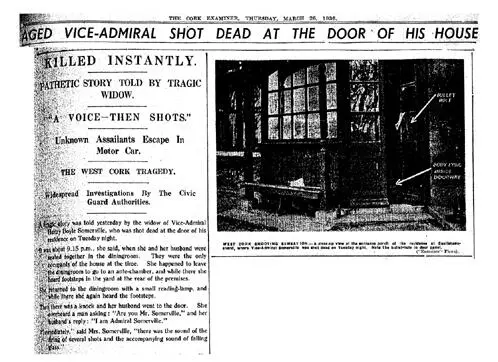
The Admiral’s funeral took place on 28 March 1936. The Cork Examiner showed a photo of a procession of hundreds following the coffin down the main street. Among the mourners, the newspaper reported, was the nephew of the deceased, Sir Patrick Coghill, who had travelled from Britain for the funeral.
The furore continued in the newspapers, and politicians and priests urged anyone who knew something to come forward. Rumours began to circulate that inquiries had extended into Kerry and that an arrest was imminent. But nobody was ever arrested for the murder of Admiral Somerville.
In time, one important fact entered the public domain: action of some kind against Admiral Somerville was authorized by Tom Barry, then the IRA OC (Officer Commanding) in County Cork. Decades after Somerville’s death, Barry went on record that an IRA squad had been instructed to ‘get’ the Admiral, but that ‘the leader of the IRA squad, not the most stable of men, apparently was carried away, and interpreted his orders quite literally, and shot the Admiral dead’.
What most intrigued me about Barry’s oddly vague account was its attempt to introduce a morally significant distance between him and the killing. Ordinarily, Barry had no qualms about the republican use of ‘physical force’. What was it about this particular incident that led him to disown it?
At the beginning of 1936, the IRA was a diminished and strategically confused organization. Morale had fallen sharply since the early ’thirties, when the IRA regrouped effectively for the first time since the Civil War and, animated by socialist ideas, held rallies and mounted sometimes violent campaigns against prison warders, police officers, the courts, and English imports such as sweets and newspapers. The threat to the institutions of the Free State grew so serious that in late 1931 the Dublin government set up a Military Tribunal to try political cases, since juries were unwilling, out of fear or ideological persuasion, to convict republican defendants. Then, in February 1932, Éamon de Valera’s pro-Republican Fianna Fáil came to power and legalized the IRA. Everything changed. There was a boom of recruitment into the IRA, whose activities were limited to resisting the political advance of the Blueshirts, the followers of a pro-Treaty, fascistic organization that called itself, successively, the Army Comrades Association, the National Guard, and the Young Ireland Association. There were riots, bitterly-fought street battles and, very occasionally, fatalities. But by the end of 1934, the Blueshirt threat had been effectively eliminated, and the IRA (which still asserted a right to bear arms in the face of the continuing British presence in Ireland) began to lose its direction. Drilling and training faltered and membership fell sharply. Some men left for the communist-inclined Republican Congress group, but a greater number drifted to Fianna Fáil. Although Fianna Fáil had not delivered a republic, for many republicans its anti-British measures (most notably, economic sanctions and the abolition of the requirement that members of the Free State parliament swear an oath of allegiance to the British Crown) represented acceptable progress. In 1935, relations between the IRA and the government — by now characterized by uneasy mutual tolerance — worsened. In February, IRA men, acting in support of a group of tenants threatened with eviction, broke into the house of a land agent in Edgeworthstown, Co. Longford, and shot dead his son. Then, in March, came a direct confrontation with the authorities: IRA men, siding with striking bus and tram workers in Dublin, sniped at Free State army lorries in use as public transport, and wounded two police officers on patrol. The government finally acted against its Civil War comrades-in-arms. Throughout 1935, arrests, surveillance and harassment of the IRA — still not an illegal organization — increased; and so, correspondingly, did IRA antagonism towards de Valera and Fianna Fáil, now seen as traitors to republicanism or, at best, its unfit trustees. By early 1936, republican logic dictated that it fell once more to the IRA to advance the cause of an Ireland united and free from British rule.
Читать дальшеИнтервал:
Закладка:
Похожие книги на «Blood-Dark Track»
Представляем Вашему вниманию похожие книги на «Blood-Dark Track» списком для выбора. Мы отобрали схожую по названию и смыслу литературу в надежде предоставить читателям больше вариантов отыскать новые, интересные, ещё непрочитанные произведения.






Обсуждение, отзывы о книге «Blood-Dark Track» и просто собственные мнения читателей. Оставьте ваши комментарии, напишите, что Вы думаете о произведении, его смысле или главных героях. Укажите что конкретно понравилось, а что нет, и почему Вы так считаете.