Joseph O'Neill - Blood-Dark Track
Здесь есть возможность читать онлайн «Joseph O'Neill - Blood-Dark Track» — ознакомительный отрывок электронной книги совершенно бесплатно, а после прочтения отрывка купить полную версию. В некоторых случаях можно слушать аудио, скачать через торрент в формате fb2 и присутствует краткое содержание. Год выпуска: 2010, ISBN: 2010, Издательство: Knopf Doubleday Publishing Group, Жанр: Современная проза, на английском языке. Описание произведения, (предисловие) а так же отзывы посетителей доступны на портале библиотеки ЛибКат.
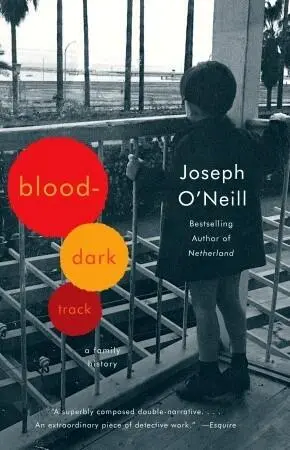
- Название:Blood-Dark Track
- Автор:
- Издательство:Knopf Doubleday Publishing Group
- Жанр:
- Год:2010
- ISBN:978-0-307-74265-0
- Рейтинг книги:4 / 5. Голосов: 1
-
Избранное:Добавить в избранное
- Отзывы:
-
Ваша оценка:
Blood-Dark Track: краткое содержание, описание и аннотация
Предлагаем к чтению аннотацию, описание, краткое содержание или предисловие (зависит от того, что написал сам автор книги «Blood-Dark Track»). Если вы не нашли необходимую информацию о книге — напишите в комментариях, мы постараемся отыскать её.
, a fascinating, personal, and beautifully crafted family history.
Joseph O'Neill's grandfathers-one Turkish, one Irish-were both imprisoned for suspected subversion during the Second World War. The Irish grandfather, a handsome rogue from a family of small farmers, was an active member of the IRA. O'Neill's other grandfather, a debonair hotelier from the tiny and threatened Turkish Christian minority, was interned by the British in Palestine on suspicion of being an Axis spy.
With intellect, compassion, and grace, O'Neill sets the stories of these individuals against the history of the last century's most inhuman events.
Blood-Dark Track — читать онлайн ознакомительный отрывок
Ниже представлен текст книги, разбитый по страницам. Система сохранения места последней прочитанной страницы, позволяет с удобством читать онлайн бесплатно книгу «Blood-Dark Track», без необходимости каждый раз заново искать на чём Вы остановились. Поставьте закладку, и сможете в любой момент перейти на страницу, на которой закончили чтение.
Интервал:
Закладка:
Shocked, Dakak ran to the balcony and threw himself down into the prison’s interior courtyard. My grandfather wrote: ‘I preferred to kill myself than face the rope or the bullet. It wasn’t until later that it dawned on me that everything they did was part of a strategy of psychological torture.’
In its hallucinatory, ghastly, and temporally fluid progression, the testimony uncannily corresponded to a nightmare; and reading it, I was by now fighting for my breath. The suicide attempts, the mental torture, the self-mutilations, the cell transfers, the food poisonings, the suspicions, the unceasing distress at the centre of it all: repetitive and demanding and interminable and horrifying, my grandfather’s grievances filled the pages like fumes. A part of me was irritated by the author of this airless, woebegone account, which made an incoherent and overly direct claim on my pity and too readily assumed assent to its tormented speculations — and, of course, a part of me consequently felt guilty: for I recognized in myself the strange mercilessness of the disobliged reader. However, I wasn’t an ordinary reader. I was the writer’s grandson. I couldn’t flee the scene. I had to persevere and attempt to understand something about Joseph’s ordeals, which he had taken such trouble to record.
My grandfather could not remember exactly how he threw himself over the balcony in the French Military Prison. When he came to, after four hours of unconsciousness, he was back at the infirmary at the Prison of Sands. His right leg was broken and he had a cut by his right eyebrow. The next day he was transferred to the government hospital in Beirut, where his leg was put in plaster.
Joseph Dakak stayed at the hospital for seven months (which suggested injuries more serious than a simple broken leg). He was nursed by a Spanish nun called Sister Inias. She visited him every night for two hours of prayers and conversation. The talk covered a variety of subjects and ranged from religion to politics to the stories in the Beirut newspapers which the nun smuggled in every day. Sister Inias would ask Dakak his opinion of current events — in particular, how he expected Turkey to act. Other times, she would tell him stories of how the Turks had slaughtered hundreds of thousands of Armenians. She told him that the Turks did not like Christians and that as a Christian he should not expect anything from his consulate.
My grandfather concluded that Sister Inias was a spy, and that she was saying these things about Turkey in order to demoralize him and tempt him into a betrayal of his own country.
During the last weeks of his stay at the hospital (in March and April 1943), a patient called Aram Hachadourian was put in the bed next to my grandfather. Hachadourian had hardly lain his head on his pillow before he’d revealed that, although a native of Gaziantep, he had lived in Iskenderun for the last forty years and was the uncle of the wife of Joseph Ayvazian, the proprietor of a hotel at Soguk Oluk in the Amanus mountains. Hachadourian said that Ayvazian had been mistreated by the Turks, who wouldn’t permit anyone stay at his hotel because of remarks he’d allegedly made in favour of the Germans.
I was startled to read this: Ayvazian was the man identified by C.T.C. Taylor, the SIME agent, as a German spy.
Hachadourian quizzed Dakak about the well-known people of Iskenderun and about Turkish Armenians photographed in a magazine published in 1937 or 1938 called Armanian . Dakak didn’t recognize any of them. Aram Hachadourian complained to my grandfather that in 1939 the Turks had forced him to leave Iskenderun and had frozen the bank account credited with the proceeds of the sale of his house, money which there was now not the slightest hope of recovering. ‘Aram Hachadourian,’ my grandfather wrote, ‘came up with any old anti-Turkish rubbish because he, too, was a spy.’
At around this time, Sister Inias arranged a visit by Joseph Dakak’s Beirut cousin, Alida Hannah. The nun told Alida, ‘Don’t be too long, I’ll take care of the guard next door’; and to Dakak’s astonishment the guard, who had never before left his post, disappeared. Joseph and Alida spoke for ten minutes. She assured him that Nazim Gandour and his brother Fazil were being tortured and were in a pitiful state. Nazim, Dakak retorted, was nothing other than an English spy.
Hachadourian, in the bed right next to Dakak’s, listened to every word. My grandfather subsequently came to the sad realization that his cousin and Hachadourian were working together and that everything she’d said had been for the Armenian’s benefit. ‘There is no doubt at all that this was the arrangement,’ my grandfather wrote in his testimony.
Two weeks later, Joseph Dakak was removed from the hospital and transferred to Palestine. On 5 May 1943, they brought him to a monastery situated between Jerusalem and Ramle, in a village called Emuas.
The monastery was surrounded by barbed wire and held thirty-three men, including Greeks, Germans, Albanians, Arabs, Serbians, Poles and Italians. By this time, my grandfather stated, he had come to understand the devious ways of the English and the subterfuges they used to extract information from him. It did not take him more than a day, therefore, to realize that the thirty-three men were all spies for the English and that at their head was none other than Nazim Gandour. As soon as a newcomer arrived a the camp, he would ostensibly be mobbed for news. The conversation would then be manipulated in such a way that the new arrival ended up by questioning Dakak. In this way, over the course of one and a half years, the number of inmates rose from thirty-three to eighty-eight. At the rate of about two a fortnight, fresh agents were sent to the monastery to do their work.
A familiar feeling of dismay overcame me — the feeling lawyers get when their witness comes out with a statement that abruptly deflates the balloon of credibility he has laboriously puffed up. It was simply impossible that an entire internment camp might be devoted to extracting information (information about what , incidentally?) from one prisoner. My grandfather was clearly a writer in the grip of paranoia.
I felt a strong pang of pity. That Joseph — an authoritative, punctilious man who (in Amy’s words) never exaggerated and never said that he had eaten three figs if he’d only eaten two — had been reduced to this state of miscomprehension was a measure of the depth of his fall.
But this development did not lead me to distrust the whole of his testimony. A witness may be reliable in certain respects and unreliable in others. My grandfather was not lying about the role of his fellow prisoners; he was simply deluded about it. His paranoia therefore did not make me especially sceptical of his version of physically observable events ( especially , because I was always conscious that the testimony was, as lawyers say, a self-serving statement), but of course it made his interpretation of them doubtful — doubtful, but not necessarily wrong. The fact that a man is paranoiac does not mean that he is immune to conspiracies to harm him.
My grandfather continued his story of his persecution in saddening detail. They used a variety of ruses to question him, he stated. One bizarre trick was to give the prisoners names that were exactly, or almost exactly, the same as the names of the political leaders of their country in the hope that this would subconsciously induce Dakak to volunteer information about the men in question. They had another strange ploy: they would bring in so-called prisoners who bore a striking resemblance to persons about whom they sought information. For example, long ago there had been in Mersin an Italian consul called Moki, and so there materialized an Italian prisoner who looked exactly like Moki and who began to speak to Dakak in Italian. And another Italian ‘prisoner’ strongly resembled the Italian consul who succeeded Moki in Mersin. Joseph Dakak wrote:
Читать дальшеИнтервал:
Закладка:
Похожие книги на «Blood-Dark Track»
Представляем Вашему вниманию похожие книги на «Blood-Dark Track» списком для выбора. Мы отобрали схожую по названию и смыслу литературу в надежде предоставить читателям больше вариантов отыскать новые, интересные, ещё непрочитанные произведения.












Обсуждение, отзывы о книге «Blood-Dark Track» и просто собственные мнения читателей. Оставьте ваши комментарии, напишите, что Вы думаете о произведении, его смысле или главных героях. Укажите что конкретно понравилось, а что нет, и почему Вы так считаете.