Paul Theroux - Hotel Honolulu
Здесь есть возможность читать онлайн «Paul Theroux - Hotel Honolulu» весь текст электронной книги совершенно бесплатно (целиком полную версию без сокращений). В некоторых случаях можно слушать аудио, скачать через торрент в формате fb2 и присутствует краткое содержание. Год выпуска: 2002, Издательство: Mariner Books, Жанр: Современная проза, на английском языке. Описание произведения, (предисловие) а так же отзывы посетителей доступны на портале библиотеки ЛибКат.
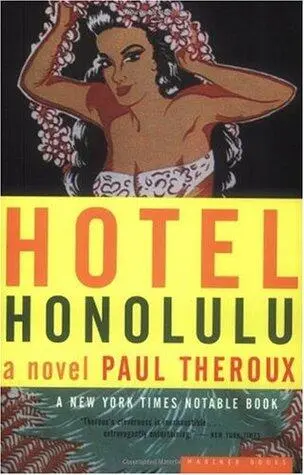
- Название:Hotel Honolulu
- Автор:
- Издательство:Mariner Books
- Жанр:
- Год:2002
- ISBN:нет данных
- Рейтинг книги:4 / 5. Голосов: 1
-
Избранное:Добавить в избранное
- Отзывы:
-
Ваша оценка:
Hotel Honolulu: краткое содержание, описание и аннотация
Предлагаем к чтению аннотацию, описание, краткое содержание или предисловие (зависит от того, что написал сам автор книги «Hotel Honolulu»). Если вы не нашли необходимую информацию о книге — напишите в комментариях, мы постараемся отыскать её.
Hotel Honolulu — читать онлайн бесплатно полную книгу (весь текст) целиком
Ниже представлен текст книги, разбитый по страницам. Система сохранения места последней прочитанной страницы, позволяет с удобством читать онлайн бесплатно книгу «Hotel Honolulu», без необходимости каждый раз заново искать на чём Вы остановились. Поставьте закладку, и сможете в любой момент перейти на страницу, на которой закончили чтение.
Интервал:
Закладка:
Sick of the subject, Chen turned his back on us and said, "The sunset. Like for make a picture."
The western sky was like an amateur painting, one of those behind- the-sofa pictures on black velvet — garish and overly simple, fatuous, too much of it all at once, the sun too round, the ocean too wide, too yellow. Most clouds become two-dimensional at sunset. All this sunset lacked were dancing dolphins and a three-masted schooner, I was thinking, and just then I saw a three-masted schooner, a dinner cruise, sailing into the liquefied light of the bright brimming ocean, preceded by dolphins spinning and flopping like badly behaved kids in a pool.
Stifled by the unreality of this, too, like a florid dream brought on by indigestion, I went outside and joined the man in the Panama hat. He was mustached, small, precise, smiling slightly at this hundred-egg omelet of nature being beaten into the sea.
"The red light breaking at the close from under a low somber sky, reached out in a long shaft," the man said, seeming to quote, and gesturing at the shaft, "and played over old wainscots, old tapestry, old gold, old color."
"I was thinking how the sunset is sort of liquefied on the sea and dissolving into the chop of the waves."
"Tessellated, more like," he said, nodding. "Rubious. Effulgent. And the languid lisp of the Pacific."
I stared at him as though at a brave brother voyager from our old planet. He still wore his half-smile. I liked the neatness of his appearance and imagined him wearing a monocle.
"There you are," Sweetie said, walking from the Elks' lanai, raising her knees and having to take dance steps because of the deep beach sand. "Time for the prizes, Dad."
She looked very pretty, her hair blown by the sea breeze, giggling as she balanced in the sand. Part Chinese, part Irish, and part Hawaiian, she had big dark staring eyes and the smooth chinless face of a seal pup.
"I'm like a basket case," Sweetie said, and laughed. "Ate too much!"
"It's King Kalakaua Night," I said.
The man looked seaward again. "The honest, dusky unsophisticating night."
"Good grinds," Sweetie said. "Kinda hard for me. These grinds made by my peers. They got expertise!"
"We're guests of the Chens," I said. "Lester's an Elk."
"Now he's on skateboards," Sweetie said.
"My wife, Ku'uipo," I said to the man, who gallantly touched his hat
brim.
"May I see your watch?" the man asked.
Sweetie's watch, a gift from Buddy, showed a hula dancer, her arms the watch's hands.
"One has a dilettante's interest in horology," the man said.
"Everyone says that about the hula, but it's not true — this is pono, this is righteous," Sweetie said.
The man turned to me and said, "We must meet for luncheon."
"Luncheon" clinched for me what "tessellated" and "rubious" had clinched for him: he was certainly a fellow inhabitant from our distant galaxy. Among these islander earthlings, we were two travelers who had met by accident, and in spite of looking like everyone else, we were unquestionably extraterrestrials. No one else knew this, yet instantly we recognized the nuances and were able to communicate in our old, strange multisyllabic tongue, a secret and subtle language spoken by no one under the palm trees here.
We exchanged our full names — another habit from the old planet — and I realized I was talking with Leon Edel, the biographer of Henry James. Edel, whom I had heard about, had been living in relative obscurity in Hawaii for many years. He said he knew my name.
"And I know yours."
"My friends on the mainland all think I'm crazy," he said.
"Mine think I'm dead," I said. "Have no idea where I am. If they knew, they'd say I'm crazy."
"They don't know what they're talking about." He touched his hat brim in farewell.
"We're not crazy. This is the place."
I resumed my seat in the Elks and whispered my question again, for the pleasure of knowing the answer.
43 Rocket Men
"I had no idea you were here too," Leon Edel said. That "too" was nice and made me feel I mattered. I volunteered that I was here as a hotel manager. He was tactful enough not to inquire further, and when he pointedly asked whether I happened to be working on anything, I just smiled. Not wishing to talk about writing is easy for another writer to understand, and a writer's not writing is more natural to another writer than writingis.
"I'm thinking of a book, titled Who I Was," I said.
"Yes, yes, yes."
I met him at the Outrigger for lunch, so as to keep our friendship secret from my hotel people. Even his calling this meal "luncheon" would have made them squint in suspicion.
"Call it work in stoppage."
Because we met as two people who felt a little strange and hidden here, we found it natural to confide in each other. We sat by the sea, eating salad, sipping iced tea. Leon was eighty-seven, my father's age, though my father was gone. One of those rare men who could be a stand- in for my father, Leon Was precious for his age and his kindness. He was
also wise. And it was a pleasure just to sit with him and talk about our wonderful old planet.
"Your wife is lovely," Leon said, interrupting himself.
"Yes, a coconut princess. Maybe a little provincial."
"She's a provincial of genius. She's life itself," Leon said. "She's for the bright rich world of bribes and rewards."
After that, we changed the subject to Hawaii, but in effect it was the same subject, for Hawaii, like Sweetie, was beautiful and healthy and fresh. You could be so happy in Hawaii's embrace you did not notice what was missing.
"James once spoke of a void furnished with 'velvet air.'"
"Did he know anything of the tropics?"
"Florida," Leon said. He raised a finger to make a Jamesian point. "You could live in Florida with an idea, he said, 'if you are content that your idea shall consist of grapefruits and oranges." Leon let this sink in. I could see the named fruit in a cut-glass bowl. "Also he was in San Diego. Coronado Beach. That's where 'lisp of the Pacific' comes from."
"Would he like it here?"
"We like it here," Leon said with assurance, a perfect way of saying yes: Henry James would love Hawaii, because we did.
"He'd dine out more than we do."
"Probably every night. He would see into every corner. He would use the pulses of the air. He would know people we don't. Doris Duke, the Hawaiian royalty, the way Stevenson did. Stevenson drank champagne with King Kalakaua. James would have found his way. Hobnobbed a little, cultivated the right people, and perhaps some of the wrong people too."
Henry James in a billowing aloha shirt approached us as Leon spoke, seeming to conspire, speculating about another inhabitant of our world. I listened closely because I wondered how much of this description fitted me and my living here. James with plump sunburned jowls, in island attire, his stout Johnsonian shape, short pale legs, round belly, big busy bum and fluttering hands, breathlessly stammering one of his inimitable voice-overs in Waikiki, indicating the throngs of tourists and the effulgent clouds, followed by his panting dog, Tosca.
That day I went back to the Hotel Honolulu and found Keola on the front steps, stabbing an ice pick into a block of blue ice.
I said, "Shouldn't you be doing that in the kitchen?"
"Bull-liar bitches talk stink about me."
"Do it later, then."
"Later I go for lawnmower da grass."
The next time I saw Leon I said, "What would James have made of the locals?"
"He would have been attentive to them, as he was attentive to everyone. Some of them he would have called 'ragged and rudimentary.' Maybe he would have mentioned their 'robust odor. . thick and resisting."
He might have said that of many of my employees. So, strange as it was, I began to see my life in this way, as an alien in an aloha shirt, looking at Hawaii through dark glasses, measuring my impressions against James's. Leon helped me understand it. Worthy of James in every way, he had immersed himself in the master's life like a monk in the steps of a lama on the path to enlightenment.
Читать дальшеИнтервал:
Закладка:
Похожие книги на «Hotel Honolulu»
Представляем Вашему вниманию похожие книги на «Hotel Honolulu» списком для выбора. Мы отобрали схожую по названию и смыслу литературу в надежде предоставить читателям больше вариантов отыскать новые, интересные, ещё непрочитанные произведения.




Обсуждение, отзывы о книге «Hotel Honolulu» и просто собственные мнения читателей. Оставьте ваши комментарии, напишите, что Вы думаете о произведении, его смысле или главных героях. Укажите что конкретно понравилось, а что нет, и почему Вы так считаете.