Paul Theroux - Hotel Honolulu
Здесь есть возможность читать онлайн «Paul Theroux - Hotel Honolulu» весь текст электронной книги совершенно бесплатно (целиком полную версию без сокращений). В некоторых случаях можно слушать аудио, скачать через торрент в формате fb2 и присутствует краткое содержание. Год выпуска: 2002, Издательство: Mariner Books, Жанр: Современная проза, на английском языке. Описание произведения, (предисловие) а так же отзывы посетителей доступны на портале библиотеки ЛибКат.
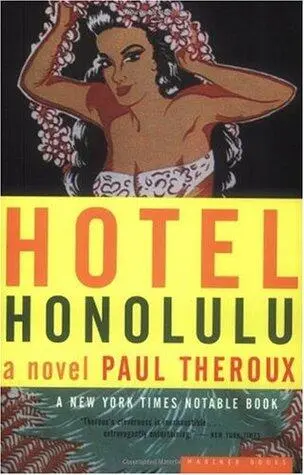
- Название:Hotel Honolulu
- Автор:
- Издательство:Mariner Books
- Жанр:
- Год:2002
- ISBN:нет данных
- Рейтинг книги:4 / 5. Голосов: 1
-
Избранное:Добавить в избранное
- Отзывы:
-
Ваша оценка:
Hotel Honolulu: краткое содержание, описание и аннотация
Предлагаем к чтению аннотацию, описание, краткое содержание или предисловие (зависит от того, что написал сам автор книги «Hotel Honolulu»). Если вы не нашли необходимую информацию о книге — напишите в комментариях, мы постараемся отыскать её.
Hotel Honolulu — читать онлайн бесплатно полную книгу (весь текст) целиком
Ниже представлен текст книги, разбитый по страницам. Система сохранения места последней прочитанной страницы, позволяет с удобством читать онлайн бесплатно книгу «Hotel Honolulu», без необходимости каждый раз заново искать на чём Вы остановились. Поставьте закладку, и сможете в любой момент перейти на страницу, на которой закончили чтение.
Интервал:
Закладка:
"Yes?"
I never spoke to the Suns without feeling I was intruding on their intimacy and perfect peace.
"We've had another complaint about your boys."
Mrs. Sun looked so sorrowful I found myself apologizing and eager to get away, suddenly finding the vandalism trivial compared to my disturbing the happiness of this wonderful couple. Mr. Sun set his book down. They both looked abject. How many times had they been put in the position of having to be sorry and make amends?
Mrs. Sun said, "I'll ask my husband to speak to them. Of course we will pay for any damage."
"The patio furniture isn't a problem. There was some breakage, though," I said. "And a guest room table will have to be replaced or refinished. It ties up Maintenance when these things happen."
"I know it has happened before because of our boys," Mrs. Sun said -
— something I had planned to say.
"Are they around?"
"Across the hall."
She knocked. No answer. I knocked, then used my master key. But by then Mr. Sun had called to her with affection and concern, and she was now back in their room with the door shut.
The boys were out, but judging from the condition of the room, Maintenance and Housekeeping would have some work to do: broken mirror, broken blinds, spills on the carpet, footprints on the wall (on the wall?), and that was only what I saw from the doorway, peering in.
"That's nothing," Trey said later. "A few years ago they trashed the bar. Buddy went ballistic."
One boy was a drunk, the other smoked dope, Trey said, but admitted he did not know which was which. It didn't matter. They were a year apart, fourteen and fifteen. In the second week of their vacation the older one was caught stealing from a convenience store, and the younger one was picked up for vandalizing a public telephone. Because of their ages, no charges were filed. The boys were left in the custody of their parents, which was meaningless because I never saw the four Suns together. The children were seldom around.
One day the Suns volunteered the information that they were just returning from St. Andrew's, the church in which they had been married. Their visits to Hawaii were always planned around their wedding anniversary.
They were, as always, holding hands. Mr. Sun tugged his wife's hand with such affection that I was moved.
"I can see that the romance hasn't gone out of your marriage," Isaid.
"It never will," Mr. Sun said.
Is a marriage a family? Mr. and Mrs. Sun were inseparable, utterly devoted to each other, quiet, and kind, their love creating a magnetic field of orderly flowing energy between them. The flow neither attracted nor repelled anyone else. No one else was magnetized, no one else mattered.
They left, all of them. The following Christmas, on a sunny afternoon, one boy shot himself in a motel in Great Falls, Montana. The other boy moved to Seattle. I didn't know which boy did which.
42 Henry James in Honolulu
It was one of the many moments in my life when I whispered to myself, "Where am I?" — in the larger sense. In the smaller sense, I knew I was smiling in impatience at my two symmetrical scoops of macaroni salad on King Kalakaua Night at the Honolulu Elks Lodge in Waikiki with my wife, Sweetie, as a guest of Lester Chen, my number-two man, and his new wife, Winona. "My kine no go shtrait," I heard. They were discussing in-line skates — were they bad for your ankles? I was also thinking how the plain truth like a sentence about this setting resembled the first line of a poem to which there is seldom a second line.
The boast of the Honolulu Elks was that they were next door to the much classier Outrigger Canoe Club. An Elk could walk out to the beach and bump into an Outrigger. There was just such an Outrigger in a blazer and a Panama hat standing on this shared margin of beach, staring at the sunset. I envied that dapper man for his belonging to this beach and not thinking, Where am I? Or so I presumed.
For myself, I was somewhere I had never been before, nor ever read about, nor knew anything of.
"There was an Elks Lodge next to the Washington School in Medford, Massachusetts, when I was growing up," I said. "I never saw a single
Homo sapiens enter or leave. Beautiful building, though, and a profound mystery to me."
One of those perplexed silences ensued, of the sort created by someone in a chatty group suddenly lapsing into echolalia or the gabble of a foreign language. The others looked away from me. Sweetie left for the buffet. Was it "Homo sapiens"?
"Everything kind of one mystery when you one keiki, yah?" Lester said. He was at his most banal when he attempted to be aphoristic in order to shut down a conversation. He had the Chinese hatred of direct questions, seeing them as a personal challenge, fearful of the conflict they might create. "This club also mysterious, okay?"
Who am I? was my next question, but also in a larger sense.
"You Sweetie husband!" Winona said to me, like someone just waking up. "I hear about you." She turned to a purple shrunken woman seated behind her. "He Sweetie husband!"
We were all badly dressed and barefoot in loose loud shirts and shorts like big misshapen children. Yet the meal was strangely formal and adult, even ceremonial, with two long speeches in the middle of it, and loyal toasts, and a strict order of courses — dinner at half past five, the setting sun glaring into my translucent macaroni salad, making it glow.
The grotesque novelty of the situation baffled me and made me suspect it might be significant. What was new to me always seemed
important. If this scene had been written, I had not read it. But how could it have been written in this green illiterate world, and by whom?
In the unreality of being a solitary witness are intimations of dementia. You wonder where to begin. Maybe it is a fever? I had believed that writing hallowed a place, established the setting as solid, palpable, credible. The place bulked, it had color, you believed it. An unwritten-about place seemed invisible until it was described by someone made confident by imagination. People grew up on a little island or in a small town and felt they had to leave home to find a place to write about, a "real" place, Chicago or New York or Paris, because their little home didn't exist or wasn't visible to the naked eye. Other writers had made the great cities real.
Yet long after I left Medford, I was encouraged to believe in the existence of my hometown when I read Henry James's story "A Ghostly Rental." The haunted house was located in a part of Medford not far from the Elks Lodge. I was reminded of what Lester Chen had just said.
"This club was mysterious in what way?"
"Exclusive," Chen said. "Okay?"
"You mean expensive?"
"Not expensive but strick," he said. "We could not join, okay?"
I took the "we" to mean Chinese. He hated these questions.
"When did the Elks allow you to join?"
"Not for a long time. Okay?"
"Statehood?"
"After that." He shook his head and said peevishly to Winona, "Okay, when that old lady try get take the bus?"
"Which old lady? Which bus?" I asked.
"In Alabama," Winona said. "Yah?"
I said, "Rosa Parks?"
"Yah."
"She was already on the bus. She wouldn't change her seat." Rosa Parks helped integrate the Honolulu Elks? In the course of this halting revelation, Sweetie had come back from the buffet with a full plate — a scoop of sticky rice, two slabs of Spam looking like a pair of pink epaulettes, a dill pickle, cold clotted potato salad, a dish of gluey poi, a broken and buttered muffin, a glass of fruit punch, a bowl of Jell-O with fruit chunks suspended in it.
Winona said, "She eating ethnic."
Sweetie had heard the end of the conversation. She said, "The people in a club don't want you for join, and you want join? How that make sense, yah?"
Читать дальшеИнтервал:
Закладка:
Похожие книги на «Hotel Honolulu»
Представляем Вашему вниманию похожие книги на «Hotel Honolulu» списком для выбора. Мы отобрали схожую по названию и смыслу литературу в надежде предоставить читателям больше вариантов отыскать новые, интересные, ещё непрочитанные произведения.






Обсуждение, отзывы о книге «Hotel Honolulu» и просто собственные мнения читателей. Оставьте ваши комментарии, напишите, что Вы думаете о произведении, его смысле или главных героях. Укажите что конкретно понравилось, а что нет, и почему Вы так считаете.