Paul Theroux - Hotel Honolulu
Здесь есть возможность читать онлайн «Paul Theroux - Hotel Honolulu» весь текст электронной книги совершенно бесплатно (целиком полную версию без сокращений). В некоторых случаях можно слушать аудио, скачать через торрент в формате fb2 и присутствует краткое содержание. Год выпуска: 2002, Издательство: Mariner Books, Жанр: Современная проза, на английском языке. Описание произведения, (предисловие) а так же отзывы посетителей доступны на портале библиотеки ЛибКат.
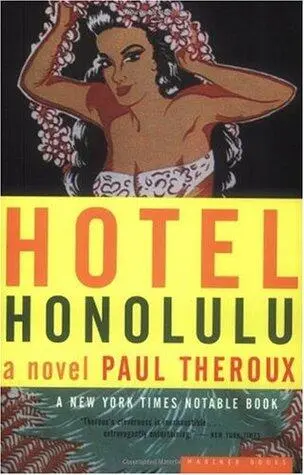
- Название:Hotel Honolulu
- Автор:
- Издательство:Mariner Books
- Жанр:
- Год:2002
- ISBN:нет данных
- Рейтинг книги:4 / 5. Голосов: 1
-
Избранное:Добавить в избранное
- Отзывы:
-
Ваша оценка:
Hotel Honolulu: краткое содержание, описание и аннотация
Предлагаем к чтению аннотацию, описание, краткое содержание или предисловие (зависит от того, что написал сам автор книги «Hotel Honolulu»). Если вы не нашли необходимую информацию о книге — напишите в комментариях, мы постараемся отыскать её.
Hotel Honolulu — читать онлайн бесплатно полную книгу (весь текст) целиком
Ниже представлен текст книги, разбитый по страницам. Система сохранения места последней прочитанной страницы, позволяет с удобством читать онлайн бесплатно книгу «Hotel Honolulu», без необходимости каждый раз заново искать на чём Вы остановились. Поставьте закладку, и сможете в любой момент перейти на страницу, на которой закончили чтение.
Интервал:
Закладка:
Nani said, "Why howlie heah. He huhu? Assa madda you — pickin' pines. No more nuttin' fo' do. Or udda ting. Dis howlie lolo he stay kolohe. But he keiki more bettah." She gasped. "Like dat."
I said, "Would you say there are any verbs in this language?"
She looked insulted. "You fucking with me?"
"In that sentence, 'fucking' is a verb. In this one, 'is' is a verb."
"Peewee, man, this howlie fucking with me," she said. "So you pretty hybolical."
Peewee said, "Try wait, Nani."
She said, "Why he went for see you, was."
I said, "A linguist would say there is no overt verb "to be." That's a type of defocused sentence with a postposed 'was.'"
"Hybolical," Nani said again.
Peewee said, "I told some people I knew you. They were like, 'Hey, he's famous.' They want to meet you."
But I declined. So, on Christmas Eve, I was left with Buddy, Peewee, Nani, my pretty wife and daughter, and several guests at our annual party, on the second-floor lanai outside Paradise Lost.
I said, "I'm through with books. Some are just junk and I get sad when I see them."
"Books are good," Peewee said.
"It's Christmas," I said. "I'd rather talk about birds. Or turtles. Or the sea. I saw a whale last year from the roof."
Peewee said, "Nani saw some dolphins yesterday."
Nani heard her name and said, "We got so many frikken birds we no know their name. But like in Whyan a turkey no gobble gobble. He kolo- kolo. And Whyan Santa Claus is Kana Kaloka."
I smiled and told myself that an ignoramus was preferable to a pseudointellectual. Some hotel guests spent hours telling me the plots of books they liked. Others, returning overdressed from a local production of the Nutcracker, lorded it over the tourists gaping at our Happy Hour hula.
"I wanted to call her Taylor, but my husband said no," Sweetie was telling one of the Christmas party guests.
"Taylor means tailor," I said. "It seems inauspicious. Like calling her Cobbler."
"That's a kind of drink," Nani said.
"Logan is a real nice name," Sweetie said. "Or Shannon. Next kid maybe."
"Shannon is Irish," I said.
"I got some Irish in me," Buddy said. He was peeling the foil from a platter of salad. "The crazy side. Also the strong side. Go ahead, have some."
"You know what's really incredulous?" Peewee said, picking up a white disk from the salad and eating it. "The way they treat prisoners. Hey, they should put them destructive guys in mailbags and line them up in Aloha Stadium one morning and get big fat Samoan women to beat the bags with baseball bats. If a guy woulda lost his life, they'd take it more serious."
"Them trees are making him hungry and driving him nuts," Buddy
said.
"Don't laugh, you'll be joining me." Sniffing the pine boughs, Peewee burst into tears. "That's the smell of my childhood," he said. "We were real poor."
No one was listening. I was murmuring, "Shtrong. Morneen. Makeen. Driveen. Joineen. Dee-shtructive. If he woulda lost his life."
Laughing, Sweetie said, "Sometimes I see him writing. I go, 'What you doing?' He goes, 'Nothing."
She had not said this to me before in the almost seven years I had been married to her. She could only say it in front of other people; she felt protected by them. They were witnesses, and her people. Unlike our daughter, Sweetie was afraid of me.
"I never know what's going on in his head. He real high maintenance."
I was looking west, toward the beach. I said, "I bought some Christmas lights for the palm tree out front."
Buddy said, "I put that palm tree in this salad."
41 Mr. and Mrs. Sun
People in the hotel said, "They hold hands," and a!ways smiled because Mr. and Mrs. Sun were in their late forties and rather plain and well past the hand-holding stage of marriage. Even some of our honeymooners didn't do it. The Suns had chubby hands like gloves, which made the handholding noticeable. I liked saying, "So what?" The hugging and clasping was less interesting to me than the Irish names of their children, Kevin and Ryan, very skinny kids, a different physical type altogether. Plump parents usually had plump kids. This seemed to be breaking some fundamental family rule. The other thing was, their kids were famous brats.
The first year — my first year, their fifth or more — the Suns came without their children. After that, they brought them. While the parents were model guests, the two boys had a reputation for trouble. One was destructive, the other a thief. "Attention seeking" was one of the kinder explanations for their behavior. I liked the hand-holding Suns without in the least understanding their children. They were from San Francisco, Chinese Americans.
Soon after I arrived in Hawaii, I had reflected on how the sunlight here was so dazzling, it gave us the conceit that we were virtuous and pure and better than other people. Everywhere else on earth was worse -
people got sick and cold on the mainland and had to wear socks, Africa was poor, China was overcrowded, Europe was senile, and the rest of the world was dark. We took personal credit for our sunshine and expected gratitude from strangers for sharing it with them. This Hawaiian heresy was dangerous, for it made us complacent about the damage we did to these little crumbly islands. We were so smug about our sunshine, we were blind to everything else, as if we had been staring at the sun too long.
Nevertheless, I found Sun a lovely, bright, open-faced name. More American than Chinese, Calvin and Amelia were quiet people, and I had not paid much attention my first year because I had mistaken them for middle-aged lovers, for whom no one else existed. On their visit my second year, I still saw them as distant, inward, happy, compliant, practically magnetized lovers, but also realized they were the parents of two disruptive teenage boys.
In spite of the staff's warning the boys for a week about various infractions, one night they had thrown furniture into the hotel pool.
I was checking to see that the chairs and tables had been fished out when I found a soggy book lying on the tiles. It had been badly splashed, an early edition of Michener's Hawaii, and although the inked inscription was blotchy with water, the handwriting was so upright and enthusiastic I could easily read it: To my dear husband, to commemorate ten years of the greatest happiness I have ever known. May the future shine as brightly upon us and let our joy be endless! Your adoring wife, A. And a date.
Apart from the old-fashioned and impossible-to-mock romantic gusto, and the date — five years before — I was struck by the joyous penmanship, the exclamation mark as bold and expressive as a Chinese brushstroke.
The book was nothing special, but the inscription made it a trophy.
"That thing down there with legs is one table," Keola said to me. "Something like one occasional table."
He meant the dark object at the deep end that the young fools had thrown in with the chairs and ashtrays and cushions.
"What did you say, Keola?"
I loved hearing him repeat it, the unexpected precision of "occasional." The wooden table, now split and ruined, was from a guest room.
"Them Sun kids again," Peewee said. "I know what I'd do with them."
We had the weird vitality of spectators at a disaster, and stood marveling at the wreckage, watching the junk being hoisted, hoping there were no corpses.
"Burlap sacks," Peewee said. "Samoan women. Baseball bats." I went upstairs to the Suns' room and knocked. I heard a soft voice: "I'll get it, darling."
Mrs. Sun answered the door. Her husband was in a chair across the room, holding a book. Another chair had been drawn up next to it. It was lovers, mostly, who pushed chairs together like this, or (also like the Suns) who moved the nightstand and pushed the twin beds cheek to cheek. Lovers were habitual rearrangers of furniture.
Читать дальшеИнтервал:
Закладка:
Похожие книги на «Hotel Honolulu»
Представляем Вашему вниманию похожие книги на «Hotel Honolulu» списком для выбора. Мы отобрали схожую по названию и смыслу литературу в надежде предоставить читателям больше вариантов отыскать новые, интересные, ещё непрочитанные произведения.







Обсуждение, отзывы о книге «Hotel Honolulu» и просто собственные мнения читателей. Оставьте ваши комментарии, напишите, что Вы думаете о произведении, его смысле или главных героях. Укажите что конкретно понравилось, а что нет, и почему Вы так считаете.