Paul Theroux - Hotel Honolulu
Здесь есть возможность читать онлайн «Paul Theroux - Hotel Honolulu» весь текст электронной книги совершенно бесплатно (целиком полную версию без сокращений). В некоторых случаях можно слушать аудио, скачать через торрент в формате fb2 и присутствует краткое содержание. Год выпуска: 2002, Издательство: Mariner Books, Жанр: Современная проза, на английском языке. Описание произведения, (предисловие) а так же отзывы посетителей доступны на портале библиотеки ЛибКат.
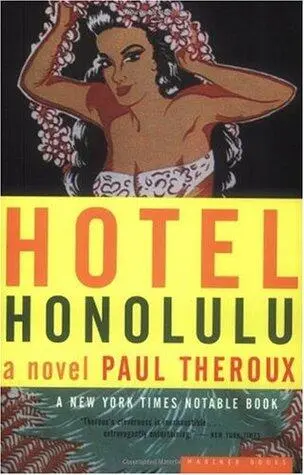
- Название:Hotel Honolulu
- Автор:
- Издательство:Mariner Books
- Жанр:
- Год:2002
- ISBN:нет данных
- Рейтинг книги:4 / 5. Голосов: 1
-
Избранное:Добавить в избранное
- Отзывы:
-
Ваша оценка:
Hotel Honolulu: краткое содержание, описание и аннотация
Предлагаем к чтению аннотацию, описание, краткое содержание или предисловие (зависит от того, что написал сам автор книги «Hotel Honolulu»). Если вы не нашли необходимую информацию о книге — напишите в комментариях, мы постараемся отыскать её.
Hotel Honolulu — читать онлайн бесплатно полную книгу (весь текст) целиком
Ниже представлен текст книги, разбитый по страницам. Система сохранения места последней прочитанной страницы, позволяет с удобством читать онлайн бесплатно книгу «Hotel Honolulu», без необходимости каждый раз заново искать на чём Вы остановились. Поставьте закладку, и сможете в любой момент перейти на страницу, на которой закончили чтение.
Интервал:
Закладка:
She had enough money for her ticket to the Philippines. Joey said goodbye. Pinky's mother, who was still in Manila, cried when she saw her daughter. Pinky's father had died. Her mother said, "Why aren't you crying?" Pinky didn't know. She never cried anymore. She didn't tell her mother that she had been to the United States. She applied for jobs. She said, "I have worked in hotels."
She became a maid in a hotel in Manila. The job was low paying and hard work. Her mother quit: she was very sick, too weak to work. Her Aunt Mariel said, "You are twenty — find a husband." Pinky put an ad in the paper, written by Aunt Mariel.
An American man answered the ad. She said to herself, I would marry him. But the man said, "I will make a video of you for my agency. It is the new way to find a husband. Maybe a foreigner."
He showed her one of the videos. It was an interview with a Young Filipina.
"It costs two thousand, but if you have no money we can make other arrangements," the man said.
He photographed her naked on the bed. Then he said, "Put your clothes on," and he interviewed her.
She did not hear again from him. She turned twenty-one, still working at the hotel. Although Philippine hotels were dirtier than American ones and the work was harder, anything was better than being bitten by a man or trapped in a motel room and hearing a man's knock. For a year she sat and watched her mother die. Uncle Tony showed up and began visiting her at night. One of those nights, her mother died.
The week she started at Reception, with the Trainee badge, she got a letter from America — Buddy Hamstra, Hotel Honolulu notepaper. He said that he had seen her video. She had forgotten about the video. He would meet her in Manila.
Uncle Tony and Aunt Mariel went with her to Buddy's room. They slept on the floor, but she woke them at midnight, gave them some pesos, and sent them away. Buddy embraced her.
In the morning she begged Buddy to marry her.
He did, on the fourth floor of the Hotel Rizal, panting from the climb, complaining that the elevators weren't working. Aunt Mariel's friend had
made all the arrangements. It took two months for Pinky to get her United States visa.
"Look," Buddy said to me. "An angel."
40 Hearts of Palm
The Christmas carols in Waikiki were being sung in Japanese. On the second-floor lanai, which contained the overspill from Paradise Lost, Buddy was comparing our Christmas decorations with those of the other hotels. I knew what was coming: the reminiscence of Santa Claus nailed to a cross, Mickey in a manger (a plastic saucer) surrounded by the Seven Dwarfs, Jesus wearing a Santa hood. "And last year — great!" The Japanese man next door in the Kodama had signed all the company Christmas cards and then jumped out the window, landing messily at the edge of the swimming pool.
"He thought he was being a good owner. Funny thing is, they had to send new cards."
"Holiday depression — I get it sometimes," Peewee said.
"Yeah, Christmas is always a ratfuck," Buddy said. "God, I hate those carols."
"I don't mind that one." Even sung in Japanese, it was clearly "Rudolph the Red-Nosed Reindeer." I said, "Something like 'In the Bleak Mid-Winter' never fails to undo me."
We could see the tops of the palm trees that fringed the beach, two streets and a row of hotels away. No Old Masters existed in our museums,
but we had Turner sunsets and Titian heavens, and I remarked that at least the world's clouds have not changed in the planet's history — sometimes I imagined our skies as Renaissance ceilings.
When I pointed to the sky, Buddy muttered something about a new Ramada hotel going up near Fort DeRussy. He was a big bulky man who whenever he was idle was always leaning on something. His elbows rested on the railing and his hands cradled his cheeks.
"I love looking at the sultry fulguration of these skies," I said, just to try out the sound. But it didn't register with him. Just a noise I was making.
Keola said, "You so hybolic."
"Oh, yeah," Buddy said. "Hey, look at them palms."
I often stared at them too, thinking: South Seas dream, where the golden apples grow, balmy Paradiso, under the hula moon.
"Some good eating there."
I thought Buddy meant the tall sign on Kalakaua Avenue advertising the sushi bar, but no, he was still talking about the palm trees. Having seen them yanked down and their feathery fronds battered by hurricane winds — never uprooted but set gracefully upright again as soon as the wind eased — I came to regard palm trees as indestructible.
"You basically lop off the trunk and tear open the core. Chop it up. Pickle it in brine. It's awesome in salad. I had palms in my yard in
Waimanalo. It looked clear-cut when I moved. I basically ate the whole yard."
To this fat man with lovely teeth, the memory of feasting on these tasty trees made his mouth juicy with saliva.
"Any palms in England?"
"No palms. Just qualms."
He queried me by squinting and opening his mouth. "What's the book?"
"This is Celine. Journey to the End of the Night."
I read: The human race is never free from worry, and since the last judgment will take place in the street, it's obvious that in a hotel you won't have so far to go. Let the trumpeting angels come, we hotel dwellers will be the first to get there.
"That babe knows what she's talking about. I love to read," Buddy said. "Maybe I should read one of your books one of these days."
"Not necessary."
I was a little sensitive on this point. The week before, Sweetie had told one of the hotel guests I was a writer. I had specifically warned her about this. "Say 'hotel manager." It had the virtue of being true and was less of a mine field.
"Your wife tells me you're a writer," the guest said.
I smiled, dreading what was to come.
"Do you write under your own name?"
"Yes."
My name rang no bells, and yet, keen to demonstrate his love of reading, he recommended several books I saw in the hands of sunbathers whenever I strolled along the beach. My anonymity made me happy here, and I reflected on how in a touristy place, as one of the herd, no one ever gets to know your name, no one ever questions why you're there.
Some guests, seeing posters for the Nutcracker, said to me, "There's ballet here?"
"Indeed there is. Also opera and the Honolulu Symphony."
"We love shit like that," one guest declared.
I said, "Just because you see palm trees and barefoot residents tossing beer cans out of their car windows doesn't mean there's no cultural life."
But going to the ballet in Hawaii seemed to me ostentatious and vulgar, the height of philistinism, the very opposite of refinement. Give me barefoot beer drinkers and brainless surf bunnies any day. I hated talk of books. It embarrassed me when Buddy, who boasted of his barbarism, mentioned books in his unconvincing voice. I needed to talk to Peewee about his bread recipes. I liked hearing Buddy tell me something I didn't know about hearts of palm and how he ate his way through a half acre of them.
Sweetie considered herself an intellectual because she listened to the audio book of Cujo while she Rollerbladed.
Peewee said, "You must miss the big city."
I said no, truthfully. That I hated the foul air. That I was just one of the big mob, in my little slot, feeling tiny and hemmed in by huge buildings. That in big cities it was never dark and never silent.
"But the culture," he said. "Shows and concerts, like we only have at Christmas, and not even the real thing."
"You can carry it with you. Your recipes are culture, Peewee," I said. "And you know language is culture."
Peewee's girlfriend, Nani, said, "I got my own language. Pidgin."
Nani said, "More betta. . talfone. . bumbye. . I never wen learn English." Keola, washing windows, smiled in comprehension, as heartily as if he were hearing music. But it was a sort of fractured birdsong, a debased and highly colloquial form of English composed of moody- sounding grunts and utterances and willful approximations. Everyone called it "Pidgin," and they said it was a separate language, like Portuguese or Greek — it wasn't English, they said. But it was, just a slovenly and ungrammatical version, never written down, without the verb "to be," and mostly used in the present tense. This helped, though, for they spoke nothing else but listened all the time, and in their squinting attention were used to translating what someone said on the basis of sound alone.
Читать дальшеИнтервал:
Закладка:
Похожие книги на «Hotel Honolulu»
Представляем Вашему вниманию похожие книги на «Hotel Honolulu» списком для выбора. Мы отобрали схожую по названию и смыслу литературу в надежде предоставить читателям больше вариантов отыскать новые, интересные, ещё непрочитанные произведения.


Обсуждение, отзывы о книге «Hotel Honolulu» и просто собственные мнения читателей. Оставьте ваши комментарии, напишите, что Вы думаете о произведении, его смысле или главных героях. Укажите что конкретно понравилось, а что нет, и почему Вы так считаете.